TTUHSC clinical hours, program by program
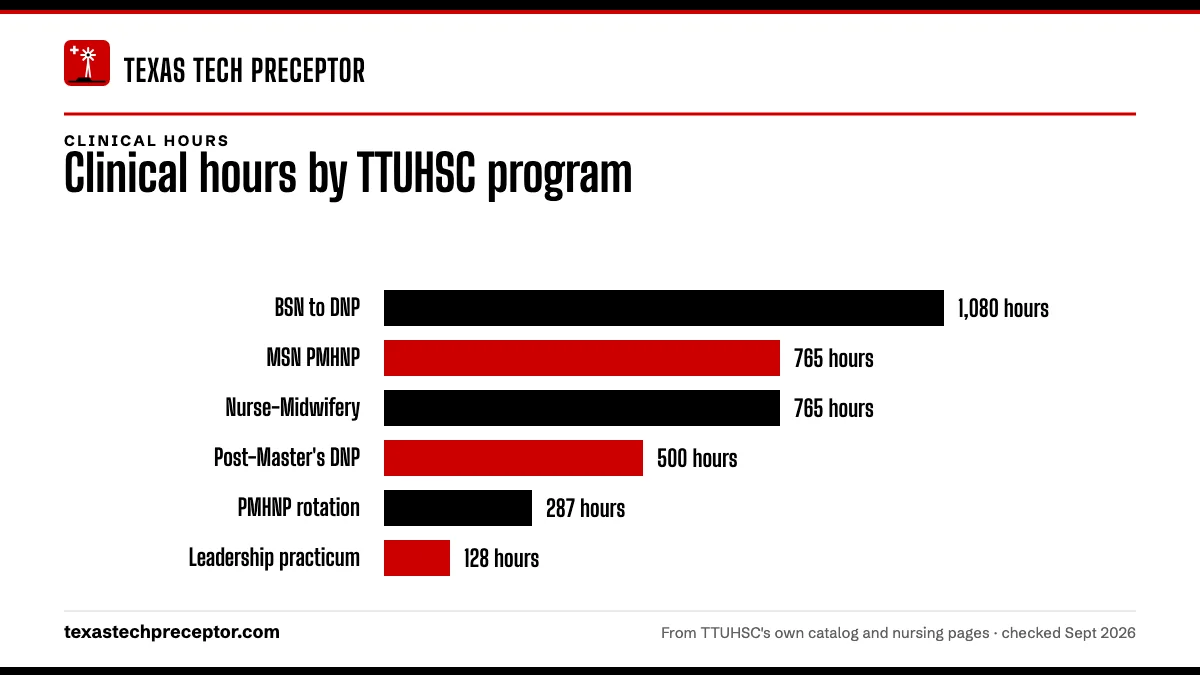
TTUHSC prints a clinical-hour total for some nursing programs and leaves it out for others. The BSN to DNP asks for at least 1,080 hours, the Post-Master's DNP for at least 500, and the MSN Nurse-Midwifery page lists 765, while the FNP, AGACNP and Pediatric NP tracks publish weekly clinical hours per course with no program total. The planner below lays out each program's clinical courses, who can precept you and when to start looking.
Get your placement plan
Tell us your TTUHSC program and where you live. A placement advisor replies with the preceptor and site options that fit your TTUHSC course.
Pick your TTUHSC program
Your clinical courses and hours, who can precept you, where, and when to start looking. From TTUHSC's own catalog and nursing pages.
- Who precepts
- A family primary care preceptor that TTUHSC's staff and faculty approve, along with the facility
- Where
- Your home area, in Texas or a state TTUHSC accepts graduate students from
- Start looking
- Before each term: a new electronic preceptor agreement for every preceptor
- Who precepts
- Psychiatric mental health preceptors near home, approved by TTUHSC
- Where
- Child and adolescent, adult and complex-patient psychiatric settings
- Start looking
- Spring start; the first rotation falls in the second spring
- Who precepts
- Preceptors and sites approved by the Program Director, arranged with TTUHSC's preceptor/site coordinators
- Where
- Birth, prenatal, gynecologic and postpartum care settings
- Start looking
- Fall Two onward, after a year of birth support, NRP and EFM
- Who precepts
- Preceptors you find, with faculty and the preceptor team helping select and contract
- Where
- Local clinical sites approved by TTUHSC
- Start looking
- Summer start; FNP clinicals begin in year three, PMHNP in the second spring
- Who precepts
- Professional mentors or preceptors approved by faculty (SON faculty may serve)
- Where
- Often your own workplace, if it meets the course objectives
- Start looking
- Summer start; practice hours from the second semester
- Who precepts
- A nurse leader who can precept a practice-site project
- Where
- A health care organization near you
- Start looking
- One practicum each semester, from the first
Reading the planner
The planner sits just above this section, with one tab per program family: FNP, PMHNP, Nurse-Midwifery, BSN to DNP, Post-Master's DNP and Advanced Nursing Leadership. Each tab opens on a headline figure, then a row of clinical course tags that link to the course guides, then three short answers: who can precept you, where the hours happen and when to begin the search.
The headline figure is always a number TTUHSC itself prints. For the BSN to DNP it is the 1,080-hour minimum and for the Post-Master's DNP the 500-hour minimum. The MSN PMHNP and Nurse-Midwifery tabs show the 765 on each program's web page, each with a note that the catalog tells a different story. The FNP tab shows a count of clinical courses instead, because TTUHSC gives weekly hours for FNP courses and no total. Any course tag reading "hours: see course page" signals the same gap: no per-course figure exists to show.
The Adult-Gerontology Acute Care and both Pediatric NP tracks are covered in their own sequence guides, AGACNP clinical courses and Pediatric NP clinical courses, rather than in the planner.
Which TTUHSC programs state a total
Five program families come with a published hour figure. The table gives each in TTUHSC's terms and names the page that prints it, because a figure on a program web page and one in the catalog do not always match.
| Program | What TTUHSC states | Where it appears | Watch for |
|---|---|---|---|
| BSN to DNP, FNP and PMHNP | A minimum of 1,080 clinical hours | Both BSN to DNP program pages | Per-course hours printed for PMHNP only |
| Post-Master's DNP | At least 500 practice hours in the DNP, 1,000 with the master's | Post-Master's DNP program page | Practicum hours measured one-to-six |
| MSN Nurse-Midwifery | Total clinical hours: 765 | MSN Nurse-Midwifery web page | Catalog course pages give other per-course hours |
| MSN PMHNP | 765 across three rotations | MSN PMHNP web page | The catalog lists a different course set |
| MSN Advanced Nursing Leadership | 128 practicum hours per practicum | Catalog course descriptions | Stated for three of the four practicums |
| MSN FNP, AGACNP, Pediatric Primary Care, Pediatric Acute Care | No program total | Weekly clinical hours per course on program pages | Confirm each course's hours with course faculty |
Education and Informatics clinical work runs on a one-to-three scale with no stated program total, and the Informatics practicum happens online under faculty guidance, with no outside site needed.
FNP, AGACNP and Pediatric NP: weekly hours, no total
For the four MSN nurse practitioner tracks outside psychiatric care, TTUHSC describes hours one course at a time. Its program plans print each clinical course with three numbers (credits, lecture hours per week, clinical hours per week), and in each sequence the weekly clinical figure climbs from the first course to the practicum. No TTUHSC page adds those weeks up into a program figure, and this site leaves that sum to TTUHSC as well.
Two things make a homemade total unreliable anyway. The AGACNP MSN page and the AGACNP certificate page print different weekly figures for the same courses, and the catalog's new credit-to-clock scale is rolling in by track and term. The MSN FNP web page also has no plan at all, so the only FNP weekly figures sit on the certificate page, which uses its own course numbers for the two primary care courses.
What you log is set by the syllabus for your section and the course faculty behind it. The FNP clinical courses guide walks through the three FNP clinical courses as TTUHSC numbers them.
Where TTUHSC's hour sources disagree
TTUHSC describes its ttuhsc.edu program plans as an unofficial copy and sends students to the catalog for the official plan. On clinical hours, the two part ways in three places.
- Nurse-Midwifery. The MSN web page lists 191, 255 and 319 hours across its three practicums. The catalog's course descriptions give 262.5 and 315 hours for the second and third levels and 210 for the certificate's first practicum, and note that competency can demand more time than the hours listed.
- PMHNP. The web plan shows three rotations adding to 765 hours. The catalog lists a different pair of clinical courses with much smaller hour figures and a credit block that does not add up, so neither version reads as settled.
- AGACNP weekly hours. The MSN page and the post-graduate certificate page print different weekly clinical hours for the same four courses.
When the figures conflict, the catalog is the plan TTUHSC calls official, and your course faculty and program director decide what your term requires. Ask before you and a preceptor agree on a schedule rather than a month into logging. The nurse-midwifery practicums guide takes that track's numbers apart in detail.
Ratios, counting rules and grades behind the numbers
Three rules sit under every figure in the planner. First, TTUHSC converts clinical credits into clock hours at a ratio that differs by program: one-to-4.25 for NP and midwifery courses, a split one-to-four and one-to-six in the BSN to DNP, and others for the DNP, Leadership, Education and Informatics. The 1-to-4.25 ratio guide explains each one and the 2026 rollout.
Second, NP clinical hours rest on SON approval of both the preceptor and the site, while the DNP catalog lists a broader set of practice activities. The guide to what counts as clinical hours sorts out which rule applies to you.
Third, hours alone do not pass a course. Clinical performance is scored pass or fail, and a fail sinks the course by itself, and the PR (In Progress) grade exists for practicum work that runs past the end of a term. The grades and progression guide covers both.
Why TTUHSC students plan their hours with us
An hour requirement is only as good as the preceptor who can offer it every week of the term. That is where our search starts: we look for preceptors near your home whose clinic days cover the weekly clinical hours your TTUHSC course lists, at a facility ready for SON approval, and we gather the preceptor's license, certification and practice details for the electronic preceptor agreement before the term opens.
For the heavier practicum terms, or a BSN to DNP plan with six clinical courses, we map the whole sequence at once so each term's preceptor is in place before the last one ends. If a preceptor's schedule shifts mid-term, the placement desk moves on a replacement quickly so your hours keep building. SON staff and faculty make every approval decision; our job is to hand them a complete, rule-ready file on the first pass. Pick your program in the planner, or use the form below to start.
Questions TTUHSC students ask
How many clinical hours is TTUHSC's MSN FNP program?
TTUHSC does not publish a program total for the MSN FNP. Weekly clinical hours for FNP courses appear on the certificate page instead, since the MSN FNP page shows no course plan. Your course syllabus and course faculty confirm what each term requires. If you want a stated minimum, the BSN to DNP FNP route lists at least 1,080 clinical hours.
Where do TTUHSC nursing students log clinical hours?
TTUHSC's public pages do not name a logging system, and the rules for recording hours are not in the public handbook sections. The method is set at the course level, in the syllabus and the D2L course site, so check both in the first week and ask course faculty about anything unclear before your first clinic day.
Do post-graduate certificate students need the same clinical hours?
Certificate students take clinical courses in the same populations as the MSN tracks, but TTUHSC individualizes every post-graduate plan. The certificate pages also print their own weekly figures, which differ from the MSN pages for some AGACNP courses. Confirm your hours with the program director once your individualized plan is set.
Is 765 hours the same for PMHNP and nurse-midwifery at TTUHSC?
Both MSN web pages list 765 clinical hours, but each figure comes with a catch. The catalog names different PMHNP clinical courses, and its midwifery course descriptions give different per-course hours. Treat 765 as each web page's figure rather than a settled total, and confirm the hours for your cohort with the program director.
What if I cannot finish my clinical hours by the end of the term?
TTUHSC's handbook reserves the PR (In Progress) grade for courses whose work extends beyond the semester, mainly clinical and practicum courses. It does not say how many hours you need finished first. Talk with course faculty early, and see our guide for students behind on clinical hours.
Related pages
Last checked 2026-09-26
We check these pages against TTUHSC's catalog, Student Handbook, program pages and licensure disclosures. Your course faculty, your program director and the plan of study for your cohort have the final word.
Your TTUHSC preceptor search, run by specialists.
Tell us your TTUHSC track, your next clinical course and the town you'll train near. We find preceptors who fit the course and pull together what SON staff and faculty need to approve both the clinician and the facility, early enough for the electronic preceptor agreement to go through before the term.
- Preceptors matched to the track: family primary care, adult-gerontology acute care, pediatrics, psychiatric mental health
- License, certification and facility details ready for TTUHSC's preceptor and facility approval
- In Lubbock, Amarillo, Abilene, the Permian Basin, Dallas-Fort Worth and the states TTUHSC accepts
Start your placement plan
Your track, your town and your next clinical term is all we need to begin.