TTUHSC's pediatric NP clinical courses, primary care and acute care
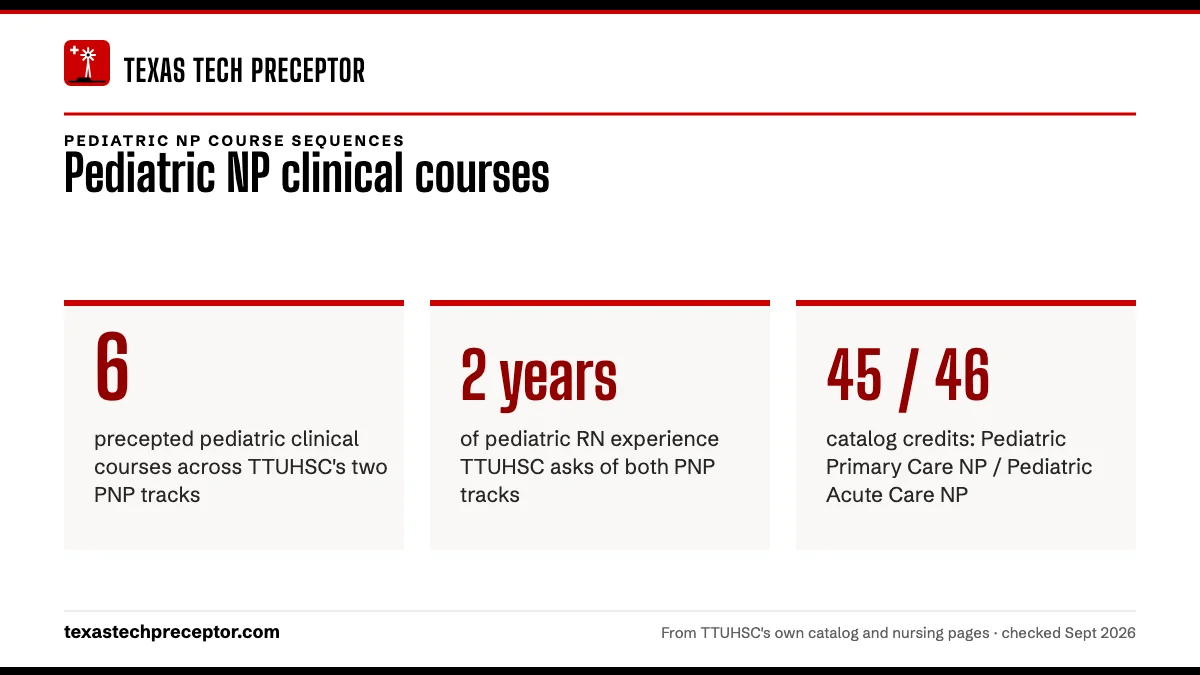
TTUHSC runs two pediatric nurse practitioner tracks, and each builds to three precepted clinical courses: NURS 5580, NURS 5681 and NURS 6680 in primary care, and NURS 5500, NURS 5600 and NURS 6690 in acute care. This guide sets out each sequence as TTUHSC prints it, how to read its weekly clinical figures, and what a pediatric preceptor search involves.
Get your placement plan
Tell us your TTUHSC program and where you live. A placement advisor replies with the preceptor and site options that fit your TTUHSC course.
Two tracks, two three-course sequences
The two pediatric tracks run on a common foundation. Each lists NURS 5324, NURS 5351, NURS 5329 and NURS 5353 as core, then NURS 5343, NURS 5345 and the assessment course NURS 5430, whose intensive is held on campus. The paths separate at the population-focus block, where each track prints three clinical courses with a concurrent clinical section.
| Level | Primary Care PNP | Acute Care PNP |
|---|---|---|
| First clinical course | NURS 5580 Pediatric Primary Care I (5:2:12.75) | NURS 5500 Pediatric Acute Care I (5:2:12.75) |
| Second clinical course | NURS 5681 Pediatric Primary Health Care II (6:2:17) | NURS 5600 Pediatric Acute Care II (6:2:17) |
| Final clinical course | NURS 6680 Pediatric Nurse Practitioner Practicum (6:1:21.25) | NURS 6690 Pediatric Acute Care III (6:1:21.5) |
Those weekly clinical figures are the only hour numbers TTUHSC prints for the pediatric tracks. It publishes no clinical-hour total for either one, and a total built by multiplying weeks would be an estimate, not a TTUHSC figure.
The primary care sequence: 5580, 5681 and 6680
The Pediatric Primary Care NP plan runs 45 credits in the 2026-27 catalog. Its population-focus block opens with two didactic foundations, NURS 5309 Foundations of the Well Child and NURS 5319 Foundations for Care of the Sick Child, before the clinical courses start.
NURS 5580 Pediatric Primary Care I, NURS 5681 Pediatric Primary Health Care II and NURS 6680 each require an on-campus skills lab. TTUHSC prints the last one under two names, Pediatric Nursing Practicum and Pediatric Nurse Practitioner Practicum; the number does not change, so register by number. The coursework is taught online, and students head to a TTUHSC campus from time to time for labs and assessments.
Admission, experience rules and the full plan are in the Pediatric Primary Care NP guide.
The acute care sequence: 5500, 5600 and 6690
The Pediatric Acute Care NP plan runs 46 credits, and the catalog calls it the Acute Care Pediatric Nurse Practitioner Track. Its population-focus block starts with NURS 5400 Foundations of Pediatric Acute Care and NURS 5309, then moves into Pediatric Acute Care I, II and III, delivered as hybrid clinical courses with on-campus skills labs.
The weekly figures match the primary care track for the first two courses and differ slightly in the last: NURS 6690 prints 21.5 clinical hours a week where NURS 6680 prints 21.25. Applicants to either track need two years as a pediatric RN, and for the acute care track TTUHSC prefers that time be spent in critical care, the ER or another acute setting.
Admission and track details are in the Pediatric Acute Care NP guide.
Reading TTUHSC's weekly clinical figures
The program pages print each course as three numbers: credits, weekly lecture hours and weekly clinical hours. NURS 5580 at 5:2:12.75, for instance, is a 5-credit course with 2 lecture hours and 12.75 clinical hours per week. Behind those numbers sits the catalog's rule of 4.25 clock hours for each clinical credit in NP courses, phased in from Summer or Fall 2026 track by track; the ratio guide explains the switch.
What the figures leave open is the term total and any flexibility in how hours spread across a semester. Those details belong to the course syllabus and course faculty. When you approach a pediatric practice, share the weekly figure alongside the semester dates on the SON academic calendar, and let the syllabus answer anything beyond that.
Weekly figures are not totals: TTUHSC publishes no clinical-hour total for either pediatric NP track.
Before the first pediatric rotation
The pediatric tracks carry a certification gate of their own: PALS, in place ahead of NURS 5580 or NURS 5500, the first pediatric clinical course on each track. The rest of the list applies to every graduate student.
- PALS, valid on the first day of your first pediatric clinical course
- BLS for every student
- Immunization records cleared by TTUHSC, with influenza and a TB screen every year
- Background clearance through the vendor TTUHSC designates, and drug screens whenever a site requires one
- An active Texas or multistate compact RN license without encumbrance
- Health insurance and this year's HIPAA training
An exemption affidavit is a risk worth settling early: TTUHSC notes that clinical sites may decline one, which can push back placement or even graduation. The immunizations and certifications guide walks through each requirement.
Who can precept, and how approval works
Under Texas Board of Nursing rule 22 TAC §219.10, a preceptor for an APRN student may be an APRN or another licensed clinician qualified to teach and supervise at that level, with a written agreement binding the school, the preceptor and the site. TTUHSC's own graduate preceptor criteria are not published, so course faculty judge whether a particular pediatric clinician suits a particular course. The preceptor requirements guide covers the rule in full.
A willing clinician is only the start. The School of Nursing signs off on the clinician and on the practice or hospital, and an electronic preceptor agreement is filed for that preceptor in every semester you train together. With three precepted courses per track, plan on that paperwork each time a new clinical course begins. The skills labs attached to each course also bring you to campus, part of the 7 to 8 days MSN nurse practitioner students spend there over the program.
Why TTUHSC pediatric NP students choose us
Pediatric clinicians are a smaller field than general primary care, which makes an early, organized search worth the effort. Your placement advisor lines up pediatric practices for the primary care track or pediatric acute care services for the acute track, close to home and matched to each of your three courses.
Each term, your placement advisor builds the approval file with you: the pediatric clinician's license and certification, where and how they practice, the site's information and whether its agreement with TTUHSC is current, and the answers the electronic agreement will ask for. The School of Nursing makes every approval decision, and our part is handing it a file with nothing missing. Should a pediatric preceptor back out, work on the next one begins at once. Share your track and first clinical term through the form below.
Questions TTUHSC students ask
Is there a TTUHSC pediatric NP option for nurses who already hold an MSN?
TTUHSC lists none. Its post-graduate NP certificates are in family practice, adult-gerontology acute care and psychiatric mental health, with nurse-midwifery offered separately, and its BSN to DNP runs only FNP and PMHNP tracks. The MSN Primary Care and Acute Care tracks are the two pediatric routes in the 2026-27 catalog.
What is the total clinical-hour requirement for TTUHSC's PNP tracks?
No total appears in TTUHSC's catalog or on its program pages for either pediatric track. What TTUHSC prints is a weekly clinical figure for each course: 12.75, then 17, then 21.25 in primary care, with the last acute care course at 21.5. Each syllabus, and the course faculty behind it, sets the real requirement.
When do I need PALS as a TTUHSC pediatric NP student?
PALS has to be valid before NURS 5580 Pediatric Primary Care I or NURS 5500 Pediatric Acute Care I, whichever your track starts with. BLS applies to all students too. Renew PALS on schedule through the last pediatric course, since an expired card can pause a rotation mid-plan.
Can a family nurse practitioner precept a TTUHSC pediatric NP student?
Possibly. The Texas rule is broad enough to include APRNs and other licensed clinicians able to supervise at that level, but TTUHSC decides fit for each course and has not published graduate preceptor criteria. Check with course faculty before asking a family practice to host a pediatric course; the clinician and the practice still need SON approval.
What is the difference between NURS 6680 and NURS 6690?
They are the final clinical courses of the two pediatric tracks. NURS 6680 closes the primary care sequence and appears as either Pediatric Nursing Practicum or Pediatric Nurse Practitioner Practicum. NURS 6690 Pediatric Acute Care III closes the acute care sequence. Both are 6-credit courses with an on-campus skills lab.
Related pages
Last checked 2026-09-26
We check these pages against TTUHSC's catalog, Student Handbook, program pages and licensure disclosures. Your course faculty, your program director and the plan of study for your cohort have the final word.
Your TTUHSC preceptor search, run by specialists.
Tell us your TTUHSC track, your next clinical course and the town you'll train near. We find preceptors who fit the course and pull together what SON staff and faculty need to approve both the clinician and the facility, early enough for the electronic preceptor agreement to go through before the term.
- Preceptors matched to the track: family primary care, adult-gerontology acute care, pediatrics, psychiatric mental health
- License, certification and facility details ready for TTUHSC's preceptor and facility approval
- In Lubbock, Amarillo, Abilene, the Permian Basin, Dallas-Fort Worth and the states TTUHSC accepts
Start your placement plan
Your track, your town and your next clinical term is all we need to begin.