TTUHSC's nurse-midwifery practicums, one term at a time
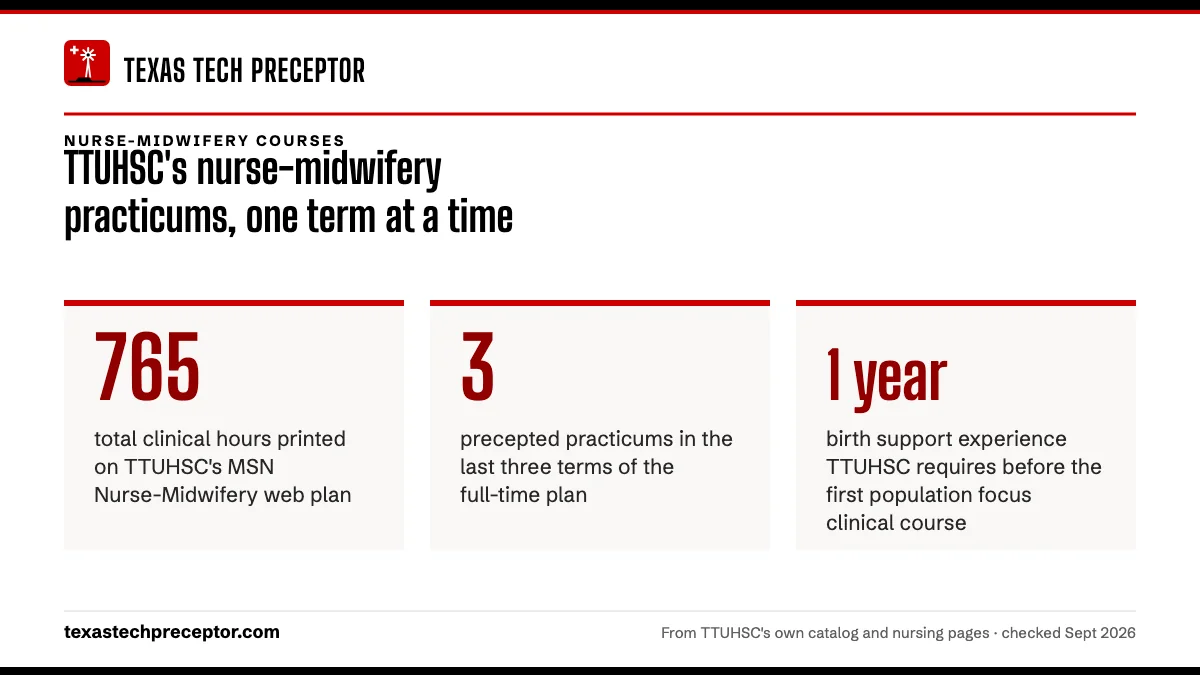
The MSN Nurse-Midwifery plan saves its precepted work for the second year: NURS 5399 in Fall Two, NURS 6520 in Spring Two and NURS 6610 in Summer Two. TTUHSC's program page and its catalog print different hours for these courses, and three readiness items (a year of birth support, NRP and an EFM course) have to be finished before the first one. Below are both sets of numbers and the order to prepare in.
Get your placement plan
Tell us your TTUHSC program and where you live. A placement advisor replies with the preceptor and site options that fit your TTUHSC course.
Where the practicums sit in the six-term plan
TTUHSC's published full-time plan runs six semesters from a Fall start, and the first three are classroom terms. You cover advanced health assessment, pathophysiology and the midwifery role first, then pharmacology for women's health, primary care of women and gynecological care, then antepartum, postpartum and newborn care. Precepted work begins only in the fourth term.
From there the credit weight climbs every term, from 3 to 5 to 6, so the heaviest practicum comes last. TTUHSC also offers part-time options, and a part-time sequence places these courses in different terms, so check your own order with your advisor and the Program Director before you plan around the terms below.
| Term | Practicum | Credits | Taken alongside |
|---|---|---|---|
| Fall Two | NURS 5399 Nurse-Midwifery Clinical Practicum A | 3 | NURS 6321 Intrapartum Care and NURS 5351 |
| Spring Two | NURS 6520 Nurse-Midwifery Integrated Clinical Practicum, Level B | 5 | NURS 5353 |
| Summer Two | NURS 6610 Nurse-Midwifery Clinical Immersion Practicum | 6 | No other course listed |
The catalog describes all three as precepted clinical courses. Practicum A shares Fall Two with the intrapartum theory course, so your first supervised term and the matching coursework run side by side.
The hours conflict: web plan versus catalog
TTUHSC publishes two different sets of hours for the same practicum ladder. The ttuhsc.edu MSN plan prints 191, 255 and 319 clinical hours, followed by the line "Total clinical hours: 765." The 2026-27 catalog's course descriptions give 262.5 hours for Level B and 315 for the Immersion, and the catalog's own Level A course, NURS 5471 (the one the post-graduate certificate uses), lists 210.
| Level | ttuhsc.edu MSN plan | 2026-27 catalog course text |
|---|---|---|
| Level A | NURS 5399: 191 | NURS 5471: 210 |
Level B, NURS 6520 | 255 | 262.5 |
Immersion, NURS 6610 | 319 | 315 |
| Stated total | 765 | No total printed |
Neither page explains the gap. The catalog does flag a ratio change: from Summer or Fall 2026, varying by track, NP and midwifery clinical credits convert at 1 to 4.25 clock hours, and the credit-to-clock guide walks through it. TTUHSC does not tie the midwifery numbers to it, so ask your course faculty which figure your syllabus uses.
When the two disagree, TTUHSC names the catalog as its official academic record and calls the website's plans an unofficial facsimile. The catalog also adds a line worth remembering: "Achieving competency may require more than the listed number of hours."
Treat any printed hour figure as a floor, not a finish line: your course faculty set the target for your term, and reaching competency can take longer.
Before NURS 5399: the readiness list
Midwifery adds its own gates on top of the clearance every TTUHSC graduate student completes, and the longest of them is measured in years of work, not weeks of paperwork. The catalog and Student Handbook set these before the first population focus clinical course:
- One year of birth support experience, which the catalog calls "required prior to the first population focus clinical course." Labor and delivery experience at admission is listed as preferred.
- NRP (Neonatal Resuscitation Program) certification, plus a completed course in electronic fetal monitoring (EFM), both finished before that first clinical course.
- Your own student malpractice insurance, bought on top of the School of Nursing's blanket liability policy.
- BLS, current immunizations, a background check through TTUHSC's institutionally approved vendor, and drug screens when TTUHSC requests them.
- An unencumbered RN license, Texas or compact multistate, which every TTUHSC MSN student needs.
One catalog quirk to know about: the midwifery malpractice note still names older course numbers, NURS 5304, NURS 5470, NURS 5571 and NURS 6620. Ask the Program Director which current courses the requirement covers. The immunizations and certifications guide explains the rest of the list, including BLS and the certification timing.
How sites are arranged for midwifery
Midwifery is the graduate exception to TTUHSC's find-your-own rule. The Student Handbook describes midwifery faculty partnering with every student and TTUHSC's preceptor/site coordinators so that each one has satisfactory preceptors and sites, and the program pages require every population focus clinical hour to be completed at a location with Program Director approval. TTUHSC also charges a clinical placement fee in every term that includes a midwifery practicum; ask TTUHSC for the current amount.
Coordination still leaves real planning on your side. Three practicums in three straight terms means three rounds of site readiness, and students far from an established site should ask the coordinators early whether a local midwifery practice they know of can be considered. The midwifery placement guide covers the coordinated process from start to finish.
Where you live matters as well. On TTUHSC's licensure disclosure, Kansas shows "Does not meet" for this track, beyond the ten states marked as closed to TTUHSC graduate students, and a move out of state during the program calls for at least 60 days' notice to the school. The licensure disclosure guide lists every state.
Campus days, grades and the summer finish
The MSN midwifery track calls for occasional travel to TTUHSC campuses. The archived graduate FAQ counts 7-8 campus days over an entire NP or midwifery program, and OSCEs are held in Lubbock with dates announced a couple of months ahead; the intensives and OSCEs guide has the detail.
Each practicum is graded under TTUHSC's graduate rule: pass/fail for the clinical portion, and an unsatisfactory clinical result means an F for the whole course, whatever the didactic grade. Hours that spill past the last day of a term are handled with the "PR" (In Progress) grade, which the handbook reserves mainly for clinical and practicum courses. The grades and progression guide covers repeats and dismissal.
Watch the last term closely. NURS 6610 carries the most credits of the three and sits in Summer Two, and summer is the shortest term on TTUHSC's calendar (May 24 to Aug. 13 in 2027), while fall and spring give you about 15 weeks. A strong Immersion site is worth securing well before that summer begins.
Why TTUHSC midwifery students work with us
We are built around TTUHSC's process, and for midwifery that means strengthening the coordinated system rather than working around it. We look for midwifery preceptors and practices near where you live that fit the practicum level you are entering, and we assemble what TTUHSC's reviewers look for: the preceptor's license and certification, how and where they practice, and the facility's details along with its agreement status.
We also keep your readiness list moving across all three terms, from the birth support year and NRP to the EFM course and insurance, so nothing holds up NURS 5399. If a site falls through mid-plan, your placement advisor starts on a replacement right away. TTUHSC's coordinators and Program Director decide; our part is making sure the file they see is complete and in line with TTUHSC's rules from the first submission. Read how it works or reach our placement desk through the form on this page.
Questions TTUHSC students ask
How many clinical hours is TTUHSC's MSN Nurse-Midwifery program?
The ttuhsc.edu program page states 765 total clinical hours across the three practicums. The 2026-27 catalog's course descriptions print different per-course figures and no total, and they add that reaching competency can take longer than the printed figure. Use the catalog as TTUHSC's official plan and let your course faculty confirm the target for your term.
Can I start the first midwifery practicum before my year of birth support is done?
The catalog makes one year of birth support experience a condition of the first population focus clinical course, together with NRP and an EFM course. If your year will finish close to Fall Two, talk to the Program Director early instead of counting on an exception, since the whole practicum sequence starts from that course.
Does the post-graduate midwifery certificate use the same practicums?
Mostly. The Nurse-Midwifery post-graduate certificate opens its clinical run with NURS 5471 Integrated Clinical Practicum, Level A (210 hours in the catalog) instead of NURS 5399, then uses NURS 6520 and NURS 6610. Certificate plans are individualized, so TTUHSC sets your sequence. The certificate guide has the full course list.
Which body accredits TTUHSC's nurse-midwifery program?
ACME, the Accreditation Commission for Midwifery Education. TTUHSC's accreditation page calls the midwifery program fully accredited by ACME, and CCNE accredits the School of Nursing's master's program. Review dates are missing from TTUHSC's page, so look them up in the ACME directory if they matter to you.
What happens if my midwifery practicum site falls through?
Midwifery sites run through TTUHSC's preceptor/site coordinators and the Program Director, so tell them first; the handbook says faculty and coordinators work with each student toward satisfactory preceptors and sites. Having a vetted local option ready helps, and our placement desk can prepare one with its details complete for the coordinators to review.
Related pages
Last checked 2026-09-26
We check these pages against TTUHSC's catalog, Student Handbook, program pages and licensure disclosures. Your course faculty, your program director and the plan of study for your cohort have the final word.
Your TTUHSC preceptor search, run by specialists.
Tell us your TTUHSC track, your next clinical course and the town you'll train near. We find preceptors who fit the course and pull together what SON staff and faculty need to approve both the clinician and the facility, early enough for the electronic preceptor agreement to go through before the term.
- Preceptors matched to the track: family primary care, adult-gerontology acute care, pediatrics, psychiatric mental health
- License, certification and facility details ready for TTUHSC's preceptor and facility approval
- In Lubbock, Amarillo, Abilene, the Permian Basin, Dallas-Fort Worth and the states TTUHSC accepts
Start your placement plan
Your track, your town and your next clinical term is all we need to begin.