The TTUHSC BSN to DNP Family Nurse Practitioner track
TTUHSC's BSN to DNP Family Nurse Practitioner track moves a baccalaureate-prepared RN to the Doctor of Nursing Practice over twelve semesters, starting each Summer, and TTUHSC sets its clinical floor at 1,080 hours or more. The preceptor search is yours, with TTUHSC's faculty and preceptor team helping on the selecting and contracting side. We run that search in your home area and prepare each preceptor's details so approval moves quickly.
Get your placement plan
Tell us your TTUHSC program and where you live. A placement advisor replies with the preceptor and site options that fit your TTUHSC course.
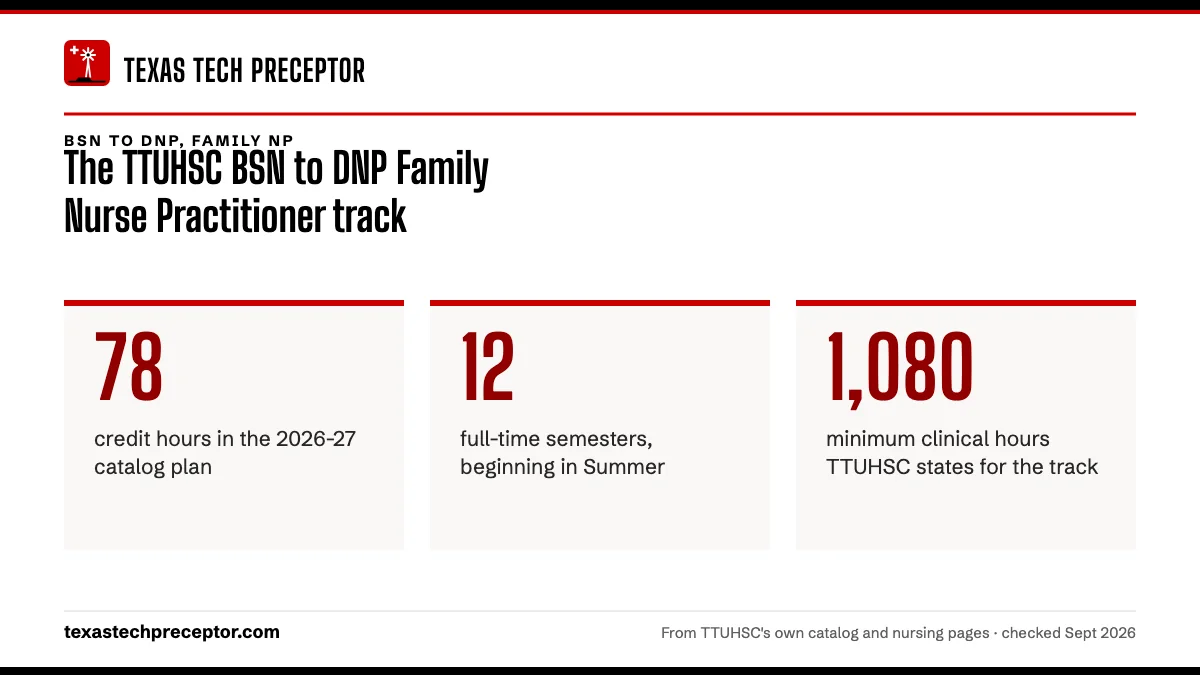
The track at a glance
The 2026-27 TTUHSC catalog sets the BSN to DNP Family Nurse Practitioner track at 78 credit hours. Full-time study runs four years with three terms in each, twelve semesters in total, and admission opens once a year for Summer. Applications are taken from September 1 through January 15; the catalog marks Fall and Spring as closed to new students.
Classes blend online work, face-to-face sessions and supervised clinical experience. TTUHSC also describes a three-year route of nine semesters, but only with the program director's approval, so treat it as something you ask for rather than a standard option. The first BSN to DNP cohort, FNP and PMHNP together, began in 2018.
| Item | What TTUHSC states |
|---|---|
| Credits | 78 |
| Length | 12 semesters full-time; a 9-semester plan needs program director approval |
| Start | Summer only; apply September 1 to January 15 |
| Clinical hours | A minimum of 1,080 in the clinical setting |
| Credit-to-clock ratio | 1 to 4 for direct care, 1 to 6 for non-direct care |
| RN experience | 2 years as an RN when the application is submitted |
| Campus visits | At least once each semester, usually 1 to 2 days |
Where the clinical semesters fall
Years one and two are coursework: pathophysiology, pharmacology, health assessment, the DNP role, evidence-based inquiry, well-child care and mental health in primary care. Clinical work begins in Semester VII, the third Summer, with NURS 6439 Primary Health Care I, roughly two years after you enroll. From that point every remaining term carries a clinical course, and the final year is three DNP Advanced Practicums in a row.
| Semester | Term | Clinical course |
|---|---|---|
| VII | Summer, year 3 | NURS 6439 Primary Health Care I: BSN-DNP (4 credits) |
| VIII | Fall, year 3 | NURS 6541 Primary Care II BSN-DNP (5 credits) |
| IX | Spring, year 3 | NURS 7660 Family Nurse Practitioner Practicum BSN-DNP |
| X | Summer, year 4 | NURS 7450 DNP Advanced Practicum I (4 credits) |
| XI | Fall, year 4 | NURS 7451 DNP Advanced Practicum II (4 credits) |
| XII | Spring, year 4 | NURS 7452 DNP Advanced Practicum III (4 credits) |
Both NURS 6541 and NURS 7660 list current ACLS as a prerequisite, so keep that card valid through the Fall and Spring of year three. TTUHSC gives the 1,080-hour floor for the whole track but no hour figure per FNP course; the 1,080-hour guide explains how direct and non-direct hours convert, and the DNP Advanced Practicum guide covers year four.
Catalog plan versus website plan
The ttuhsc.edu program page and the catalog match on 78 credits, twelve semesters and the Summer start, yet their course lists differ. The website version adds NURS 6310 Practical Application of Statistics in Healthcare, NURS 5320 Diagnostic Methods and Procedures for Advanced Practice, and a rural health and telehealth course still shown without a final number. It also lists the FNP Practicum at one credit. The catalog names fewer courses under the same semester totals.
TTUHSC flags the website plans as unofficial and names the catalog as the version that counts. If the two still disagree when you register, follow the catalog and check with your program director, or the enrolled student advisor for DNP programs, on which courses your cohort will take.
Admission wording differs as well. The program page wants an unencumbered RN license from Texas or a compact state, whereas the catalog specifies an unencumbered RN license without naming a state. Our RN license guide sets the two side by side and names who settles it.
Your preceptors and the preceptor team
The program page asks whether you will have to find your own preceptors and answers "Yes," then adds that faculty and the preceptor team help with "selecting and contracting" preceptors and facilities. So the search belongs to you, and TTUHSC supports the approval and contract steps that follow.
For each clinical term you identify a qualified clinician near home and the practice or facility where you would train. SON staff and faculty sign off on the person and on the site, and each preceptor needs a new electronic agreement every term; our agreement guide lists what to have ready. Enrolled graduate students may also browse TTUHSC's roster of preceptors that students have worked with over the last two years, described in the preceptor team guide.
Six clinical terms mean six rounds of search, approval and agreement. Year three centers on family primary care across the lifespan; year four moves into the DNP Advanced Practicums, where your faculty set what each setting must offer.
Waiting for Semester VII to open before searching leaves little room: the clinician and the practice site each need sign-off, and the agreement has to be redone every term.
Campus visits and the term calendar
Expect a campus trip in every semester of the plan. Lubbock hosts most intensives, a share are held in Austin and Dallas, and a typical visit takes a day or two. Our intensives and OSCEs page gathers what TTUHSC publishes about those trips.
Graduate nursing courses fill the whole term, with no 8-week sessions, and your first clinical course, NURS 6439, lands in the shortest one. On the 2026-27 calendar, Summer covers May 24 through August 13, against September 8 through December 18 for Fall.
Grading raises the stakes. Clinical performance is graded pass/fail, and an unsatisfactory clinical grade turns the whole course into an F, however strong the exams. Every nursing course also needs a B or better, and C grades in two graduate courses in one term lead to dismissal.
Before Semester VII: what to have in order
Clear these before your first clinical term
- Current ACLS for
NURS 6541andNURS 7660, plus BLS, which every TTUHSC nursing student holds - Criminal background clearance through the vendor TTUHSC designates, plus drug testing ahead of most placements and at random, with a five-day window when a test is requested
- Vaccination records accepted by the Office of Institutional Health, with tuberculosis screening repeated yearly
- Annual HIPAA training records, and health coverage, which is mandatory in TTUHSC's online programs that include clinicals
- SON sign-off on your preceptor and facility, with the current term's electronic preceptor agreement finished
If you live outside Texas, read TTUHSC's licensure disclosure before applying. For the BSN to DNP, South Dakota joins the ten states whose graduate students TTUHSC cannot accept, and Kansas carries a "does not meet" mark. An enrolled online student planning to relocate across state lines owes TTUHSC 60 days' notice or more.
Why BSN to DNP FNP students choose us
The BSN to DNP gives you six clinical terms, each needing an approved preceptor, an approved facility and a fresh agreement, and running that cycle for TTUHSC students is our specialty. We search near where you live for family practice preceptors whose patients match the course ahead, confirm license, certification and practice details, and assemble the site information TTUHSC's reviewers look at.
We begin well ahead of the term, so everything reaching TTUHSC is complete the first time, and we stay with you through all four years. If a preceptor steps away partway through, we find a replacement and prepare the new paperwork. The decision stays with TTUHSC's staff and faculty, and our preparation makes it an easy one. Send your cohort year and hometown through the contact page, or use the request form at the bottom of this page.
Questions TTUHSC students ask
When does the first clinical course start in TTUHSC's BSN to DNP FNP?
In Semester VII, the third Summer of the standard plan, with NURS 6439 Primary Health Care I. A student who starts in Summer 2027 and follows the twelve-semester plan reaches it in Summer 2029. The two years of coursework before it are the right window to line up a preceptor and facility so both can be approved on time.
Can I finish the BSN to DNP FNP in three years?
TTUHSC describes a nine-semester, three-year plan, but it requires the program director's approval; the standard route is twelve semesters over four years. A shorter plan also packs the clinical terms closer together, so if you pursue it, begin looking for preceptors earlier and confirm your sequence with the DNP Programs Enrolled Student Advisor.
How many clinical hours does the BSN to DNP FNP require?
TTUHSC sets the floor at 1,080 clinical hours for the whole track and publishes no hour figure for each FNP course. Direct patient care converts at four clock hours per credit and non-direct work at six, and your course faculty confirm what each course requires before the term starts.
Does TTUHSC accept BSN to DNP students who live outside Texas?
From many states, yes. TTUHSC's disclosure names ten states it cannot take graduate students from, South Dakota is added for the BSN to DNP, and Kansas shows as not meeting requirements. If you live outside Texas, check your eligibility with the Admissions Team before applying; a later move needs 60 days' notice.
Is ACLS required for the BSN to DNP FNP?
Yes. The catalog lists current ACLS as a prerequisite for NURS 6541 Primary Care II and NURS 7660 Family Nurse Practitioner Practicum, both in year three. BLS is required of every TTUHSC nursing student. Time your renewals so neither card expires in the middle of a clinical course.
Can a placement service find my BSN to DNP preceptors?
Yes. TTUHSC expects you to find your preceptors, and that search is exactly what we do: we locate family practice preceptors near you, confirm their details and prepare what the electronic preceptor agreement and facility approval ask for. Approval and contracting of every preceptor and facility remain with TTUHSC's faculty and preceptor team.
Related pages
Last checked 2026-09-26
We check these pages against TTUHSC's catalog, Student Handbook, program pages and licensure disclosures. Your course faculty, your program director and the plan of study for your cohort have the final word.
Your TTUHSC preceptor search, run by specialists.
Tell us your TTUHSC track, your next clinical course and the town you'll train near. We find preceptors who fit the course and pull together what SON staff and faculty need to approve both the clinician and the facility, early enough for the electronic preceptor agreement to go through before the term.
- Preceptors matched to the track: family primary care, adult-gerontology acute care, pediatrics, psychiatric mental health
- License, certification and facility details ready for TTUHSC's preceptor and facility approval
- In Lubbock, Amarillo, Abilene, the Permian Basin, Dallas-Fort Worth and the states TTUHSC accepts
Start your placement plan
Your track, your town and your next clinical term is all we need to begin.