Questions TTUHSC nursing students ask us
Short answers to the questions we hear most from TTUHSC School of Nursing students, each with a link to the page that covers the topic in full. If yours is missing, ask it in the form below and your placement advisor will answer directly.
Get your placement plan
Tell us your TTUHSC program and where you live. A placement advisor replies with the preceptor and site options that fit your TTUHSC course.
Who approves a preceptor we find?
TTUHSC does. Both the clinician and the practice need sign-off from SON staff and faculty, and a preceptor found through us passes through exactly the same review as one you found on your own. Our part is the search and a complete, checked file. The decision stays with TTUHSC.
Approval also repeats. TTUHSC's electronic preceptor agreement is required for each preceptor in each semester, so two terms with the same clinician means two agreements. The full sequence, from search to approval to logging clinical hours, is laid out on the placement process page.
Which TTUHSC programs we help with
Our search service fits every TTUHSC program in which the student brings the preceptor:
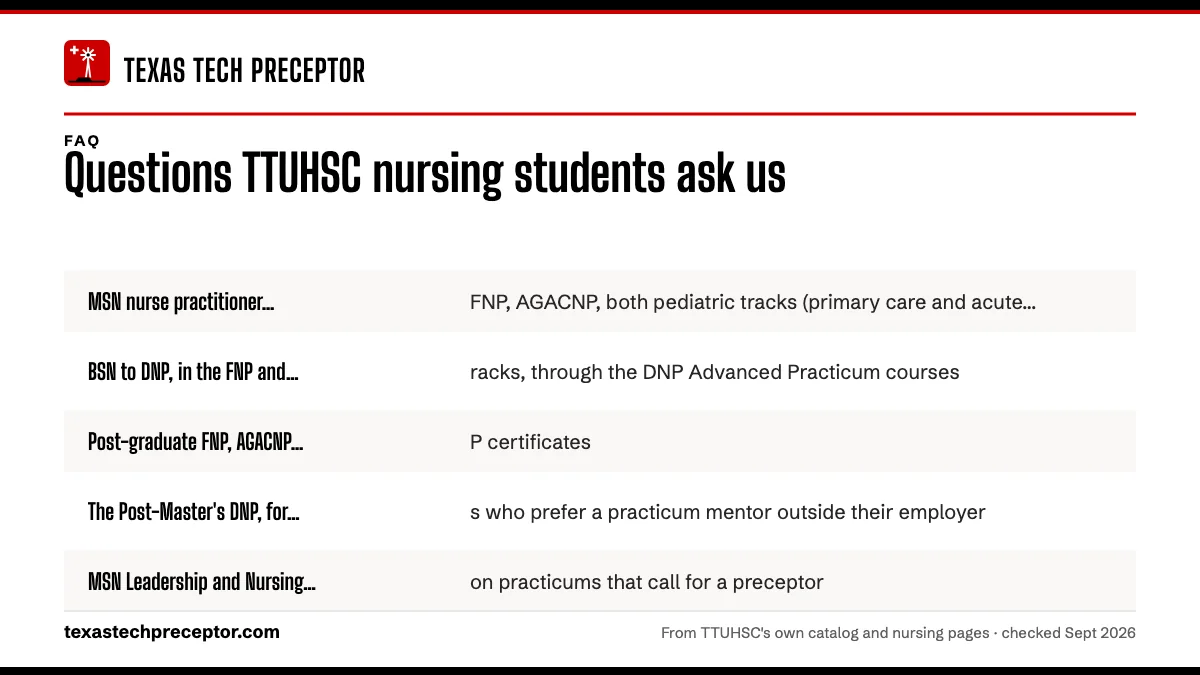
- MSN nurse practitioner tracks: FNP, AGACNP, both pediatric tracks (primary care and acute care) and PMHNP
- BSN to DNP, in the FNP and PMHNP tracks, through the DNP Advanced Practicum courses
- Post-graduate FNP, AGACNP and PMHNP certificates
- The Post-Master's DNP, for students who prefer a practicum mentor outside their employer
- MSN Leadership and Nursing Education practicums that call for a preceptor
Three groups run differently. Midwifery students have sites arranged through TTUHSC's faculty and its preceptor and site coordinators, and the Program Director approves each location. For Traditional and Accelerated BSN students, placement decisions rest with the clinical course faculty. The Informatics and Intelligent Systems practicum takes place in a virtual environment. Every track is on the programs page.
Where you live and where you train
Graduate clinical hours at TTUHSC can happen close to home, as long as the School of Nursing signs off on both the clinician and the site. So the search starts from your address, not from Lubbock. Students around Dallas-Fort Worth, Austin, San Antonio or Houston usually have many practices within a short drive. Students in smaller West Texas towns often weigh a longer commute against a closer fit to the course, and we map both options for you.
Living outside Texas works in most states, though not all. TTUHSC names ten states from which its graduate nursing programs take no students, adds South Dakota for the BSN to DNP, and marks Kansas as not meeting requirements for the midwifery and BSN to DNP programs; the licensure disclosure page names them. Planning a move mid-program? Graduate online students owe TTUHSC notice at least 60 days before relocating, and our state guides cover each state.
When to get in touch
Earlier is better, and the right moment depends on your plan. MSN PMHNP students reach their first clinical course in the second spring of the full-time plan. BSN to DNP FNP students begin clinical work in the summer of year three, and BSN to DNP PMHNP students in the spring of year two. TTUHSC does not print the semester for the MSN FNP, AGACNP and pediatric tracks, so your plan of study is the guide; the first clinical course page gathers what TTUHSC does publish.
A useful rule: contact us one full semester before the clinical course begins, and earlier still for a rural address or a specialized setting. Already in a term with no preceptor? Reach out today; the can't find a preceptor page is written for exactly that.
What to send us first
The more we know at the start, the sooner the first outreach goes out. A complete first message covers:
- Your TTUHSC program and track, and whether you study full time or part time
- The clinical course you need covered and its semester
- Your home town or ZIP, plus the longest commute you can manage on clinic days
- The weekdays and hours you can spend in clinic around your job
- Any clinician or practice you approached already, with the answer you got
- Where you stand on certifications such as ACLS, PALS or NRP, and on TTUHSC compliance items
Send it through the form below, and your placement advisor replies with next steps and any follow-up questions.
The parts that stay with you
Some steps belong to you as a TTUHSC student, and handling them early keeps a confirmed preceptor from waiting on your paperwork. TTUHSC requires a background check, drug screens before most placements, immunizations with a yearly TB test, BLS for every student plus track-specific certifications, health insurance, and HIPAA training every year. The immunizations and certifications page lists them.
You also complete the electronic preceptor agreement each semester, attend TTUHSC's on-campus days, and record your clinical hours the way your course faculty direct. We make each of those easier by keeping your preceptor's details current and your placement plan clear, term after term.
Questions TTUHSC students ask
Can I have two preceptors in the same clinical course?
That is up to your course faculty. If they agree that splitting hours between two clinicians meets the course objectives, each preceptor needs TTUHSC's approval and a separate electronic agreement for that semester, and each facility needs its own review. We can line up both and prepare two sets of details, which helps when one clinician can offer only part of your weekly hours.
Can you take over with a clinician I already contacted?
Yes. If a clinician showed interest but nothing is settled, tell us who they are and what was discussed. We pick up the follow-up, confirm dates and hours, and build the approval file, without repeating calls you already made. If they decline, you still have a search underway instead of starting over.
Do OSCEs and on-campus days affect my clinical schedule?
They can. The MSN NP and midwifery tracks bring students to campus for a total of seven or eight days, including OSCEs held in Lubbock, with dates announced roughly two months out. BSN to DNP students travel in at least once per semester. We plan your preceptor's schedule around those dates once you have them.
Can my clinical hours be at the place I work?
For undergraduates, TTUHSC's handbook limits clinical hours on the student's own unit without Program Director permission. TTUHSC's public pages set no matching rule for graduate NP students, so ask your course faculty before counting on your employer. The Post-Master's DNP is the clear exception: practicum hours may happen at your workplace when faculty agree the experience meets the course objectives.
Does TTUHSC publish a deadline for submitting my preceptor?
Not on its public pages. The graduate submission date is shared inside the program, and your course faculty or the Graduate Coordinator can tell you the date for your course and term. Then tell us: we plan the search and your approval file backward from that date, leaving room for questions during review.
Related pages
Last checked 2026-09-26
We check these pages against TTUHSC's catalog, Student Handbook, program pages and licensure disclosures. Your course faculty, your program director and the plan of study for your cohort have the final word.
Your TTUHSC preceptor search, run by specialists.
Tell us your TTUHSC track, your next clinical course and the town you'll train near. We find preceptors who fit the course and pull together what SON staff and faculty need to approve both the clinician and the facility, early enough for the electronic preceptor agreement to go through before the term.
- Preceptors matched to the track: family primary care, adult-gerontology acute care, pediatrics, psychiatric mental health
- License, certification and facility details ready for TTUHSC's preceptor and facility approval
- In Lubbock, Amarillo, Abilene, the Permian Basin, Dallas-Fort Worth and the states TTUHSC accepts
Start your placement plan
Your track, your town and your next clinical term is all we need to begin.