TTUHSC's Post-Master's Doctor of Nursing Practice
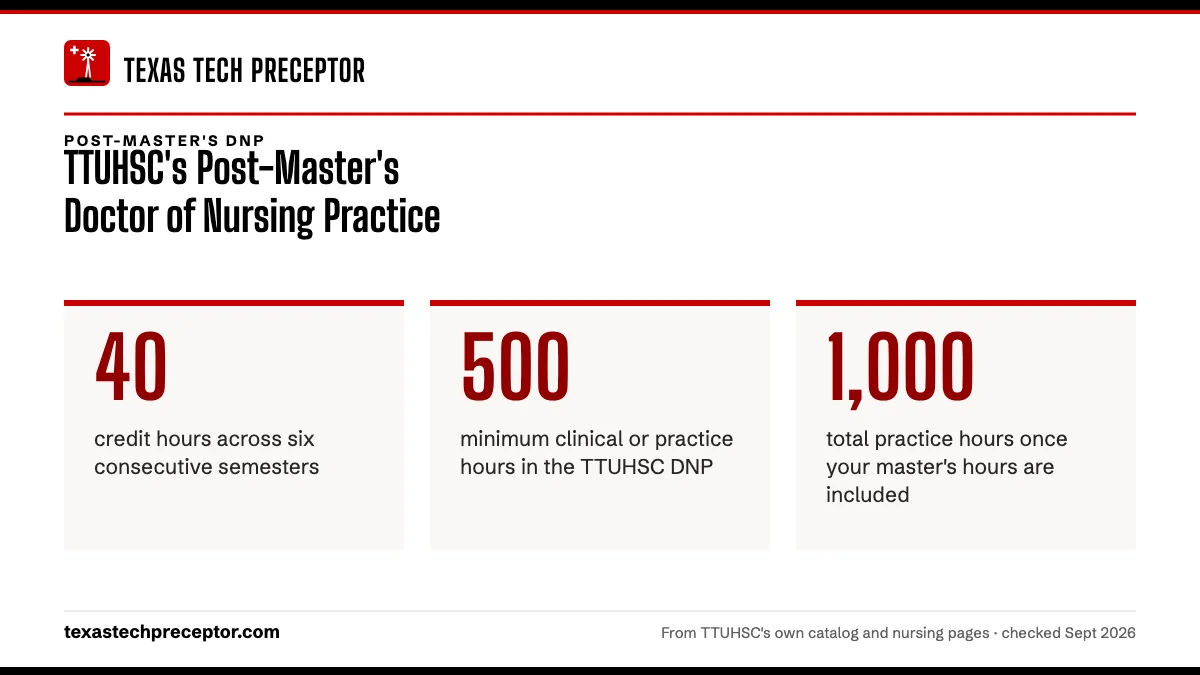
TTUHSC's Post-Master's DNP is a 40-credit, six-semester program that starts each Summer and asks every student to complete at least 500 clinical or practice hours. Six of its courses carry practicum work, and with faculty approval those hours can take place where you already work. When your employer cannot supply the experience a course needs, we find the mentor or preceptor who can.
Get your placement plan
Tell us your TTUHSC program and where you live. A placement advisor replies with the preceptor and site options that fit your TTUHSC course.
The program in brief
The Post-Master's DNP is TTUHSC's doctoral route for nurses who already hold a master's. It runs online with on-campus executive sessions, covers six consecutive semesters, about two years, and admits only for Summer. Applications for the Summer cohort open September 1 and close January 15. TTUHSC's first DNP cohort began in 2008.
Practicum hours are counted at one credit to six clock hours. TTUHSC's current web plan is labeled for students beginning in Summer 2027, and the 2026-27 catalog is the official plan for the academic year.
| Item | What TTUHSC states |
|---|---|
| Credits | 40 |
| Length | Six consecutive semesters, about 2 years |
| Start | Summer only; apply September 1 to January 15 |
| Tracks | Executive Leadership; Advanced Nursing Practice |
| Practice hours | At least 500 in the DNP; 1,000 counting the master's |
| Practicum ratio | 1 credit to 6 clock hours |
| Campus time | Intensives twice a semester, about three days each |
Two tracks and what each asks of you
Both tracks require a current, unencumbered RN license in the United States; our RN license guide compares that rule with the MSN's Texas or compact requirement. Beyond the license, the tracks diverge on experience.
The Advanced Nursing Practice track is for practicing APRNs. TTUHSC asks for state board approval as a nurse practitioner or certified nurse-midwife, national certification and at least one year of experience as an APRN. The Executive Leadership track is for nurses in management, and it asks for at least one year in a healthcare leadership position.
APRNs certified in another population who also want psychiatric practice have a third option in the catalog: the PMHNP post-graduate certificate paired with the Post-Master's DNP. The DNP half is applied for and admitted separately. Our post-graduate NP certificates guide covers the certificate side.
Six semesters and the practicum courses
The first semester is research only. Practicum work starts in Semester II with NURS 6325 Informatics and Technology, and the program ends with a five-credit DNP project and practice immersion.
| Semester | Courses | Practicum course |
|---|---|---|
| I | NURS 6540 Translational Research and Implementation Science | None |
| II | NURS 6311 statistics, NURS 6325, NURS 6330 evidence-based inquiry | NURS 6325 Informatics and Technology |
| III | NURS 6342, NURS 6344, NURS 6345 population health and epidemiology | NURS 6342 Systems Thinking and Systems Citizenship; NURS 6344 Advanced Practice Development |
| IV | NURS 6350 Financial Intelligence for the DNP Leader, NURS 7311 | NURS 7311 Leading Teams in Complex Health Care Environments |
| V | NURS 7321 Health Care Economics, NURS 7331 | NURS 7331 Population Health at the Organizational and Public Policy Level |
| VI | NURS 7552 | NURS 7552 DNP Project Seminar and Practice Immersion |
One conflict to note: the web plan counts Semester III as 9 credits, while the catalog lists the same three courses under a total of 8. Ask the DNP Programs Enrolled Student Advisor which figure your cohort follows.
500 practice hours and what can count
TTUHSC states that each student will complete at least 500 clinical or practice hours within its DNP, and that those hours bring the total to 1,000 once the hours from your master's are included. Confirm with the program how your earlier hours are counted before your first practicum term.
The catalog takes a broad view of DNP practice experience. Alongside direct and indirect patient care, it names observation, interviews, community events, relevant local, state or national meetings, and other distinctive learning opportunities tied to a course's objectives. The guide to what counts as clinical hours sets this beside the rules for other TTUHSC programs.
Breadth is not the same as automatic credit. Each experience has to serve a specific course's learning objectives, and faculty approve the arrangement, so agree on the plan with your course faculty before you start logging time toward it.
Practicums at your workplace, with faculty approval
The catalog allows practicum hours at your own place of employment when the experience clearly gives you the chance to meet the course's learning objectives. You may work with professional mentors or preceptors that faculty approve, and SON faculty can serve in that role themselves. Our workplace clinicals guide compares this with TTUHSC's rules for other programs.
Your employer will not suit every course. A practicum on population health at the organizational and policy level, or on leading teams across complex settings, may call for a department, agency or health system outside your current role. That is when an outside mentor or preceptor becomes the practical answer.
Employment alone does not qualify a site: the experience has to match the course objectives, and faculty approve the mentor or preceptor.
Executive sessions, grades and moving
Every Post-Master's DNP course requires on-campus intensives. TTUHSC holds them twice a semester for about three days each, anchored on the Lubbock campus with travel to Austin and Dallas; our intensives page gathers the details. For 2026-27, Summer runs May 24 to August 13, Fall September 8 to December 18 and Spring January 11 to April 23.
Graduate grading applies throughout: a B or better in every nursing course, a pass in the clinical or practicum part of a course, and dismissal after a C or lower in the same course twice or in two courses in one semester. The grades and progression guide has the full rules.
If you plan to move to another state during the program, TTUHSC requires at least 60 days' notice from online graduate students, and approval of clinical work in the new state is case by case. See moving out of state.
Why Post-Master's DNP students choose us
DNP practicums call for a different kind of search than NP rotations, and TTUHSC's process is our specialty. We look for leaders, clinicians and organizations near you whose work fits the course in front of you, whether that is informatics, systems thinking, team leadership, organizational population health or the final practice immersion, and we confirm their credentials and roles.
We prepare the mentor or preceptor details and the organization's information that your faculty review, well before the term, so approval is quick and your hours start on time. If a mentor steps away, we find a replacement. Every arrangement is approved by TTUHSC's faculty, and what we send arrives complete and ready for their review. Let us know your track and your next practicum semester on the contact page.
Questions TTUHSC students ask
How many practice hours does TTUHSC's Post-Master's DNP require?
At least 500 clinical or practice hours inside the TTUHSC DNP. TTUHSC pairs those with the hours from your master's for 1,000 in total. Practicum credit converts at one credit to six clock hours, and the hours are spread across six practicum courses from Semester II to Semester VI.
Can I do my Post-Master's DNP practicum hours at my job?
Often, yes. TTUHSC's catalog allows practicum hours at your place of employment when the experience clearly lets you meet the course's learning objectives. Faculty approve any mentor or preceptor you work with, and SON faculty may serve in that role. Courses that reach beyond your current job may need an outside mentor.
When does the TTUHSC Post-Master's DNP start?
Only in Summer. Applications run from September 1 to January 15 for the following Summer cohort. The current web plan is labeled for students beginning in Summer 2027, a term that runs May 24 to August 13. The program then continues for six consecutive semesters.
Which Post-Master's DNP courses include practicum hours?
Six: NURS 6325 Informatics and Technology, NURS 6342 Systems Thinking and Systems Citizenship, NURS 6344 Advanced Practice Development, NURS 7311 Leading Teams in Complex Health Care Environments, NURS 7331 Population Health at the Organizational and Public Policy Level, and NURS 7552 DNP Project Seminar and Practice Immersion.
Do I have to be a nurse practitioner for the Post-Master's DNP?
No. The Executive Leadership track asks for at least one year in a healthcare leadership position rather than APRN status. The Advanced Nursing Practice track asks for state board approval as an NP or certified nurse-midwife, national certification and a year of APRN experience. Both tracks require a current, unencumbered U.S. RN license.
Can you find a mentor or preceptor for a DNP practicum?
Yes. We search near you for leaders, clinicians and organizations whose work fits your practicum course, confirm their credentials and roles, and prepare the details your faculty review. TTUHSC's faculty approve every mentor and preceptor, and if one steps away mid-term, we find a replacement.
Related pages
Last checked 2026-09-26
We check these pages against TTUHSC's catalog, Student Handbook, program pages and licensure disclosures. Your course faculty, your program director and the plan of study for your cohort have the final word.
Your TTUHSC preceptor search, run by specialists.
Tell us your TTUHSC track, your next clinical course and the town you'll train near. We find preceptors who fit the course and pull together what SON staff and faculty need to approve both the clinician and the facility, early enough for the electronic preceptor agreement to go through before the term.
- Preceptors matched to the track: family primary care, adult-gerontology acute care, pediatrics, psychiatric mental health
- License, certification and facility details ready for TTUHSC's preceptor and facility approval
- In Lubbock, Amarillo, Abilene, the Permian Basin, Dallas-Fort Worth and the states TTUHSC accepts
Start your placement plan
Your track, your town and your next clinical term is all we need to begin.