TTUHSC MSN Nurse-Midwifery: six semesters, three practicums and coordinated sites
TTUHSC's MSN Nurse-Midwifery is a 47-credit online track with full ACME accreditation. Its published full-time plan opens in Fall, lasts six terms and saves three precepted practicums for the second year. Placement here is a joint effort rather than a solo search: midwifery faculty and TTUHSC's site coordinators arrange sites with you, and the Program Director signs off on each one. Your part is arriving ready, and strong local options with complete details make that work easier.
Plan your midwifery practicums
Tell us where you live and your Fall Two start.
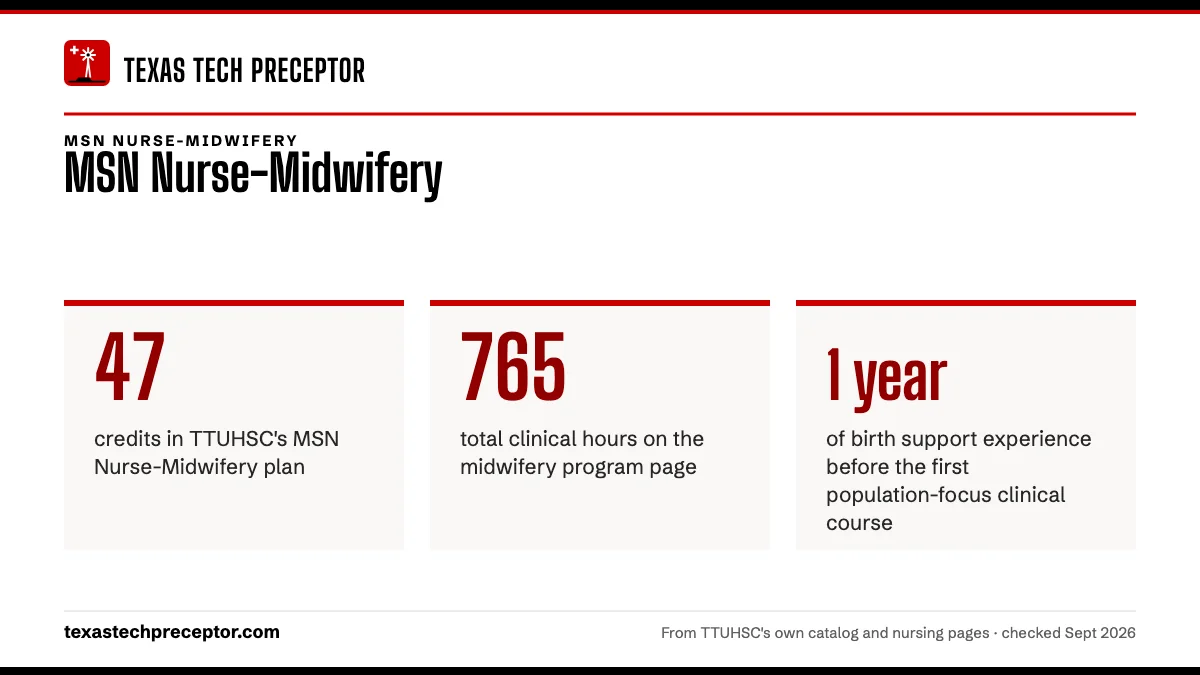
The midwifery track at a glance
Like every MSN student, you also need an active RN license, either Texas or a compact multistate license, with no encumbrance on it. The rest of this guide covers how placement works here, the readiness gates, the practicum hours and where you can live.
| Item | What TTUHSC states |
|---|---|
| Credits | 47 |
| Format | Online, with occasional travel to TTUHSC campuses |
| Start | Fall or Spring in the MSN admission table; the published full-time plan begins in Fall |
| Length | Six semesters full-time, Fall One to Summer Two; part-time options available |
| Clinical hours | "Total clinical hours: 765" on the program page; catalog course pages differ |
| Placement | Coordinated by faculty and TTUHSC preceptor/site coordinators; sites approved by the Program Director |
| Before clinicals | One year of birth support, NRP, an EFM course and your own malpractice insurance |
| Preferred | Labor and delivery experience |
| Accreditation | ACME (fully accredited); CCNE for the MSN |
How midwifery placement differs
Midwifery is the TTUHSC graduate track where site arrangements are a joint effort. According to the Student Handbook, the midwifery faculty and TTUHSC's coordinators work alongside each student until suitable preceptors and sites are in place, and every population-focus clinical hour happens at a location the Program Director has approved. TTUHSC bills a clinical placement fee in each term that includes a midwifery practicum; the program can give you the current amount.
Because the faculty work with you rather than for you, your input counts. Where you live, how far you can travel, and which midwives, physicians and birth settings are nearby all feed the decision. The midwifery placement page walks through who does what.
Coordinated placement still starts with you: the earlier the faculty know your location and options, the more room they have to work.
Readiness gates: birth support, NRP, EFM and insurance
Four items have to be finished ahead of your first population-focus clinical course. The catalog calls for a full year of birth support experience, a Neonatal Resuscitation Program card and a course in electronic fetal monitoring. Midwifery students must also buy their own student malpractice coverage before midwifery clinical courses, in addition to the blanket coverage the School of Nursing carries for students in clinical activity. The insurance and HIPAA page explains both.
The pages read do not define birth support, so confirm with the program which roles count toward the year before relying on one. TTUHSC names labor and delivery experience as a preference rather than a requirement.
Plan the year backward from Fall Two, when the first practicum begins. BLS, the immunization series, a background check, drug screens, health insurance and yearly HIPAA training apply here as they do in every TTUHSC graduate track.
The three practicums and the hours question
The plan closes with three precepted practicums in consecutive terms: Clinical Practicum A (NURS 5399) in Fall Two, the Integrated Clinical Practicum, Level B (NURS 6520) in Spring Two, and the Clinical Immersion Practicum (NURS 6610) in Summer Two.
How many hours they carry depends on which TTUHSC page you open. The program page assigns them 191, 255 and 319, for 765 in all. The catalog's course pages put Level B at 262.5 and the immersion at 315, show 210 for the Level A course in the certificate plan, and note that reaching competency can take longer than the stated figure.
Since competency can outrun the listed number, leave slack in each practicum schedule and check every term's requirement with course faculty. The midwifery practicums page covers each course in depth.
Six semesters, term by term
The first year is didactic, which gives you three terms to finish the readiness gates and settle your location with the faculty. Part-time options exist; ask the program director how a part-time plan spaces the three practicums, since each one builds on the one before it.
| Term | Focus |
|---|---|
| Fall One | Advanced health assessment, pathophysiology, nurse-midwifery foundations: role and leadership |
| Spring One | Pharmacology for women's health, primary care of women, gynecological care |
| Summer One | Antepartum care; postpartum and newborn care |
| Fall Two | Scientific foundations, intrapartum care, Clinical Practicum A |
| Spring Two | Integrated Clinical Practicum, Level B; informatics, quality and safety |
| Summer Two | Clinical Immersion Practicum |
Where you can live, and campus travel
The track runs online with occasional trips to TTUHSC campuses. The archived graduate FAQ put campus time for the MSN nurse practitioner and midwifery tracks at seven to eight days over the whole program.
Midwifery adds one state to the list. Ten states, Arizona, New York and Washington among them, are closed to every TTUHSC graduate applicant, and the licensure disclosure also rates Kansas "Does not meet" for nurse-midwifery. If you live outside Texas, check with the Admissions Team that your state is eligible before applying, and if you relocate mid-program, TTUHSC needs to hear about it 60 or more days ahead of the move. Every state's status is on the licensure disclosure page.
TTUHSC reports full accreditation of the midwifery program from ACME, and its master's nursing program as a whole holds CCNE accreditation.
How we support TTUHSC midwifery students
Midwifery placement at TTUHSC is coordinated, and our work fits inside that process. We research the midwives, physicians and birth settings near your home, gather each candidate's license, certification and practice details, and keep your readiness items on schedule, so what you bring to the faculty and coordinators is complete and well organized.
- Local options mapped for Clinical Practicum A, Level B and the immersion, with each candidate's details verified.
- A readiness calendar for the birth-support year, NRP, EFM and malpractice coverage, timed to Fall Two.
- Fast work on alternatives if a site changes late.
Each midwifery site gets its approval from TTUHSC's Program Director; our job is to make your options strong and your paperwork complete. See how it works or tell us about your plan in the form below.
Questions TTUHSC students ask
Does TTUHSC place nurse-midwifery students in clinical sites?
Midwifery placement is shared between you and TTUHSC. Faculty and TTUHSC's site coordinators help arrange suitable preceptors and sites, the Program Director approves each location, and a placement fee is billed in every practicum term. The program can tell you the current fee.
Is TTUHSC's nurse-midwifery program accredited?
Yes. TTUHSC reports that ACME, the Accreditation Commission for Midwifery Education, fully accredits its nurse-midwifery program, and CCNE accredits its master's nursing program. TTUHSC's own pages give no review dates, so check the accreditors' directories if you need them. See nursing accreditation.
How many clinical hours does TTUHSC's MSN Nurse-Midwifery require?
The program page says 765, split 191, 255 and 319 across three practicums. Catalog course descriptions give higher figures for the last two and warn that competency may need more time than listed. Ask your course faculty for the number that applies in your term.
What counts as birth support experience for TTUHSC midwifery?
TTUHSC wants a year of birth support behind you before the first midwifery clinical course and prefers labor and delivery experience, but the pages read do not define birth support. Ask the program director what qualifies before you count on a particular role or employer.
Do TTUHSC midwifery students need their own malpractice insurance?
Yes. TTUHSC's blanket policy covers students during clinical activity, and nurse-midwifery students must add their own student malpractice coverage before midwifery clinical courses begin. Confirm the current details with the program well before Fall Two.
Is there a post-graduate nurse-midwifery certificate at TTUHSC?
Yes. Master's-prepared nurses can take the Nurse-Midwifery Post-Graduate Certificate, which uses an individualized plan, a different course set and practicums at sites the Program Director approves. The post-graduate midwifery guide covers it.
Related pages
Last checked 2026-09-26
We check these pages against TTUHSC's catalog, Student Handbook, program pages and licensure disclosures. Your course faculty, your program director and the plan of study for your cohort have the final word.
Your TTUHSC preceptor search, run by specialists.
Tell us your TTUHSC track, your next clinical course and the town you'll train near. We find preceptors who fit the course and pull together what SON staff and faculty need to approve both the clinician and the facility, early enough for the electronic preceptor agreement to go through before the term.
- Preceptors matched to the track: family primary care, adult-gerontology acute care, pediatrics, psychiatric mental health
- License, certification and facility details ready for TTUHSC's preceptor and facility approval
- In Lubbock, Amarillo, Abilene, the Permian Basin, Dallas-Fort Worth and the states TTUHSC accepts
Start your placement plan
Your track, your town and your next clinical term is all we need to begin.