The TTUHSC clinical placement process, start to finish
At the TTUHSC School of Nursing, a graduate NP placement is built by the student and signed off by the school. You secure a preceptor in your home area who fits your clinical course, SON staff and faculty approve that preceptor and the facility, you complete the term's electronic preceptor agreement, and your compliance record has to be current before the first hour counts.
Get your placement plan
Tell us your TTUHSC program and where you live. A placement advisor replies with the preceptor and site options that fit your TTUHSC course.
Who does what in a TTUHSC graduate placement
Four parties share every graduate NP placement at TTUHSC, and each has a defined part. The student finds the preceptor and the site. SON staff and faculty review and approve both. The facility, through an agreement with TTUHSC, agrees to host students. Course faculty keep responsibility for the learning and the grade from the first week to the last.
That division comes from TTUHSC's own graduate FAQ, which puts the search with students and the approval with the school. The table sorts each stage by who acts and what TTUHSC actually publishes about it.
| Stage | Who acts | What TTUHSC publishes |
|---|---|---|
| Finding a preceptor and site | You, the student | Students obtain their own preceptors to fit each clinical course; a two-year preceptor list serves as a guide |
| Approving the preceptor | SON staff and faculty | Approval is required; graduate preceptor criteria are not posted publicly |
| Approving the facility | SON staff and faculty | Approval is required; a School of Nursing unit handles affiliation agreements |
| Semester paperwork | You, with your preceptor | An electronic agreement for each preceptor, each semester; the system's name is not public |
| Supervision and grading | Course faculty | The clinical portion is pass/fail, and failing it fails the whole course |
Six steps from search to first clinical day
The order below follows TTUHSC's published rules. Your course faculty and the Graduate Coordinator can add course-specific steps, so use this as the frame and your syllabus as the detail.
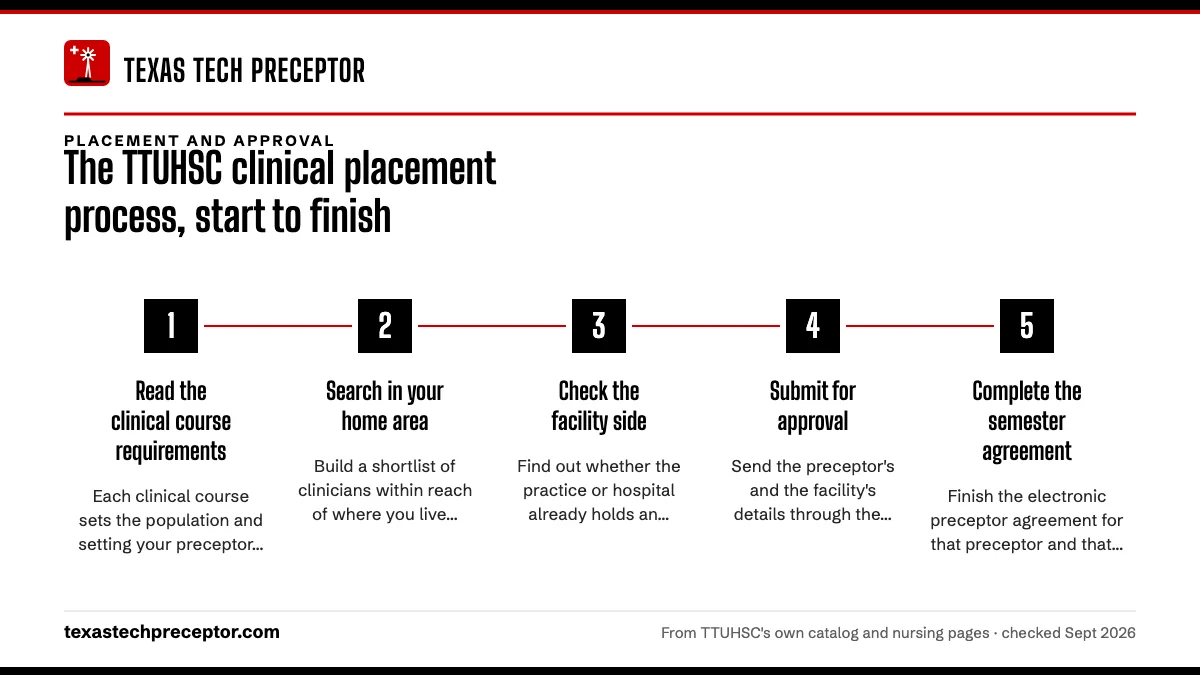
- Read the clinical course requirementsEach clinical course sets the population and setting your preceptor must cover. Start from the course, not from whoever happens to be available, because fit is what approval turns on.
- Search in your home areaBuild a shortlist of clinicians within reach of where you live. TTUHSC's list of preceptors used in the past two years is one starting point; see the preceptor list and preceptor team.
- Check the facility sideFind out whether the practice or hospital already holds an agreement with TTUHSC. A site without one adds a contracting step, explained on affiliation agreements.
- Submit for approvalSend the preceptor's and the facility's details through the route your course names. SON staff and faculty approve both before hours count.
- Complete the semester agreementFinish the electronic preceptor agreement for that preceptor and that term. A preceptor you worked with last term needs a new one.
- Clear compliance, then beginConfirm every requirement below is current, check your course site in D2L, and start hours on the dates your faculty set.
Compliance items that must be current
Approval and compliance run on parallel tracks. A preceptor can be approved while your own file still holds you back, so check these items well before the term opens. The list is the short version of the 2026-27 Student Handbook's requirements.
- A criminal background check through the institutionally approved vendor, repeated after any break in enrollment
- Drug screening ahead of most clinical placements and at random times, with five days to finish a screen once it is requested
- Immunizations: hepatitis B, MMR, varicella, yearly TB screening and influenza; COVID-19 only when a clinical partner requires it
- BLS for everyone; ACLS for FNP and AGACNP, PALS for Pediatric NP, NRP and EFM for Nurse-Midwifery, each before the first population-focus clinical course
- Health insurance, mandatory for online programs with clinical requirements
- Proof of HIPAA training every year, since students without it are kept out of clinical
- An RN license from Texas or a compact state, current and unencumbered, for MSN students; DNP students need a U.S. RN license held to the same standard
Screening rules in full are on background checks and drug screens.
How your clinical hours are counted
TTUHSC turns clinical credits into clock hours with a set ratio for each program type. The 2026-27 catalog puts nurse practitioner and nurse-midwifery clinical courses on a 1-to-4.25 scale, phased in during Summer or Fall 2026 according to track, while BSN to DNP courses count direct care at 1-to-4 and non-direct care at 1-to-6. The clinical hours guide breaks this down program by program.
Only some programs publish a total. The MSN PMHNP web plan adds up to 765 clinical hours, MSN Nurse-Midwifery states 765, BSN to DNP students complete at least 1,080, and Post-Master's DNP students at least 500. TTUHSC states no total for FNP, AGACNP or Pediatric NP, so plan from your course schedule and your faculty's guidance rather than a figure found elsewhere.
Clinical work in each course is graded pass/fail. Fail that portion and the course grade becomes an F, whatever your exam scores, so a preceptor who fits the course protects your grade from the first shift.
Programs that follow a different path
Not every TTUHSC program runs on the student-found model. Nurse-Midwifery is coordinated: faculty work with TTUHSC preceptor and site coordinators, the Program Director approves locations, and each practicum semester carries a clinical placement fee. The details are on nurse-midwifery placement.
Traditional and Accelerated BSN students are placed by the school, since placement decisions rest with the faculty teaching the clinical course. Post-Master's DNP practice hours may happen at the student's workplace when the experience meets the course objectives and faculty approve it. The Informatics and Intelligent Systems practicum runs in a virtual learning environment, so no outside site is involved. Who sets up the Leadership, Education and RN to BSN practicums is not stated on TTUHSC's public pages, so students in those tracks should ask their program director how sites are chosen.
What TTUHSC leaves unpublished
Several pieces of the graduate process are missing from TTUHSC's public pages. The deadline for submitting a preceptor, the name of the electronic agreement system, the criteria a graduate preceptor must meet, and any rules on faculty site visits all sit in course materials or with the staff who run placement.
For those answers, go to the titles TTUHSC names. Course faculty own course-level expectations. The Graduate Coordinator, who sits in the Office of Student Success unit for clinical placement and agreements, handles approvals and contracts. Your program director settles anything that touches your plan of study. Ask in the term before your first clinical course, because a late answer shortens the time left to search.
Why TTUHSC students hand the search to us
The search is the part of this process TTUHSC leaves with you, and it is the part we do best. Our placement desk looks for a preceptor and facility that fit your exact TTUHSC clinical course, close to where you live, and checks that fit against the course before anything is submitted.
We then build the approval file: proof of the preceptor's license and board certification, a summary of the practice and its patients, the facility's name, address and contract status with TTUHSC, and the answers the semester agreement will want. Faculty and staff at TTUHSC decide; we deliver a file that leaves them nothing to chase and matches the school's rules on the first pass. If a preceptor drops, we start on a replacement right away. Share your course and term through the form below.
Questions TTUHSC students ask
Does TTUHSC place graduate NP students with preceptors?
No official TTUHSC page says it does. The graduate FAQ puts the preceptor search on students, while BSN to DNP pages add that faculty and a preceptor team assist with selection and contracts. Two groups work differently: Nurse-Midwifery runs coordinated placement with a fee each practicum semester, and BSN students are placed by faculty.
How far ahead should I start looking for a TTUHSC preceptor?
TTUHSC does not publish a graduate preceptor deadline, so start as early as your course sequence allows. Approval of the preceptor and facility, a possible new facility agreement and the semester agreement all have to land before the term begins. Check when your first clinical course falls and count back from it.
Can I use a preceptor outside Texas?
Yes, if you live there and your state is open to TTUHSC. Clinicals follow your home area, and many states qualify, but TTUHSC's licensure page names ten it cannot take graduate students from. Moving mid-program needs notice to TTUHSC at least 60 days ahead, with approval for clinicals in the new state weighed individually.
What happens if my clinical site falls through mid-semester?
No graduate procedure for this appears on TTUHSC's public pages, so tell your course faculty right away and ask what they need from you. A replacement preceptor needs approval and a new electronic agreement for that term. See backup preceptors for building a plan B before you need one.
Who approves my preceptor at TTUHSC?
Two approvals are needed, one for the preceptor and one for the facility where you will train, both from SON staff and faculty. Course faculty judge whether the preceptor fits the course, and a School of Nursing unit in the Office of Student Success handles facility contracts. Graduate preceptor criteria are not on TTUHSC's public pages, so confirm them with your course faculty.
Related pages
Last checked 2026-09-26
We check these pages against TTUHSC's catalog, Student Handbook, program pages and licensure disclosures. Your course faculty, your program director and the plan of study for your cohort have the final word.
Your TTUHSC preceptor search, run by specialists.
Tell us your TTUHSC track, your next clinical course and the town you'll train near. We find preceptors who fit the course and pull together what SON staff and faculty need to approve both the clinician and the facility, early enough for the electronic preceptor agreement to go through before the term.
- Preceptors matched to the track: family primary care, adult-gerontology acute care, pediatrics, psychiatric mental health
- License, certification and facility details ready for TTUHSC's preceptor and facility approval
- In Lubbock, Amarillo, Abilene, the Permian Basin, Dallas-Fort Worth and the states TTUHSC accepts
Start your placement plan
Your track, your town and your next clinical term is all we need to begin.