DNP Advanced Practicum I, II and III at TTUHSC
Both TTUHSC BSN to DNP tracks finish with the same three 4-credit courses: NURS 7450 in the final Summer, NURS 7451 in the Fall and NURS 7452 in the closing Spring. TTUHSC prints hours for them only on the PMHNP plan, 120, 180 and 180. Each of those terms needs an approved preceptor, an approved facility and its own electronic preceptor agreement.
Get your placement plan
Tell us your TTUHSC program and where you live. A placement advisor replies with the preceptor and site options that fit your TTUHSC course.
Where the three practicums fall
TTUHSC's BSN to DNP admits in Summer only and lays its plan out over 12 semesters, four years of full-time study with three terms a year. The DNP Advanced Practicums fill semesters X, XI and XII, the program's last Summer, Fall and Spring, and each one carries 4 credits on both the FNP and the PMHNP catalog plans.
| Semester | Practicum | FNP track, same term | PMHNP track, same term |
|---|---|---|---|
| X, Summer | NURS 7450 DNP Advanced Practicum I | NURS 6320 Systems Leadership | NURS 6353 Financial Intelligence for the APRN DNP Leader |
| XI, Fall | NURS 7451 DNP Advanced Practicum II | NURS 6353 Financial Intelligence for the APRN DNP Leader | No other course listed |
| XII, Spring | NURS 7452 DNP Advanced Practicum III | NURS 6340 Advancing Policy and Politics in Health Care | No other course listed |
The FNP track also offers a 3-year, 9-semester accelerated plan with program director approval, and on that plan the practicum run comes sooner. If you are on it, confirm your exact practicum terms with the program director before you start contacting preceptors.
What comes right before them
The two tracks reach the final year by different roads. FNP students take their population-focus clinicals in semesters VII to IX: Primary Health Care I (NURS 6439), then Primary Care II (NURS 6541) and the FNP Practicum (NURS 7660). Add the three advanced practicums and that is six clinical terms in a row, with no pause before NURS 7450. The last two of those FNP courses list current ACLS as a prerequisite.
PMHNP students start clinical work sooner, with NURS 6604 (children and adolescents), NURS 6603 (adults) and NURS 7500 (complex psychiatric patients) in semesters VI to VIII. Semester IX, a Spring term holding NURS 5201 and NURS 6340, has no clinical course at all, which makes it the natural window to line up the final-year preceptors.
The course-by-course PMHNP hours, including the three earlier clinicals, are set out in the 1,080-hour guide.
Hours: stated for PMHNP, open for FNP
TTUHSC's PMHNP plan gives NURS 7450 120 clinical hours and NURS 7451 and NURS 7452 180 each. Together with the three earlier PMHNP clinicals, those figures make up the program's 1,080-hour minimum.
The FNP track reads differently. Its program page sets a 1,080-hour floor for the program as a whole but prints no hours for any single course, so the PMHNP split does not carry over. Take each FNP practicum's target from its syllabus and course faculty.
Both tracks count time on two scales: the catalog converts BSN to DNP clinical credits at 1 to 4 for direct care and at 1 to 6 for non-direct work. How much of each advanced practicum is direct patient care and how much is non-direct work is set at the course level, not on the program page. The clinical hours guide explains what TTUHSC counts.
Keep the PMHNP numbers out of an FNP plan: TTUHSC publishes no per-course hours for FNP students in NURS 7450 to NURS 7452.
One agreement per preceptor, per term
Both BSN to DNP program pages answer the preceptor question the same way: the search is yours, and faculty along with the preceptor team assist with choosing and contracting. Sign-off on each preceptor, and on each practice, rests with SON staff and faculty. Under the Texas Board of Nursing's rule for APRN programs, 22 TAC §219.10, a preceptor can be an APRN or another licensed clinician able to teach at the advanced practice level, and the program, preceptor and facility sign written agreements that spell out each role.
The practical point for the final year is the agreement cycle. TTUHSC requires an electronic preceptor agreement for every preceptor you use each semester, so keeping one preceptor for all three practicums still means three agreements.
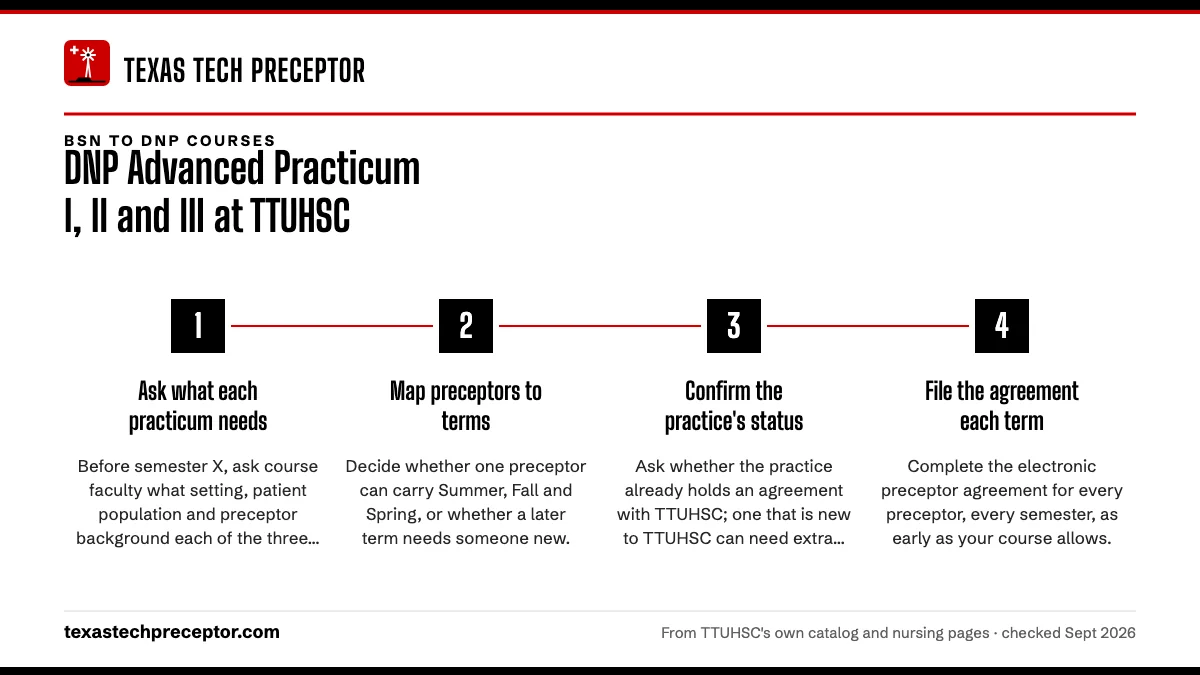
- Ask what each practicum needsBefore semester X, ask course faculty what setting, patient population and preceptor background each of the three courses expects.
- Map preceptors to termsDecide whether one preceptor can carry Summer, Fall and Spring, or whether a later term needs someone new.
- Confirm the practice's statusAsk whether the practice already holds an agreement with TTUHSC; one that is new to TTUHSC can need extra time.
- File the agreement each termComplete the electronic preceptor agreement for every preceptor, every semester, as early as your course allows.
What each agreement cycle asks you to gather is covered in the electronic preceptor agreement guide.
OSCEs, intensives and your final-year calendar
BSN to DNP students come to campus at least once per semester, each trip typically taking one or two days. Most intensives are held in Lubbock, with some in Austin and Dallas. The PMHNP plan pairs an OSCE with NURS 7450 and NURS 7451 and lists another in the closing Spring, so book practicum days around those trips once the dates arrive. The intensives and OSCEs guide covers what each visit involves.
Term length shapes the load too. Practicum I lands in summer, and the Summer 2027 term, May 24 through Aug. 13, is the shortest of TTUHSC's year, while the fall and spring terms stretch to roughly 15 weeks. On the PMHNP track, the summer practicum is also the one with the fewest listed hours, so the heavier NURS 7451 and NURS 7452 fall in the longer terms.
Grades, license and location in the last year
The graduate rules apply to all three practicums. The clinical portion is graded pass/fail, and failing it turns the course into an F no matter how the exams went. Every nursing course also needs at least a B, and a C or lower can be repeated just once, which in the closing Spring can move your finish date. Practicum work that runs past the term gets a "PR" (In Progress) grade. See grades and progression for the full rules.
Location rules matter here as well. TTUHSC's licensure page adds South Dakota to the states it cannot accept BSN to DNP students from, and marks Kansas "Does not meet" for the BSN to DNP. If you plan to move out of state during this year, TTUHSC needs notice at least 60 days ahead, and approval of clinicals in the new state is decided case by case.
On licensure, the catalog's wording is a valid RN license with no encumbrance, while the program page narrows it to Texas or compact; the RN license guide sets out that conflict and where to confirm it.
Why BSN to DNP students plan the final year with us
The final year is three placements in a row with no slack between them, so we plan it as one project. We look for preceptors near you who fit what your course faculty expect and, wherever possible, who can stay with you from Summer through Spring. Before each term we assemble the file TTUHSC reviews: who the preceptor is, their license and certification, where and how they practice, and whether the practice already has an agreement with TTUHSC.
Your placement advisor keeps all three agreement cycles on schedule and stays on call; if a preceptor steps away mid-run, the search for a replacement starts right away. The final say on every preceptor and facility belongs to TTUHSC's staff and faculty, and our job is to hand them a submission that is complete and matches TTUHSC's rules on the first pass. Read how it works, or share your semester plan with us using the form on this page.
Questions TTUHSC students ask
How many clinical hours is DNP Advanced Practicum I at TTUHSC?
On the PMHNP track, TTUHSC's plan lists 120 clinical hours for NURS 7450, then 180 each for NURS 7451 and NURS 7452. The FNP track lists no hours for these courses, only the program-wide minimum of 1,080 clinical hours, so FNP students take each course's target from its syllabus and course faculty.
Can one preceptor cover all three DNP Advanced Practicums?
TTUHSC's public pages do not rule it out, and one steady preceptor can save a lot of searching. The paperwork still repeats: the electronic preceptor agreement is required for every preceptor each semester, so Summer, Fall and Spring mean three agreements. Course faculty decide whether one setting fits all three courses.
Are the DNP Advanced Practicums the same for FNP and PMHNP students?
They share course numbers, titles, credits and semester slots on both catalog plans. What differs is the company they keep: FNP students take systems leadership, financial and policy courses alongside them, while PMHNP students take only the financial course, with Practicum I. Published hours exist only for the PMHNP track.
Does the 3-year BSN to DNP option change when the practicums fall?
It can. TTUHSC offers FNP students a 3-year, 9-semester plan with program director approval, while the published 12-semester sequence puts the practicums in semesters X to XII. On the shorter plan they arrive sooner, so get your exact terms from the program director before you line up preceptors.
Do the DNP Advanced Practicums involve campus visits?
BSN to DNP students come to campus at least once per semester, and the PMHNP plan lists an OSCE in each practicum term. Visits usually last one to two days, in Lubbock or sometimes Austin or Dallas. Course faculty share the dates, so leave room in your practicum schedule for travel.
Related pages
Last checked 2026-09-26
We check these pages against TTUHSC's catalog, Student Handbook, program pages and licensure disclosures. Your course faculty, your program director and the plan of study for your cohort have the final word.
Your TTUHSC preceptor search, run by specialists.
Tell us your TTUHSC track, your next clinical course and the town you'll train near. We find preceptors who fit the course and pull together what SON staff and faculty need to approve both the clinician and the facility, early enough for the electronic preceptor agreement to go through before the term.
- Preceptors matched to the track: family primary care, adult-gerontology acute care, pediatrics, psychiatric mental health
- License, certification and facility details ready for TTUHSC's preceptor and facility approval
- In Lubbock, Amarillo, Abilene, the Permian Basin, Dallas-Fort Worth and the states TTUHSC accepts
Start your placement plan
Your track, your town and your next clinical term is all we need to begin.