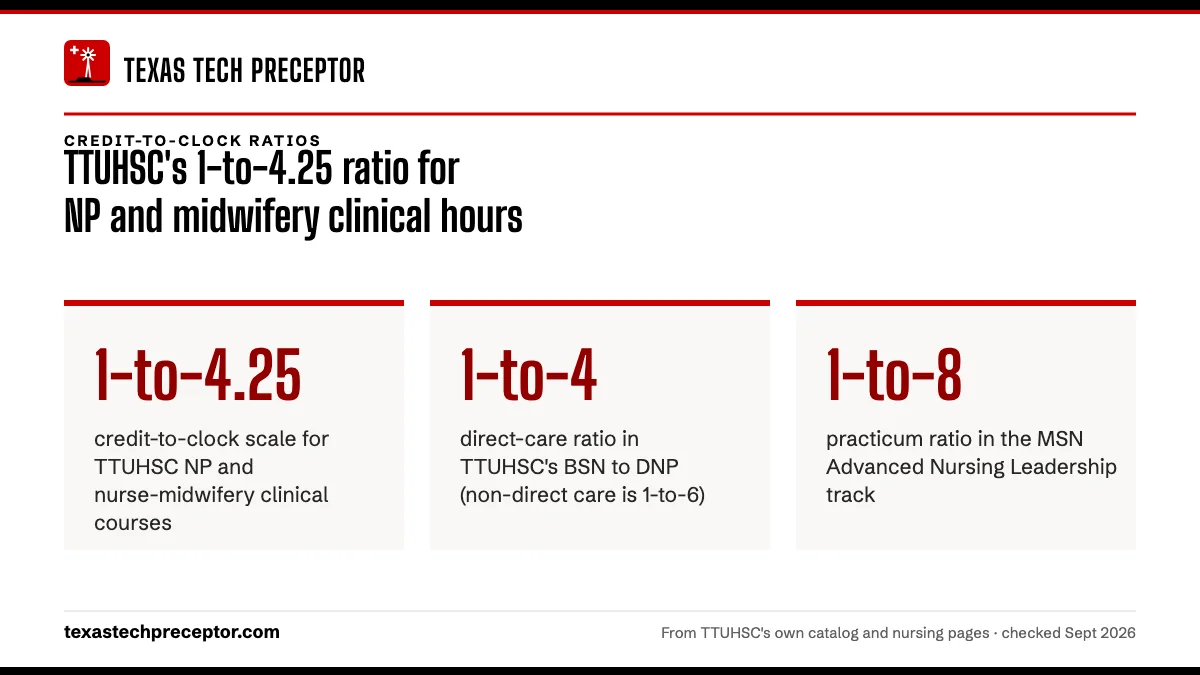
TTUHSC's 1-to-4.25 ratio for NP and midwifery clinical hours
TTUHSC's 2026-27 catalog sets a 1-to-4.25 credit-to-clock scale for nurse practitioner and nurse-midwifery clinical courses, with each track switching over in Summer or Fall 2026. Other programs run on their own ratios, from one-to-three in Education and Informatics to one-to-eight in Leadership. Here is what each ratio covers, where TTUHSC's pages still disagree, and how to turn a ratio into a preceptor's calendar.
Get your placement plan
Tell us your TTUHSC program and where you live. A placement advisor replies with the preceptor and site options that fit your TTUHSC course.
What TTUHSC's catalog says
The ratio lives in the MSN section of TTUHSC's 2026-27 Academic Catalog, the edition TTUHSC treats as the official academic record from May 1 to April 30. The wording is short: "For nurse practitioner and nurse-midwifery clinical courses, clinical hours are measured on a 1-to-4.25 scale."
A note beside it sets the timing: "Beginning in Summer or Fall 2026, depending on track, clinical hours in nurse practitioner and nurse midwifery clinical courses will be measured on a one-to-4.25 basis." The catalog does not say which tracks switch in summer and which in fall. If your first clinical course falls in 2026, or you began under an earlier plan, your course faculty or program director can tell you which scale your section follows.
The scale reaches the clinical courses of every MSN NP track (Family, Adult-Gerontology Acute Care, Pediatric Primary Care, Pediatric Acute Care and Psychiatric Mental Health) and of Nurse-Midwifery. On TTUHSC's plans those courses carry the (CL) mark, meaning you enroll in a clinical section alongside the lecture.
Every ratio in TTUHSC's catalog
TTUHSC sets a separate credit-to-clock ratio for each kind of clinical or practicum work. The table lists them as the 2026-27 catalog states them.
| Program or course type | Ratio | How the catalog puts it |
|---|---|---|
| MSN nurse practitioner and nurse-midwifery clinical courses | 1 to 4.25 | A 1-to-4.25 scale, phased in from Summer or Fall 2026 |
| BSN to DNP (FNP and PMHNP), direct care | 1 to 4 | Direct care on a one-to-four basis |
| BSN to DNP, non-direct care | 1 to 6 | Non-direct care on a 1:6 basis |
| Post-Master's DNP practicums | 1 to 6 | Practicum hours on a one-to-six basis |
| MSN Nursing Education and Nursing Informatics | 1 to 3 | A one-to-three basis |
| MSN Advanced Nursing Leadership | 1 to 8 | A one-to-eight basis |
| Traditional, Accelerated and RN to BSN | 1 to 3 | A one-to-three basis |
A single credit therefore stands for very different amounts of clinic time depending on the program. That is how a two-credit Leadership practicum comes to about eight hours a week at a practice site, while a BSN clinical credit asks for far less.
How the ratio shows up on your plan
TTUHSC's program pages print each course with a three-number key. By TTUHSC's own legend, the first number is credit hours, the second is lecture hours per week and the third is clinical hours per week, and a (CL) course requires concurrent enrollment in a clinical section. The ratio is what links a course's clinical credits to that weekly figure.
TTUHSC's Leadership courses show the link in plain numbers. Each Advanced Nursing Leadership practicum prints as two credits, one lecture hour and eight practicum hours a week, and the catalog describes 128 practicum hours spread over 16 weeks, roughly eight a week. NP and midwifery courses follow the same logic on the 4.25 scale, with weekly figures that rise as a track moves from its first clinical course toward its practicum.
One caution: the key is not used the same way on every page. On both PMHNP plans, MSN and BSN to DNP alike, the third number sits beside a stated hour total and does not behave like a weekly figure. Where TTUHSC prints an hour total for a course, plan by the total.
The 2026 switch and the conflicts it leaves
Because the new scale arrives track by track, TTUHSC's pages do not all show matching numbers yet. Three gaps stand out.
- For the four AGACNP clinical courses, the weekly clinical figures on the MSN page do not match those on the post-graduate certificate page.
- The MSN Nurse-Midwifery web page gives practicum hours that differ from the figures in the catalog's course descriptions for the same practicum levels.
- The MSN page on TTUHSC's separate School of Nursing catalog site (app4.ttuhsc.edu) still says NP and midwifery clinical hours are measured "on a one-to-3.5 basis."
The staggered rollout is a likely reason for all three, though TTUHSC has not said so. The 2026-27 Academic Catalog is the plan TTUHSC calls official; for the hours your own section requires, the syllabus and your course faculty decide. Get that number before a preceptor commits to a schedule. The clinical hours hub shows which programs state totals at all.
Ratios outside the MSN NP tracks
The BSN to DNP runs two ratios at once: four clock hours per credit for direct patient care and six for non-direct work. TTUHSC's public pages do not list which activities fall on each side. The 1,080-hour BSN to DNP page shows how those hours spread across six clinical courses.
The Post-Master's DNP measures practicum hours one-to-six toward its 500-hour minimum; most of its clinical sections carry a few practice hours a week, with the heaviest load in the final practice immersion. Education and Informatics use one-to-three, and the Informatics practicum runs in a virtual environment with faculty rather than at an outside site. BSN programs also use one-to-three, with clinical placement decided by TTUHSC faculty. For what each program lets you count, see what counts as clinical hours.
Turning weekly hours into a preceptor schedule
A ratio becomes real when it meets a clinic calendar. By the dates on the 2026-27 SON calendar, the fall and spring terms last roughly 15 weeks apiece, with a shorter summer, with holidays such as Thanksgiving inside the term. A preceptor who works fewer days than your weekly figure needs, or who takes a long break mid-term, leaves a gap that is hard to close in the final weeks.
That is exactly where our search begins. We read the weekly clinical hours on your TTUHSC course, then look for preceptors near home whose clinic days cover them for the whole term, at a facility ready for SON approval. When one preceptor's schedule falls short, we pair a second, and each gets an electronic preceptor agreement for the semester. TTUHSC approves every preceptor and facility; the packet that reaches its staff from us is complete and matched to the course. Tell us your track and term in the form below.
Questions TTUHSC students ask
What does 1-to-4.25 mean for TTUHSC clinical hours?
It is the credit-to-clock scale TTUHSC's catalog sets for nurse practitioner and nurse-midwifery clinical courses. It ties each clinical credit to a fixed amount of clock time, which appears on your program plan as weekly clinical hours. Your syllabus turns it into the exact number you owe each week.
When does the 1-to-4.25 ratio start for my TTUHSC track?
The catalog says Summer or Fall 2026, depending on track, without listing the start term for each one. If your first clinical course falls in 2026 or you started under an older plan, ask your course faculty or program director which scale your section uses before you set a schedule with a preceptor.
Does TTUHSC's BSN to DNP use the 1-to-4.25 ratio?
No. The catalog gives the BSN to DNP two ratios of its own: four clock hours per credit for direct care and six for non-direct care. The program states its total separately as a minimum of 1,080 clinical hours, with per-course hours published for the PMHNP track only.
Do post-graduate certificate courses use the same ratio?
The catalog states the scale for NP and nurse-midwifery clinical courses, and certificate students take clinical courses in those same populations. The certificate pages print their own weekly figures, though, and for AGACNP they differ from the MSN page. Every certificate plan is individualized, so the program director confirms the hours that apply to you.
Why does my syllabus show different hours from the program page?
TTUHSC calls its web plans an unofficial copy and points to the catalog, and the scale change is still rolling in by track. The syllabus for your section is the working document for the term. If it differs from what you planned around, raise it with course faculty in the first week.
Related pages
Last checked 2026-09-26
We check these pages against TTUHSC's catalog, Student Handbook, program pages and licensure disclosures. Your course faculty, your program director and the plan of study for your cohort have the final word.
- TTUHSC 2026-27 Catalog: MSN, Family Nurse Practitioner Track (MSN credit-to-clock rules)
- TTUHSC 2026-27 Catalog: BSN to DNP, Family Nurse Practitioner Track
- TTUHSC 2026-27 Catalog: Post-Master's DNP
- TTUHSC 2026-27 Catalog: NURS 5211 Advanced Nursing Leadership in Practice: Practicum I
- TTUHSC School of Nursing Catalog 2026-27: MSN Program
Your TTUHSC preceptor search, run by specialists.
Tell us your TTUHSC track, your next clinical course and the town you'll train near. We find preceptors who fit the course and pull together what SON staff and faculty need to approve both the clinician and the facility, early enough for the electronic preceptor agreement to go through before the term.
- Preceptors matched to the track: family primary care, adult-gerontology acute care, pediatrics, psychiatric mental health
- License, certification and facility details ready for TTUHSC's preceptor and facility approval
- In Lubbock, Amarillo, Abilene, the Permian Basin, Dallas-Fort Worth and the states TTUHSC accepts
Start your placement plan
Your track, your town and your next clinical term is all we need to begin.