What counts as clinical hours at TTUHSC
At TTUHSC, NP clinical hours rest on a preceptor and a site that SON staff and faculty have each signed off on, under an electronic preceptor agreement for that semester. Past that baseline the rules shift by program: the BSN to DNP separates direct from non-direct care, the Post-Master's DNP lists a wide range of practice activities, and some MSN practicums are projects or fully virtual. Where TTUHSC's public pages stop, your syllabus and course faculty decide.
Get your placement plan
Tell us your TTUHSC program and where you live. A placement advisor replies with the preceptor and site options that fit your TTUHSC course.
The baseline for NP and midwifery hours
TTUHSC's graduate FAQ allows NP clinical hours in a student's home area, provided two sign-offs happen first: the preceptor and the site each need approval from SON staff and faculty. Add the electronic preceptor agreement, completed for every preceptor each semester, and you have the three pieces that sit under any hour you log in an NP clinical course.
The practical rule that follows is to have both approvals and the term's agreement settled before your first day at a site. Each preceptor needs an agreement and each facility needs approval, so check with course faculty before you add a second location or a new preceptor partway through a term.
Nurse-midwifery adds its own layer. Midwifery population-focus hours take place only at sites the Program Director has cleared, arranged with TTUHSC's preceptor and site coordinators. For who may supervise NP students under Texas rules, see preceptor requirements.
Approval does not roll forward on its own: the electronic preceptor agreement is completed again for every preceptor, every semester.
Direct and non-direct care in the BSN to DNP
The BSN to DNP is the one TTUHSC program that names two kinds of clinical hours. Hands-on patient care converts at one credit to four clock hours, while non-direct work converts at one to six, so a credit of non-direct time means a longer stretch on the clock. The catalog stops there: it does not define non-direct care or say which course activities fall under each heading.
In practice that means reading each syllabus for how the course divides its hours, and asking faculty before you log anything other than face-to-face patient care. Either way, the total for both tracks has to reach the program's 1,080-hour minimum, set out in the 1,080-hour breakdown.
The MSN catalog gives NP and midwifery clinical courses a single scale with no direct and non-direct split. For those courses, any activity beyond patient care with your approved preceptor is something to clear with course faculty first.
The DNP practice-hour list
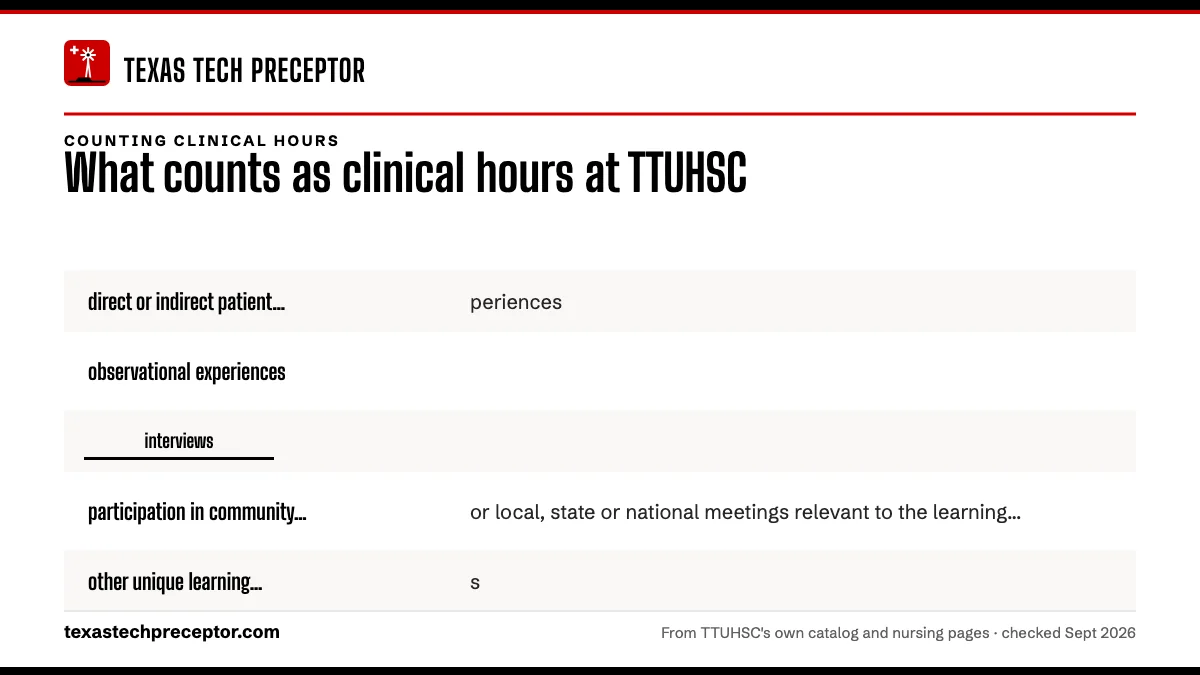
The widest definition TTUHSC publishes sits in the Post-Master's DNP catalog entry. Practice hours there may include:
- direct or indirect patient care experiences
- observational experiences
- interviews
- participation in community events or local, state or national meetings relevant to the learning objectives
- other unique learning opportunities
That entry also opens the door to practicums at a student's own job, as long as the work plainly serves the course's learning objectives, and it permits faculty-approved professional mentors in place of a classic preceptor, a role SON faculty can take on themselves. These rules belong to the Post-Master's DNP and its 500-hour minimum. They are not written for NP clinical courses, so an MSN or BSN to DNP student should confirm before counting an interview or a meeting. The workplace clinicals guide covers the employer question in full.
Practicums built around projects, teaching or virtual work
Three MSN tracks count practicum time that looks nothing like a clinic day.
- Advanced Nursing Leadership. Four practicums,
NURS 5211toNURS 5214, at about eight hours a week. Practicum II is built around a QI project that both the host organization and TTUHSC's QIRB sign off on, and Practicums III and IV are precepted. - Nursing Education.
NURS 6368, the Nurse Educator Immersive Teaching Practicum, pairs you with an approved preceptor, and the quality-improvement and simulation-teaching courses carry clinical sections of their own. - Nursing Informatics and Intelligent Systems. Faculty guide the practicum and it happens online from start to finish, with no outside site or preceptor to arrange.
For these tracks, the course defines what counts: project milestones, teaching sessions or virtual work, logged the way the syllabus asks. The leadership practicums guide covers all four Leadership courses.
Hours are the floor, not the finish line
TTUHSC's midwifery course descriptions say it outright: the listed hours may fall short of what competency takes. The same logic runs through every graduate clinical course, because clinical performance is scored pass or fail, and a fail sinks the whole course regardless of exam scores.
The handbook also lets faculty fail a student at any point in a semester for unsafe practice. So a complete log is necessary but not sufficient: your faculty's judgment of safe, competent practice decides whether the hours turn into a passed course. The grades and progression guide covers the clinical grade, and the PR grade for practicum work that runs past the term.
Questions to settle with course faculty
TTUHSC's public pages leave several counting questions to each course. Settle these early, ideally in writing, before a preceptor builds a schedule around you:
- Which tool or form you use to record hours, and how often. TTUHSC's public pages name no logging system.
- Whether on-campus skills labs, OSCEs or simulation time count toward the clinical requirement for your course.
- Whether hours at your own employer, or on your own unit, are allowed. The handbook limits this for undergraduates; no graduate NP rule is published.
- How hours are handled if the practicum runs past the last class day.
- For BSN to DNP students, which activities count as direct and which as non-direct care.
How we protect every hour you log
Most counting problems start before the first shift: a preceptor whose patients do not match the course population, a facility missing the details SON staff need, or an agreement filed late. Our placement work is built to head those off. We match you with a preceptor whose practice fits your TTUHSC course, confirm the facility's information for approval, and have everything the electronic preceptor agreement asks for ready well before the term.
If a preceptor has to step away, our placement desk starts the replacement search right away, keeping your hours on an approved footing. The approval itself stays with TTUHSC's staff and faculty, and the file they receive from us is complete and fitted to the course. Share your program and term in the form below.
Questions TTUHSC students ask
Does shadowing count as clinical hours at TTUHSC?
Only the Post-Master's DNP lists observational experiences among its practice hours. For NP clinical courses, TTUHSC's public pages describe hours with an approved preceptor at an approved facility and say nothing about shadowing, so check the syllabus and ask course faculty before counting any observation time.
Can a physician precept TTUHSC NP clinical hours?
Under the Texas Board of Nursing's rule for APRN programs, a preceptor may be an APRN or another licensed health professional able to teach and supervise at the advanced practice level, with written agreements linking school, preceptor and site. TTUHSC approves each preceptor and facility itself, so fit with your course matters as much as the license. See preceptor requirements.
Do extra clinical hours carry over to the next course?
TTUHSC's handbook offers a PR grade when course work extends past the semester, mostly in clinical and practicum courses, but it publishes no rule for moving hours from one course or term to another. Each clinical course carries its own requirement, so ask faculty before assuming extra hours will roll forward.
Can my RN job hours count as NP clinical hours?
No TTUHSC page lets RN work stand in for NP clinical hours, which are supervised practice in the advanced practice role under an approved preceptor. The Post-Master's DNP allows practicums at your employer when the experience meets course objectives, but that is a practicum rule for a different program.
Who decides whether my TTUHSC clinical hours count?
Your course faculty, working within the program's rules, with SON staff and faculty approving the preceptor and facility up front. Midwifery sites also need the Program Director's approval. When a question falls outside the catalog and your syllabus, the program director is the next person to ask.
Related pages
Last checked 2026-09-26
We check these pages against TTUHSC's catalog, Student Handbook, program pages and licensure disclosures. Your course faculty, your program director and the plan of study for your cohort have the final word.
Your TTUHSC preceptor search, run by specialists.
Tell us your TTUHSC track, your next clinical course and the town you'll train near. We find preceptors who fit the course and pull together what SON staff and faculty need to approve both the clinician and the facility, early enough for the electronic preceptor agreement to go through before the term.
- Preceptors matched to the track: family primary care, adult-gerontology acute care, pediatrics, psychiatric mental health
- License, certification and facility details ready for TTUHSC's preceptor and facility approval
- In Lubbock, Amarillo, Abilene, the Permian Basin, Dallas-Fort Worth and the states TTUHSC accepts
Start your placement plan
Your track, your town and your next clinical term is all we need to begin.