The TTUHSC electronic preceptor agreement
For each preceptor you work with, in each semester you work with them, TTUHSC requires you to complete an electronic preceptor agreement. It is simple to describe and easy to underestimate: one agreement covers one preceptor for one term, and it sits beside, not in place of, approval of your preceptor and facility.
Get your placement plan
Tell us your TTUHSC program and where you live. A placement advisor replies with the preceptor and site options that fit your TTUHSC course.
What TTUHSC requires
According to TTUHSC's graduate FAQ, students go through an electronic agreement for every preceptor they use, every semester. That wording sets two counting rules. The agreement is per preceptor, so a term split between two clinicians means two agreements. It is also per semester, so a preceptor you keep from fall into spring needs a fresh agreement for spring.
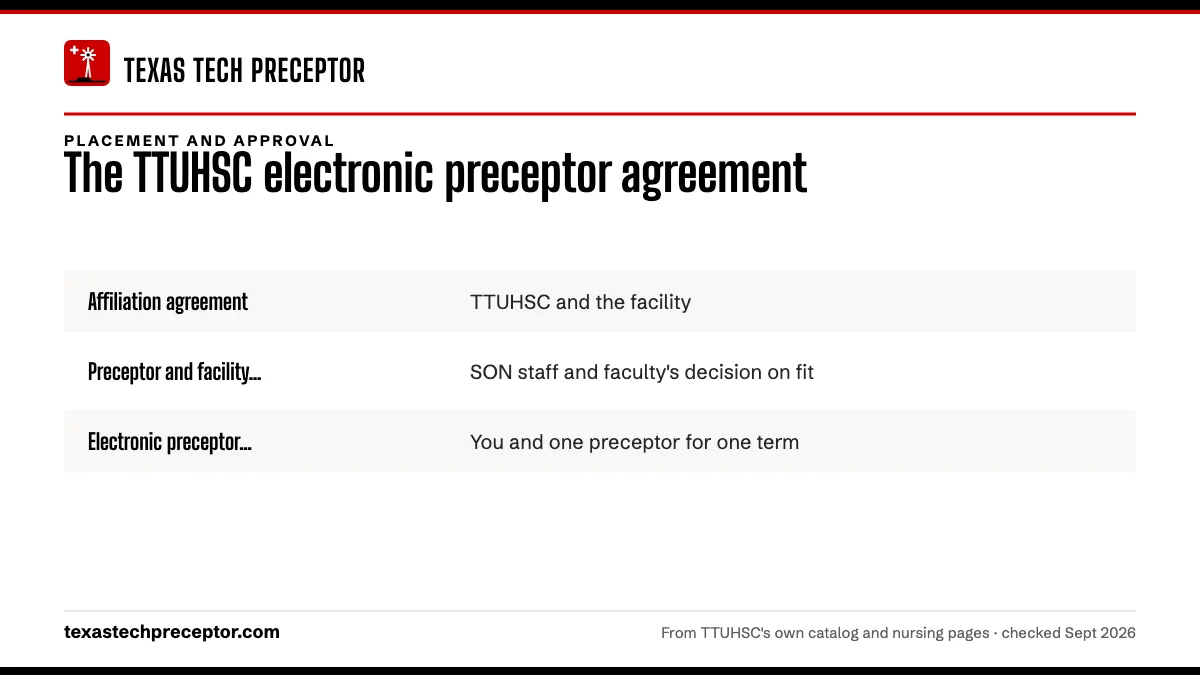
Completing it is the student's task. Approval of the preceptor and of the facility by SON staff and faculty is a separate requirement, and a facility may also need an affiliation agreement with TTUHSC. It helps to see the three as layers: facility, person, term.
| Layer | Who it binds | How often |
|---|---|---|
| Affiliation agreement | TTUHSC and the facility | Stays in force until it lapses or is renewed; timeline not published |
| Preceptor and facility approval | SON staff and faculty's decision on fit | Whenever you propose a preceptor or site |
| Electronic preceptor agreement | You and one preceptor for one term | Every semester, for every preceptor |
The Texas rule behind written agreements
The agreement fits a Texas Board of Nursing requirement. Rule 22 TAC §219.10, which covers clinical learning experiences in APRN programs, requires the program, the clinical preceptor and the affiliating facility to put their functions and responsibilities in a written agreement. The same rule keeps the designated faculty member responsible for the student and in regular contact with preceptor and student alike.
TTUHSC's pages do not cite the rule by number, and the form's fields are not public. What the rule does explain is why the agreement names a specific person for a specific term: responsibilities attach to that preceptor, and faculty oversight attaches to that course. When either one changes, the paperwork changes with it.
What to gather before you start
Because the form sits inside TTUHSC's own systems, the list below is built from what approval and the Texas rule depend on. Having it in hand keeps the agreement from stalling on a missing detail.
- The preceptor's full name, credentials and license details, including the state that issued the license
- Any national certification the preceptor holds and the population it covers
- The practice or facility name and address, and the clinic or unit where you will train
- Whether that facility already has an affiliation agreement with TTUHSC
- Your course number and title for the term, exactly as TTUHSC prints them
- The start and end dates and weekly schedule you and the preceptor have settled on
- A reliable way to reach the preceptor, in case the process asks for their confirmation
Anything the current form adds beyond this, course faculty or the Graduate Coordinator will know. The licensing side is covered on preceptor requirements.
Timing it around the semester
TTUHSC does not publish a deadline for graduate preceptor agreements, so aim to have yours complete before the term's first class day. For 2026-27, fall classes open September 8, spring on January 11 and summer on May 24. Clinical hours need an approved preceptor and facility behind them, so the start of term is the practical line.
Graduate clinical courses run the full semester, and summer carries clinical work too, including BSN to DNP and nurse-midwifery practicums. If your plan puts clinical courses in back-to-back terms, you will complete agreements several times in one year, even when the preceptor stays the same. The academic calendar guide has the add, drop and end-of-term dates that frame each round.
When a preceptor changes mid-term
Plans shift. A preceptor may change jobs, cut clinic days or step back partway through a semester. Because the agreement is tied to the person, a replacement means a new agreement for the new preceptor, plus approval of that preceptor and facility if they are new to you.
TTUHSC does not publish a graduate procedure for a site that falls through, so tell your course faculty the day it happens and ask what they need. The backup preceptors guide covers how to keep a second option ready. When practicum work stretches beyond a term, the Student Handbook's PR (In Progress) grade is the one used mainly for clinical and practicum courses, and your faculty decide whether it applies.
How the undergraduate version compares
The only TTUHSC agreement steps in public view belong to the undergraduate side. SON OP 30.725, a 2009 School of Nursing policy for Traditional BSN preceptors, describes an online Preceptor Letter of Agreement that the preceptor completes. Office staff then check the preceptor's RN license on the Texas Board of Nursing site, and the Department Chair signs.
The graduate process may run differently, and TTUHSC's public pages neither name its system nor post a link. For the current tool and its steps, ask your course faculty or the Graduate Coordinator, and read the orientation material in your D2L course at the start of term. Be wary of vendor names you see mentioned online, since none is confirmed on an official TTUHSC page.
Agreement-ready from day one with us
The agreement moves fastest when every detail is already in hand, and that is how we deliver a placement. Along with a preceptor and site that fit your TTUHSC course, our placement desk gives you a verified license and certification record for the preceptor, a short profile of the practice, the facility's details and its contract standing with TTUHSC, and the specifics the electronic agreement asks for.
When the next term comes, we check that your preceptor is still available and refresh those details before the new agreement is due. TTUHSC's staff and faculty hold the approval; our part is making sure what they review is whole, accurate and built to TTUHSC's rules from the outset. Tell us your course and term in the form below.
Questions TTUHSC students ask
What is TTUHSC's electronic preceptor agreement system called?
TTUHSC's public pages describe it only as an electronic preceptor agreement process and do not name the system behind it. Ask your course faculty or the Graduate Coordinator for the current link, and check your course's orientation material in D2L at the start of term.
Does my preceptor have to sign the agreement?
TTUHSC does not publish the graduate form's steps, so confirm with course faculty. Texas rules call for written agreements among the program, preceptor and facility, and TTUHSC's undergraduate policy has the preceptor complete the letter of agreement online, so expect your preceptor to take part in some form.
Can I start clinical hours before the agreement is done?
Plan on waiting. TTUHSC requires approval of the preceptor and facility and a completed agreement for every preceptor each semester, and hours are only as solid as the approvals behind them. If the term is close and something is pending, tell your course faculty rather than starting early.
Do I need an agreement for a short rotation with a second clinician?
TTUHSC's wording covers every preceptor you use each semester and names no exception for short experiences. If your course includes a brief stint with another clinician, ask your course faculty how to handle the paperwork before that day arrives, since that clinician may need approval as well.
Is the preceptor agreement the same as an affiliation agreement?
No. An affiliation agreement is a contract between TTUHSC and the facility, handled by the SON's affiliation agreements staff. The electronic preceptor agreement is yours to complete for each preceptor each term. A placement at a new facility may need both. See affiliation agreements.
Related pages
Last checked 2026-09-26
We check these pages against TTUHSC's catalog, Student Handbook, program pages and licensure disclosures. Your course faculty, your program director and the plan of study for your cohort have the final word.
Your TTUHSC preceptor search, run by specialists.
Tell us your TTUHSC track, your next clinical course and the town you'll train near. We find preceptors who fit the course and pull together what SON staff and faculty need to approve both the clinician and the facility, early enough for the electronic preceptor agreement to go through before the term.
- Preceptors matched to the track: family primary care, adult-gerontology acute care, pediatrics, psychiatric mental health
- License, certification and facility details ready for TTUHSC's preceptor and facility approval
- In Lubbock, Amarillo, Abilene, the Permian Basin, Dallas-Fort Worth and the states TTUHSC accepts
Start your placement plan
Your track, your town and your next clinical term is all we need to begin.