TTUHSC's PMHNP clinical rotations: what the website and catalog each say
TTUHSC's MSN Psychiatric Mental Health NP website plan lays out three precepted rotations: children and adolescents, then adults, then complex psychiatric patients across the lifespan. The 2026-27 catalog, by contrast, names other clinical courses and other hour figures. Below are both versions side by side, how to settle which one applies to you, and when the search for each rotation should begin.
Get your placement plan
Tell us your TTUHSC program and where you live. A placement advisor replies with the preceptor and site options that fit your TTUHSC course.
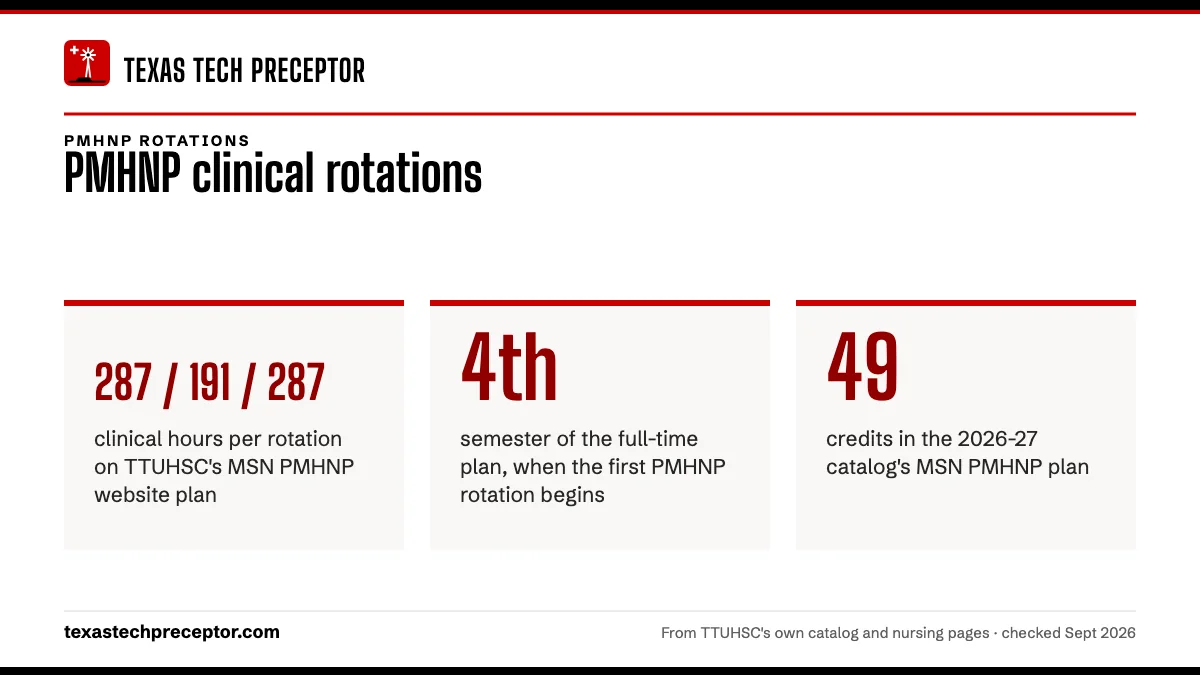
The three rotations on TTUHSC's website plan
The ttuhsc.edu PMHNP page prints a full-time plan of six semesters from a Spring start and a part-time plan of nine. Clinical work fills the last three semesters of either plan, one population per term, each with the clinical hours the website states.
| Rotation focus | Course on the website plan | Clinical hours (website) | Semester: full-time / part-time |
|---|---|---|---|
| Children and adolescents | NURS 5704 | 287 | 4 (Spring) / 7 (Spring) |
| Adults | NURS 5703 | 191 | 5 (Summer) / 8 (Summer) |
| Complex psychiatric patients across the lifespan | NURS 6600 | 287 | 6 (Fall) / 9 (Fall) |
Each website course title opens with Diagnostics & Management and names its population, and the final one centers on interprofessional collaboration. The plan also prints a credit triple beside each course, but its third number there is clinical credit rather than weekly hours, so read the stated clinical hours instead. These are the website's figures; the catalog tells a different story.
What the 2026-27 catalog prints instead
The catalog, which TTUHSC treats as the official record for program plans, lists 49 credits for the MSN PMHNP but a different population-focus block. It names NURS 6500, a course on interprofessional management of complex psychiatric patients across the lifespan, at 157.5 clinical hours, and NURS 5120 Specialty Practice for the PMHNP at 52.5 clinical hours.
Around those two sit five 2-credit courses: NURS 5203 Neuroscience and Epigenetics, NURS 5204 Psychopharmacology, NURS 5207 on advanced mental health assessment across the lifespan, NURS 5202 Psychotherapeutic Modalities and NURS 5201 Telehealth and Rural Service Delivery.
The block itself looks unfinished. The catalog labels it 28 credit hours, yet the courses printed beneath it come to far fewer by their course numbers. The core lists differ too: the website includes NURS 5329, while the catalog includes NURS 5352. The catalog's post-graduate PMHNP certificates use the same NURS 5120 and NURS 6500.
Website versus catalog: a conflict to settle before you search
Neither source is safe to plan from alone. The catalog is TTUHSC's stated official plan, but its PMHNP block appears incomplete. The website plan is complete and specific, yet TTUHSC calls its web plans an unofficial facsimile and points students back to the catalog. Only the complex-patient course appears in both, under different numbers and different hours.
Settle it with the people who decide. Take the question to the program director, who leads advising for TTUHSC's MSN NP tracks, and to the Graduate Enrolled Student Advisor for anything about registration. Your rotations should follow the written plan TTUHSC gives you at orientation, with course faculty confirming each rotation's hours in the syllabus.
Until then, describe your needs to a prospective preceptor as PMHNP clinical rotations with a population focus, rather than a fixed course number and hour count, so a practice's yes still holds whichever version your plan uses.
Confirm your PMHNP course numbers and hours with your program director before you quote either version to a preceptor.
When each rotation begins, and when to start looking
The MSN PMHNP admits students once a year, for Spring. On the full-time website plan the first rotation arrives in semester 4, the second Spring, roughly a year after you start; part-time students reach it three semesters later, in semester 7. The adult rotation follows in Summer and the complex-patient rotation in Fall, so three consecutive terms each need an approved preceptor.
Summer is the tightest of the three. The 2026-27 SON calendar runs Summer 2027 from May 24 to Aug. 13, a shorter window than fall or spring, and the adult rotation lands there, so secure that preceptor well ahead. The first clinical course guide compares start points across programs, and the academic calendar guide holds the term dates.
Finding preceptors for three different populations
Each rotation points toward a different kind of practice: one that treats children and adolescents, one centered on adults, and one where you can join interprofessional care for complex patients of all ages. TTUHSC's program listing says PMHNP students complete their required hours close to home, with preceptors TTUHSC has approved, and the School of Nursing's staff and faculty must sign off on the clinician and the practice alike.
Texas's rule for APRN programs, 22 TAC §219.10, opens precepting to APRNs and to other licensed clinicians whose training lets them teach and supervise at the advanced practice level. TTUHSC's own graduate criteria for preceptors are unpublished, so course faculty weigh each candidate; the preceptor requirements guide explains the rule. Each preceptor also needs a fresh electronic preceptor agreement every semester.
Access shapes the search. HRSA's mid-2026 tally put 412 mental health professional shortage designations on the Texas map, a sign of how thinly psychiatric clinicians are spread in many communities.
Where the other PMHNP paths differ
Post-graduate PMHNP certificate students follow individualized plans. The catalog gives them NURS 5120 and NURS 6500, while the website asks them to contact the School of Nursing about the curriculum. Catalog credit totals run from 28 for current APRNs to 40 for nurses who are not yet APRNs. The post-graduate certificates guide covers those plans.
BSN to DNP PMHNP students work through a longer version of the same arc under their own course numbers. They start in Summer, reach NURS 6604 for children and adolescents in the sixth semester, then move to NURS 6603 for adults and NURS 7500 for complex psychiatric patients before the DNP Advanced Practicums, all detailed in the BSN to DNP PMHNP guide. Admission, the Spring-only start and the rest of the MSN plan are in the MSN PMHNP program guide.
Why TTUHSC PMHNP students choose us
We plan your three rotations as one connected search, starting from the plan of study your program director confirms. Your placement advisor looks near home for child and adolescent, adult and complex-care preceptors who fit each rotation, and times every request to the term it serves, with the short summer term planned well in advance.
Each semester's paperwork is ready before the term opens: the mental health clinician's license and certification, what their practice looks like day to day, the practice's details and its agreement standing with TTUHSC, and every entry the electronic agreement expects. Approval belongs to TTUHSC's staff and faculty, and we hand them a file that is whole and squarely inside TTUHSC's rules on the first submission. If a preceptor drops, a new search starts right away. Share your Spring start year through the form below.
Questions TTUHSC students ask
Which is right for TTUHSC PMHNP clinicals, the catalog or the website?
Neither settles it alone. The catalog carries official weight, yet its PMHNP block looks incomplete, and the website plan is detailed but carries an unofficial label. Your program director, together with the written plan TTUHSC issues at orientation, decides which courses and hours apply to you, and course faculty confirm the hours in each syllabus.
How many clinical hours is each TTUHSC PMHNP rotation?
The website plan lists 287 hours for children and adolescents, 191 for adults and 287 for complex psychiatric patients across the lifespan. The catalog lists different courses instead: NURS 6500 at 157.5 hours and NURS 5120 at 52.5. Confirm the figure for your own rotation with course faculty before you commit a preceptor to it.
When does the first TTUHSC MSN PMHNP rotation start?
On the website's full-time plan, in semester 4, the second Spring after a Spring start, so about a year in. On the part-time plan it starts in semester 7. Begin the search for a child and adolescent preceptor well before then, since the adult and complex-patient rotations follow in the next two terms.
Who can precept a TTUHSC PMHNP student?
The Texas Board of Nursing rule is broad: an APRN, or another licensed clinician qualified to supervise at the advanced practice level, may precept. TTUHSC adds its own review of every clinician and practice but has not posted graduate preceptor criteria, so run a specific name past course faculty before asking that clinician to commit.
Do the MSN PMHNP rotations match the BSN to DNP PMHNP?
Not exactly. The BSN to DNP PMHNP covers the same three populations under its own course numbers, at 180 hours for children and adolescents, 180 for adults and 240 for complex psychiatric patients, and then adds DNP Advanced Practicums I to III. The MSN website plan uses NURS 5704, NURS 5703 and NURS 6600 instead.
Related pages
Last checked 2026-09-26
We check these pages against TTUHSC's catalog, Student Handbook, program pages and licensure disclosures. Your course faculty, your program director and the plan of study for your cohort have the final word.
Your TTUHSC preceptor search, run by specialists.
Tell us your TTUHSC track, your next clinical course and the town you'll train near. We find preceptors who fit the course and pull together what SON staff and faculty need to approve both the clinician and the facility, early enough for the electronic preceptor agreement to go through before the term.
- Preceptors matched to the track: family primary care, adult-gerontology acute care, pediatrics, psychiatric mental health
- License, certification and facility details ready for TTUHSC's preceptor and facility approval
- In Lubbock, Amarillo, Abilene, the Permian Basin, Dallas-Fort Worth and the states TTUHSC accepts
Start your placement plan
Your track, your town and your next clinical term is all we need to begin.