The 1,080 clinical hours in TTUHSC's BSN to DNP
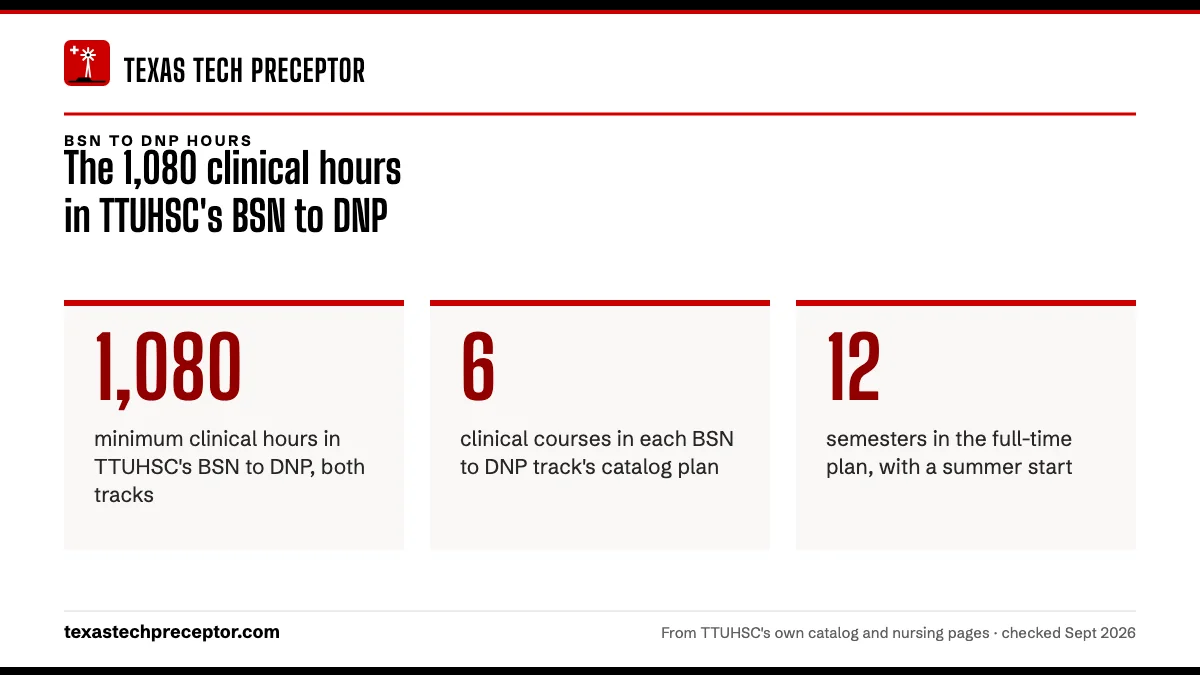
Both BSN to DNP tracks at TTUHSC, Family NP and Psychiatric Mental Health NP, set a floor of 1,080 clinical hours. The PMHNP plan spells those hours out course by course; the FNP plan names its clinical courses but not their hours. This guide lays out both sequences, the one-to-four and one-to-six split, and what the numbers mean for finding preceptors across a four-year program.
Get your placement plan
Tell us your TTUHSC program and where you live. A placement advisor replies with the preceptor and site options that fit your TTUHSC course.
Where the 1,080 comes from
The FNP program page puts it plainly: "You will have a minimum of 1,080 hours in the clinical setting." The PMHNP page advertises "1,080+ clinical hours," and the catalog's PMHNP plan prints hours beside each clinical course that add up to exactly that figure. In both tracks, 1,080 is a floor rather than a target.
The catalog also measures BSN to DNP clinical time differently from the MSN: "one-to-four basis for direct care and 1:6 basis for non-direct care." A credit of non-direct work therefore asks for more clock time than a credit of hands-on patient care. TTUHSC's public pages do not say which activities in which courses fall on each side, so the syllabus for each course and its faculty settle the split.
TTUHSC's first BSN to DNP cohort, with both tracks, started in 2018, and the program now runs as a summer-start, twelve-semester plan in both specialties.
PMHNP: the hours course by course
The PMHNP track is the only BSN to DNP route where TTUHSC prints hours for each course. The catalog plan places all six clinical courses in the second half of the program:
| Semester | Course | Focus | Clinical hours |
|---|---|---|---|
| VI, Spring | NURS 6604 | Diagnostics and Management III: Children and Adolescents | 180 |
| VII, Summer | NURS 6603 | Diagnostics and Management II: Adults | 180 |
| VIII, Fall | NURS 7500 | Diagnostics and Management IV: Complex Psychiatric Patients | 240 |
| X, Summer | NURS 7450 | DNP Advanced Practicum I | 120 |
| XI, Fall | NURS 7451 | DNP Advanced Practicum II | 180 |
| XII, Spring | NURS 7452 | DNP Advanced Practicum III | 180 |
Semester IX, a spring with no clinical course, sits between the diagnostics sequence and the advanced practicums. It is the natural window to secure the preceptor for NURS 7450, since that practicum lands in a summer term. The plan also attaches an OSCE to each advanced practicum and a telehealth OSCE to the adult course. The BSN to DNP PMHNP guide covers the rest of that plan.
FNP: named courses, hours not published
The FNP track's catalog plan names six clinical courses and prints hours for none of them. The primary care run starts in semester VII with NURS 6439 Primary Health Care I, continues in the fall with NURS 6541 Primary Care II and closes in semester IX with NURS 7660, the FNP Practicum. The three DNP Advanced Practicums, NURS 7450, NURS 7451 and NURS 7452, then fill semesters X through XII, the same course numbers the PMHNP track uses.
ACLS must be current for NURS 6541 and NURS 7660. The FNP web plan and catalog plan also differ: the web version adds several courses and shows the FNP Practicum as a one-credit course next to a rural health and telehealth course, while the catalog lists fewer courses under the same semester totals. The catalog is TTUHSC's official plan, and the BSN to DNP FNP guide walks through the differences.
The timeline across twelve semesters
Both tracks admit in summer only and run twelve semesters over four years, using fall, spring and summer every year. For PMHNP the first clinical course lands in semester VI, the spring of year two; for FNP it lands in semester VII, the summer of year three. The FNP track also has a three-year, nine-semester plan with program director approval, which pulls the clinical courses closer together.
Campus time runs alongside the clinical work. BSN to DNP students should expect a campus trip every semester, usually lasting a day or two; Lubbock hosts most intensives, with some held in Austin and Dallas. On-campus intensives and OSCEs explains the pattern, and the first clinical course guide compares this timeline with the MSN tracks.
Finding preceptors for 1,080 hours
TTUHSC's BSN to DNP pages answer the preceptor question directly: the search is yours, backed by faculty and a preceptor team who help with choosing and contracting. Every preceptor and site still goes through SON approval, and each preceptor needs a new electronic preceptor agreement each semester, so a six-course sequence can mean six or more agreements across the last two years or more of the program.
The populations change as you move through the plan. PMHNP students need a child and adolescent psychiatric setting, then adult psychiatric care, then complex patients across the lifespan. FNP students move from primary care into a family practicum before the advanced practicums. One preceptor seldom covers all of it.
The PMHNP page describes clinicals as done locally with approved preceptors, so the search centers on wherever you live in Texas or an accepted state. TTUHSC's licensure disclosure adds South Dakota to the states the BSN to DNP cannot take students from; check the licensure disclosure before planning a rotation outside Texas.
Why BSN to DNP students plan with us
A four-year program with six clinical courses rewards early planning, and that is how we work. We map your whole clinical sequence against TTUHSC's plan, then search near home for preceptors who fit each course's population, a term ahead of when you need them. For every preceptor we gather the license, certification and practice details the electronic preceptor agreement asks for, along with the facility details SON staff review.
When a preceptor can stay on for a second course, we confirm it early; when the next course needs a new specialty, that search is already moving. If anyone drops mid-term, the placement desk goes to work on a replacement so your count toward 1,080 does not stall. Faculty and the preceptor team approve and contract each placement, and what we send their way is complete and built around TTUHSC's rules from the start. Use the form below to share your track and cohort year.
Questions TTUHSC students ask
Is 1,080 hours the most I will log in TTUHSC's BSN to DNP?
TTUHSC calls 1,080 a minimum, and the PMHNP page lists 1,080-plus. Your log can run past it if a course or a preceptor's schedule adds time, and course faculty decide when each clinical portion is complete. Treat 1,080 as the floor you plan around, not a ceiling.
How many clinical hours are in each FNP course of the BSN to DNP?
TTUHSC does not print per-course hours for the FNP track, only the 1,080-hour program minimum and the names of its clinical courses. Ask course faculty for each course's requirement when the syllabus opens, and plan your preceptor's schedule from that figure rather than from the PMHNP track's published hours.
Can I finish TTUHSC's BSN to DNP in three years?
For FNP, a three-year, nine-semester plan exists alongside the standard twelve semesters, but it needs program director approval. TTUHSC's public PMHNP pages describe only the four-year plan. A faster plan packs the clinical courses closer together, so each preceptor needs to be secured sooner.
Do the DNP Advanced Practicum hours count toward the 1,080?
In the PMHNP catalog plan, yes: NURS 7450, NURS 7451 and NURS 7452 carry clinical hours in the list that makes up the 1,080. For FNP students the advanced practicums are clinical courses too, but with no published per-course hours, so ask course faculty how each one counts toward your total.
What is non-direct care in TTUHSC's BSN to DNP?
TTUHSC's catalog uses the term for clinical hours measured one-to-six, as opposed to direct patient care at one-to-four, but its public pages do not define it course by course. Each syllabus sets the split. The counting rules for clinical hours page covers the practice activities TTUHSC lists for its DNP practicums.
Related pages
Last checked 2026-09-26
We check these pages against TTUHSC's catalog, Student Handbook, program pages and licensure disclosures. Your course faculty, your program director and the plan of study for your cohort have the final word.
Your TTUHSC preceptor search, run by specialists.
Tell us your TTUHSC track, your next clinical course and the town you'll train near. We find preceptors who fit the course and pull together what SON staff and faculty need to approve both the clinician and the facility, early enough for the electronic preceptor agreement to go through before the term.
- Preceptors matched to the track: family primary care, adult-gerontology acute care, pediatrics, psychiatric mental health
- License, certification and facility details ready for TTUHSC's preceptor and facility approval
- In Lubbock, Amarillo, Abilene, the Permian Basin, Dallas-Fort Worth and the states TTUHSC accepts
Start your placement plan
Your track, your town and your next clinical term is all we need to begin.