Home-area clinicals for TTUHSC nursing students
TTUHSC's online graduate programs let you complete clinical hours where you live, whether that is Lubbock, a Permian Basin town, a Dallas suburb or another state TTUHSC accepts students from. Home area is not a blank check: the School of Nursing still has to sign off on both your preceptor and the site, and most NP plans keep a few set days on campus.
Get your placement plan
Tell us your TTUHSC program and where you live. A placement advisor replies with the preceptor and site options that fit your TTUHSC course.
What TTUHSC says about clinicals near home
TTUHSC states the home-area idea in several places. The graduate FAQ allows clinical hours near where a student lives, provided the school's staff and faculty clear both the person precepting and the facility. The School of Nursing programs page places MSN PMHNP clinical hours where the student lives, with preceptors the school has approved, and the BSN to DNP PMHNP page speaks of clinicals done locally.
An archived master's and post-graduate page went furthest, placing clinicals "in or near the student's home community." Read together, the message is consistent: you train near home, and approval travels with you. Nurse-Midwifery is the exception, since its locations are coordinated with faculty and approved by the Program Director.
Home area, with campus days built in
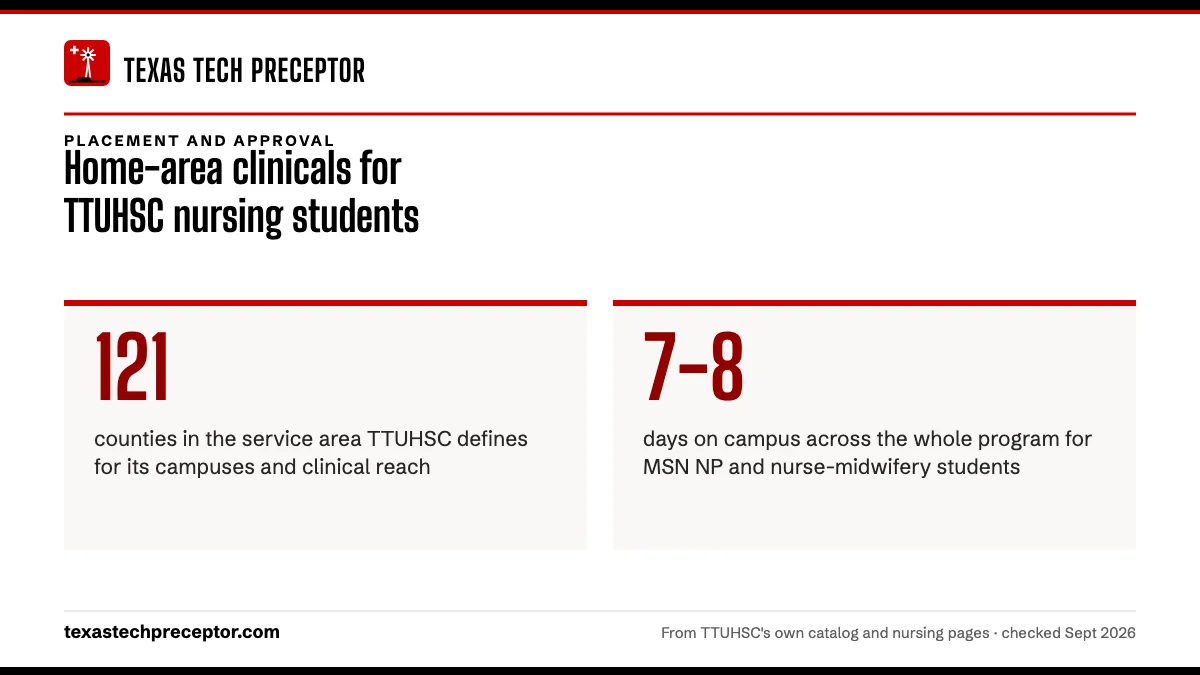
Clinicals near home sit alongside required campus time. MSN NP and nurse-midwifery students spend seven to eight days on campus over the full program, with OSCEs in Lubbock and dates announced a couple of months ahead. BSN to DNP students travel in once or more each semester, one or two days per visit, for intensives split among Lubbock, Austin and Dallas. Post-Master's DNP intensives run twice a semester and are anchored on the Lubbock campus.
Those trips are fixed points in your calendar. A preceptor schedule that leaves room for them avoids a clash mid-term, and telling your preceptor the dates early keeps goodwill intact. The on-campus intensives and OSCEs guide has the details by program.
Home area across Texas
TTUHSC's footprint runs from the Panhandle to North Texas. Lubbock, Abilene, Amarillo, Dallas/Mansfield and Odessa in the Permian Basin anchor a 121-county service area, and graduate students also live in Austin, San Antonio, Houston and towns far from any campus.
| Region | TTUHSC campus or site | An official detail worth knowing |
|---|---|---|
| Lubbock and the South Plains | Lubbock, the flagship campus, with the F. Marie Hall SimLife Center | Covenant Health's student page requires a school affiliation agreement and a preceptor the student secures |
| Abilene and the Big Country | Abilene campus, next to Hendrick Health | The School of Nursing runs a community health center in Abilene |
| Amarillo and the Panhandle | Amarillo campus, with School of Nursing instruction | Harrington Library serves TTUHSC students there |
| Midland, Odessa and the Permian Basin | Odessa campus and a Midland site | TTUHSC's Louise and Clay Wood Simulation Center sits inside Medical Center Hospital in Odessa |
| Dallas-Fort Worth | Dallas branch campus and the Mansfield instructional site | Some BSN to DNP intensives are held in Dallas |
| Austin, San Antonio and Houston | No graduate nursing campus | Some BSN to DNP intensives are held in Austin |
Regional guides go deeper, starting with Lubbock and rural West Texas.
Rural West Texas: distance and scarcity
Home area in rural West Texas can mean the nearest fitting preceptor is a long drive away. That comes from the map, not from TTUHSC's rules. Much of the state carries shortage-area designations, and a practice serving a wide area may already be hosting students from other programs.
HRSA's quarterly summary for mid-2026 counted 451 Texas primary care HPSA designations and 412 for mental health, a measure of how thin access is in many communities. The West Texas Area Health Education Center, a program of the F. Marie Hall Institute for Rural & Community Health at TTUHSC, focuses on building the rural health workforce. TTUHSC's pages do not describe a placement role for it in NP education, so treat it as context rather than a placement channel.
For a rural student, the practical answer is to widen the radius in steps and plan the drive into your week before you commit.
Home area outside Texas
TTUHSC accepts graduate students from many states, and those students complete clinicals where they live under the same approval of preceptor and facility. TTUHSC's professional licensure page flags ten states where the School of Nursing cannot take graduate students: the West Coast trio of California, Oregon and Washington; Arizona and Colorado; Arkansas, Louisiana and North Carolina in the South; and New York and Pennsylvania in the Northeast. South Dakota joins that list for BSN to DNP, and the tables show Kansas falling short of requirements for both Nurse-Midwifery and BSN to DNP.
Each graduate program page also notes that changing regulations can limit which states TTUHSC accepts, and tells applicants living outside Texas to check eligibility with the Admissions Team. Your state's own board may add steps for out-of-state programs; the licensure disclosure covers TTUHSC's side and the state guides cover each board. Relocating mid-program is its own process: graduate online students owe TTUHSC notice 60 or more days ahead, and clinical approval after the move is handled one case at a time.
Choosing a home-area site approval will accept
A good home-area site is close enough to sustain and solid enough to approve. Weigh each candidate against these points.
- Fit first: a site whose patients match your clinical course beats a closer one that does not
- Check the facility's agreement status with TTUHSC before you commit
- Ask about the facility's own student onboarding, badging and immunization rules
- Map the drive against your weekly clinical hours and your work schedule
- Plan around campus days, OSCEs and intensives so your preceptor knows when you are away
- Keep a second option in the same area in case the first falls through
Distance matters more than it looks on a map. Clinical hours pile up week after week, and a site you can reach reliably protects both your hours and your job.
Why home-area students choose us
Home-area clinicals reward local knowledge, and that is what our placement desk brings. We search the clinicians and facilities around your town, from Lubbock and Midland to Dallas suburbs, small Panhandle communities and the other states TTUHSC accepts, and bring you preceptors who fit your TTUHSC course and can take you in your term.
Each match comes with a ready file: the preceptor's credentials and where they practice, the site's details and whether it already works with TTUHSC, and what each term's electronic agreement will ask. TTUHSC's staff and faculty approve; we make sure the placement they review is complete, local and a clean fit with the school's rules from day one. Send your town and course through the form below.
Questions TTUHSC students ask
Does home area mean I can pick any clinic near me?
Only a clinic whose preceptor and facility SON staff and faculty approve for your course. Being nearby helps you sustain the hours, but fit with the clinical course decides approval, and a site new to TTUHSC may first need a facility contract before you can start there.
Do I have to go to Lubbock for clinicals?
Not for your precepted hours, which happen in your home area. You will travel for required campus time: OSCEs in Lubbock for MSN NP students, and intensives in Lubbock, Austin or Dallas for BSN to DNP students. Nurse-Midwifery students travel to a TTUHSC campus for orientation and a skills practicum.
Can I do clinicals in a different Texas city from where I live?
TTUHSC's wording centers on the home area, and its public pages set no distance limit. If a better-fitting site sits in another city, ask your course faculty before committing, and weigh the travel against the weekly hours your course needs.
What if no preceptor near me fits my course?
Widen the search in steps: neighboring towns, then the nearest larger city, then clinicians your professional network knows. Tell your course faculty early if the gap is real, since approval and agreements take time once you find someone. The can't find a preceptor guide lays out next moves.
Does TTUHSC help with housing for distant rotations?
TTUHSC's public School of Nursing pages do not describe housing help for NP students, and they show no NP placement or housing role for the West Texas AHEC. Build travel and any overnight stays into your planning for a site outside commuting range.
Related pages
Last checked 2026-09-26
We check these pages against TTUHSC's catalog, Student Handbook, program pages and licensure disclosures. Your course faculty, your program director and the plan of study for your cohort have the final word.
Your TTUHSC preceptor search, run by specialists.
Tell us your TTUHSC track, your next clinical course and the town you'll train near. We find preceptors who fit the course and pull together what SON staff and faculty need to approve both the clinician and the facility, early enough for the electronic preceptor agreement to go through before the term.
- Preceptors matched to the track: family primary care, adult-gerontology acute care, pediatrics, psychiatric mental health
- License, certification and facility details ready for TTUHSC's preceptor and facility approval
- In Lubbock, Amarillo, Abilene, the Permian Basin, Dallas-Fort Worth and the states TTUHSC accepts
Start your placement plan
Your track, your town and your next clinical term is all we need to begin.