Affiliation agreements at the TTUHSC School of Nursing
An affiliation agreement is the contract between TTUHSC and a clinical facility, and it is a different thing from approving your preceptor. Before you train at a hospital, clinic or practice, SON staff and faculty must approve that facility, and it may need an agreement with TTUHSC. A site with no agreement adds a contracting step that runs on the institutions' timeline, not yours.
Get your placement plan
Tell us your TTUHSC program and where you live. A placement advisor replies with the preceptor and site options that fit your TTUHSC course.
Facility approval and preceptor approval are two decisions
TTUHSC's graduate rule names both, requiring SON staff and faculty to clear the preceptor and the facility alike. A preceptor can be an excellent fit while the building they work in is not yet cleared for TTUHSC students, and the reverse happens too.
The affiliation agreement is the facility-level piece. It sets terms between the facility and TTUHSC for hosting students and is meant to cover many students across many terms. Your per-semester electronic preceptor agreement then ties one preceptor to one term inside that frame.
Texas expects this structure. Under 22 TAC §219.10, the Board of Nursing rule on clinical learning in APRN programs, the program, preceptor and facility each have their duties defined in written agreements.
The School of Nursing unit that handles agreements
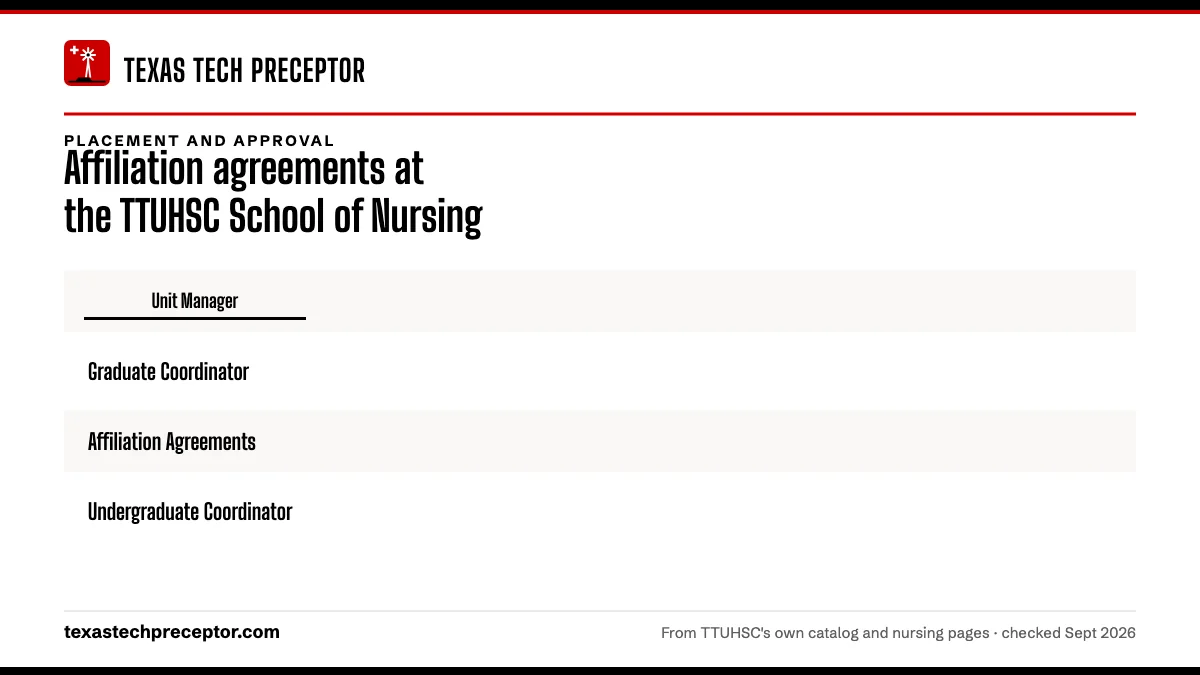
Affiliation agreements have a named home at TTUHSC. Inside the SON's Office of Student Success, a unit named Clinical Placement, Affiliation Agreements, and Preceptor Management carries them, and the 2026-27 catalog lists four roles there:
- Unit Manager
- Graduate Coordinator
- Affiliation Agreements
- Undergraduate Coordinator
For graduate students, the Graduate Coordinator is the natural first contact about whether a facility is covered, and the Affiliation Agreements role sits in the same unit. TTUHSC publishes titles, not a process map, so ask how a new-site request should reach the unit and what it needs from the facility. The clinical roles guide shows how these titles connect to program directors and advisors. Having the facility's details ready makes that first conversation productive.
Where agreements surface in TTUHSC's rules
Affiliation agreements appear in several TTUHSC documents, often as the reason a requirement exists at all.
- The Student Handbook ties drug screening to placement: students pass a screen before clinical placement and in line with the facility's affiliation agreement
- Program pages warn that a clinical site may refuse a vaccination exemption, which could delay or prevent placement or graduation
- COVID-19 vaccination is not an SON requirement, but clinical partners may require it
- For undergraduates, SON OP 30.725 has the Program Director or Clinical Director confirm that a current affiliation agreement is on file for the agency
The pattern holds across all of them: a facility's terms can add to what TTUHSC itself asks. Reading a site's requirements early avoids a late surprise, and the immunizations and certifications guide lists TTUHSC's own baseline.
How a health system's own process adds steps
Large systems often run a student process of their own on top of the school-level contract. Covenant Health in Lubbock is a clear public example. Its clinical rotation page says a student's school must hold an affiliation agreement with Covenant before any rotation at a Covenant facility, and it leaves finding a preceptor to the student, stating that Covenant does not match students with providers.
Covenant's list continues: a rotation application, a supervising professional agreement that student and preceptor both sign with the rotation's start and end dates, proof of finishing its online orientation, and a photo for a badge. It wants the set no later than two weeks ahead of day one. That is a second layer of paperwork sitting on top of TTUHSC's own.
Covenant appears here only to show how facilities work, not as a site open to TTUHSC students. Every health system sets its own rules, so read the student page of any facility you are considering.
Lead time for a new agreement
TTUHSC does not publish how long a new graduate affiliation agreement takes. That silence is the best reason to move early: a contract between a university and a health system passes through reviewers on both sides, and neither side schedules around your term start.
A practical order helps. First, confirm with the Graduate Coordinator whether the facility is already covered. If it is not, raise the site the moment your preceptor says yes, and pass along the facility's legal name, address and the person who handles student agreements there. Keep your preceptor updated so the offer holds while contracting runs, and line up a second option in case the new agreement cannot be finished in time.
A willing preceptor at a facility with no TTUHSC agreement is not yet a finished placement. Confirm the facility's status before you stop searching.
Questions to put to a facility before you commit
A short conversation with the facility, or its student coordinator, answers most of what decides whether a site is ready this term or next.
- Does the facility have a current affiliation agreement with TTUHSC?
- If not, who there handles school agreements, and what do they need from TTUHSC?
- Does the facility run its own student application, orientation or badging, and how far ahead?
- Does it require vaccines or screenings beyond TTUHSC's list, such as COVID-19?
- Will your preceptor be on site for the dates and weekly hours your course needs?
Write the answers down with names and dates. They feed straight into your approval request and your semester agreement, and they show faculty the groundwork is done.
How we handle the facility side for TTUHSC students
Our placement desk checks the facility as closely as the preceptor. Before we present a match, we find out whether the site already hosts TTUHSC students, what the facility's own onboarding requires and how far ahead, and who there signs student agreements.
When a facility needs a new agreement, we gather the details TTUHSC's placement and agreements unit will ask for and flag the timing, so contracting can start the day your preceptor commits. Final approval belongs to TTUHSC's staff and faculty; we make sure the facility information in front of them is complete and meets TTUHSC's rules at first review. See how it works or send your course and town through the form below.
Questions TTUHSC students ask
Who signs an affiliation agreement, me or TTUHSC?
TTUHSC and the facility. The affiliation agreement is an institutional contract, handled in the School of Nursing by its placement and agreements unit. Your part is to identify the facility, share its contact details and complete the electronic preceptor agreement for your preceptor each semester.
Does a private practice need an affiliation agreement too?
TTUHSC approves the facility as well as the preceptor, whatever the facility's size, and Texas rules call for written agreements among program, preceptor and facility. Whether a small practice signs a full affiliation agreement or a simpler document is something the Graduate Coordinator can confirm for you.
How do I find out if a hospital already works with TTUHSC?
Ask the Graduate Coordinator before you commit. TTUHSC does not post a public list of affiliated facilities. A preceptor on TTUHSC's two-year list is a sign the facility hosted TTUHSC students recently, but agreements can lapse and clinicians move, so confirm the current status directly.
Can an affiliation agreement delay my clinical start?
It can. If your facility has no agreement and the contract is not finished by the term start, the placement cannot begin there on time. TTUHSC does not publish a timeline, so raise new facilities early and keep a second site in view. See need a preceptor fast if the term is close.
Do BSN students deal with affiliation agreements?
Not directly. For undergraduates, TTUHSC faculty make placement decisions, and SON OP 30.725 has the Program Director or Clinical Director confirm a current agreement is on file for the agency. Graduate students take a more active role because they propose the facility themselves.
Related pages
Last checked 2026-09-26
We check these pages against TTUHSC's catalog, Student Handbook, program pages and licensure disclosures. Your course faculty, your program director and the plan of study for your cohort have the final word.
Your TTUHSC preceptor search, run by specialists.
Tell us your TTUHSC track, your next clinical course and the town you'll train near. We find preceptors who fit the course and pull together what SON staff and faculty need to approve both the clinician and the facility, early enough for the electronic preceptor agreement to go through before the term.
- Preceptors matched to the track: family primary care, adult-gerontology acute care, pediatrics, psychiatric mental health
- License, certification and facility details ready for TTUHSC's preceptor and facility approval
- In Lubbock, Amarillo, Abilene, the Permian Basin, Dallas-Fort Worth and the states TTUHSC accepts
Start your placement plan
Your track, your town and your next clinical term is all we need to begin.