Finding your own preceptor as a TTUHSC nursing student
Yes, TTUHSC graduate NP students find their own preceptors. The School of Nursing's graduate FAQ gives the search to the student and keeps approval, agreements and supervision with SON staff and faculty. Below is the rule word for word, the programs it covers, and what TTUHSC gives you to work with.
Get your placement plan
Tell us your TTUHSC program and where you live. A placement advisor replies with the preceptor and site options that fit your TTUHSC course.
TTUHSC's rule, in its own words
The clearest statement sits in the School of Nursing's graduate FAQ, under the question of how clinical hours work and whether students have to find their own preceptors. The answer reads in full:
"Students are responsible for obtaining their own preceptors based upon the requirements for each clinical course. A listing of preceptors used within the past two years is available for current graduate students to use as a guide. Clinical hours can be completed in a student's home area but both the preceptor AND the facility must be approved by SON staff and faculty. There is an electronic preceptor agreement process that students must complete for every preceptor they use each semester."
That FAQ page came down in the ttuhsc.edu redesign and survives in an April 2026 archive. The live BSN to DNP pages carry the same message: asked whether students will find their own preceptors, TTUHSC answers yes, with faculty and a preceptor team helping. No current TTUHSC page says the school places NP students.
What each sentence asks of you
The FAQ answer, taken apart
- Obtaining your own preceptor. The search, the first contact and the confirmation that a clinician will take you are yours. TTUHSC's part begins when you put the name forward for approval.
- Based on each clinical course. A preceptor is judged against a specific course, not against you in general. A pediatric acute care course and a pediatric primary care course, for example, point to different settings.
- The list is a guide. It names clinicians who hosted TTUHSC graduate students in the last two years. It offers leads, not confirmed openings.
- Home area, two approvals. You can train near where you live, and the school reviews the preceptor and the site as two distinct approvals.
- An agreement every term. Each preceptor you use needs the electronic agreement completed for that semester, even one you have worked with before.
Read together, the rule gives you the legwork and gives TTUHSC the checks. Knowing where one ends and the other begins keeps your timeline realistic, and the clinical placement process guide shows how the pieces line up across a semester.
Which TTUHSC programs this covers
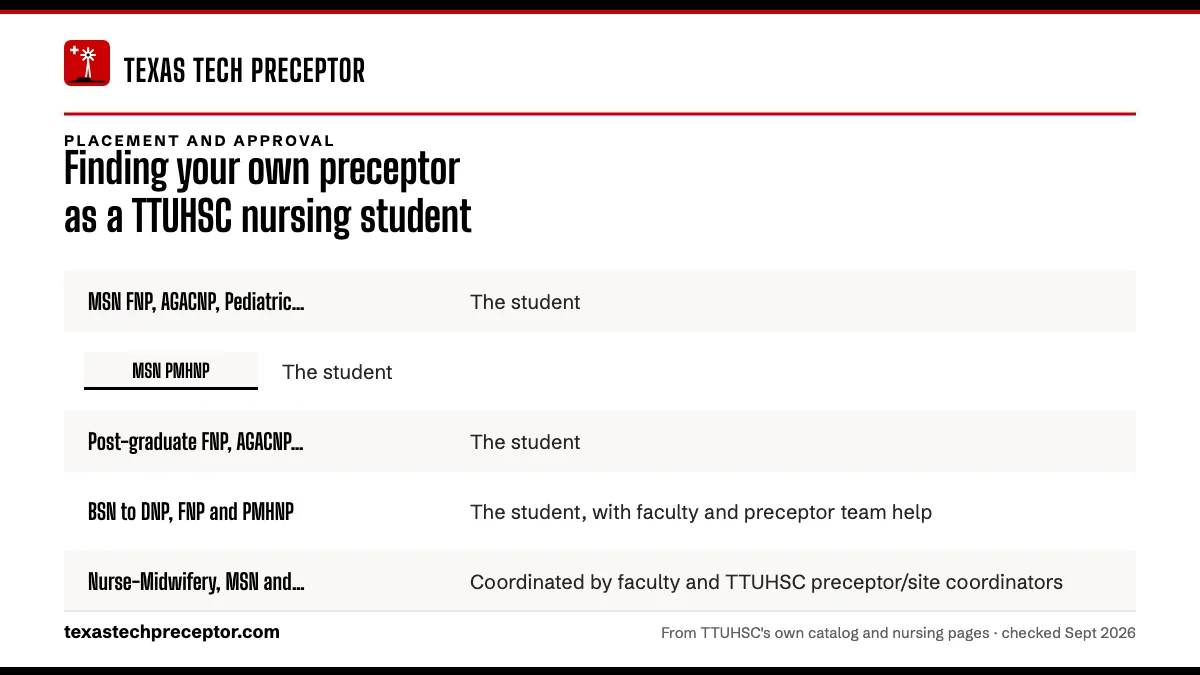
The rule applies across the graduate nurse practitioner tracks, with a few programs organized differently. The table uses TTUHSC's own wording where it exists.
| Program | Who finds the preceptor | Basis |
|---|---|---|
| MSN FNP, AGACNP, Pediatric Primary Care NP, Pediatric Acute Care NP | The student | Graduate FAQ, with SON approval of preceptor and facility |
| MSN PMHNP | The student | Programs page: hours in the home area with approved preceptors |
| Post-graduate FNP, AGACNP and PMHNP certificates | The student | Inferred from the FAQ, which covers graduate students; certificate pages are silent |
| BSN to DNP, FNP and PMHNP | The student, with faculty and preceptor team help | BSN to DNP program pages |
| Nurse-Midwifery, MSN and post-graduate | Coordinated by faculty and TTUHSC preceptor/site coordinators | Student Handbook; the Program Director approves locations |
| Post-Master's DNP | Arranged with faculty approval, possibly at your workplace | 2026-27 catalog |
| MSN Informatics and Intelligent Systems | No outside site needed | Virtual, faculty-guided practicum |
| Traditional and Accelerated BSN | The school | Faculty teaching the clinical course decide placement |
For the Leadership, Education and RN to BSN practicums, TTUHSC's pages are silent on who makes the arrangements; your program director can tell you.
What TTUHSC provides while you search
Finding your own preceptor does not mean searching without support. TTUHSC offers several things that speed a search once you know how to use them.
- A record of clinicians who precepted TTUHSC graduate students over the last two years, offered to current students as a guide (how to use it)
- For BSN to DNP students, faculty plus a preceptor team that assists with selecting and contracting
- Review of your proposed preceptor and site by the school's staff and faculty, which confirms fit before hours count
- A unit in the Office of Student Success devoted to clinical placement, affiliation agreements and preceptor management
- A School of Nursing blanket liability policy covering students in any student-related clinical activity
Two things TTUHSC's public pages leave out are the graduate preceptor criteria and a submission deadline. Course faculty and the Graduate Coordinator hold those answers, and asking early gives you the most room.
Getting the course match right
The phrase "requirements for each clinical course" is the part of the rule that deserves the most attention. Each population-focus course centers on a setting. MSN FNP students work through primary care courses before NURS 6660, the FNP Practicum. AGACNP courses are acute care. Pediatric NP students follow either a primary care or an acute care sequence, and PMHNP rotations move from children and adolescents to adults to complex psychiatric patients of every age.
Under Texas rules a preceptor can be an APRN or another licensed professional qualified to teach at the advanced practice level, and TTUHSC decides who qualifies for your course. Read the rule on preceptor requirements and the setting in your syllabus, then match the two before you ask anyone for a yes.
Starting early enough
TTUHSC does not post a graduate deadline for submitting preceptors, which leaves the start of your search to judgment. Work backward from the first class day of the term your clinical course runs. Approval of the preceptor, approval of the facility, a new affiliation agreement if the site lacks one, and the semester's electronic agreement all have to be finished before hours begin.
Readiness items stack on top. FNP and AGACNP students need ACLS, and Pediatric NP students need PALS, ahead of their first population-focus clinical course. The first clinical course guide shows when that course arrives in each plan, which tells you when the clock really starts. With clinical courses in consecutive terms, the hunt for next term's preceptor starts while this term's rotation is still underway.
Why TTUHSC students choose us for the search
TTUHSC made the search your job, and the best way to handle it is to put a specialist on it. Our placement desk works from your exact TTUHSC course and the town you live in, reaches clinicians who fit that course, and confirms their interest before your name goes anywhere.
Then we prepare the review materials: the preceptor's credentials checked at the source, the clinic or hospital and its standing with TTUHSC, and each field the term's electronic agreement will need. The decision belongs to TTUHSC's staff and faculty, and what lands on their desk from us is complete and built to TTUHSC's rules. Fill in the form below, or see how it works first.
Questions TTUHSC students ask
Can I use my current employer as a clinical site?
TTUHSC publishes no graduate NP rule against it, and the Post-Master's DNP catalog explicitly permits practicum hours at your job if the work serves the course objectives and faculty sign off. For NP tracks, the preceptor and facility still need SON approval, and undergraduates face a stricter rule. See workplace clinicals.
Will the clinicians on TTUHSC's preceptor list take me?
Not necessarily. The list shows clinicians who precepted TTUHSC graduate students in the past two years, and TTUHSC offers it as a guide. Whether someone has room this term, still works at the same site, and fits your course is something you confirm directly before putting them forward.
Do BSN students at TTUHSC find their own preceptors?
No. For Traditional and Accelerated BSN students, the Student Handbook leaves placement decisions to the faculty teaching the clinical course and commits to placing students somewhere convenient where possible. The student-found rule belongs to the graduate nurse practitioner tracks, not to pre-licensure students.
Does TTUHSC charge a placement fee for NP clinicals?
TTUHSC's pages show a clinical placement fee only for Nurse-Midwifery, charged in each practicum semester, and they do not publish the amount. Nothing on its pages points to a similar fee for the nurse practitioner tracks, where the student carries the search.
Who do I ask about preceptor rules for my course?
Start with your course faculty, who set course-level expectations. The Graduate Coordinator handles approvals and agreements for graduate students, and your program director settles questions about your plan of study. The Graduate Enrolled Student Advisor takes registration, add and drop questions.
Related pages
Last checked 2026-09-26
We check these pages against TTUHSC's catalog, Student Handbook, program pages and licensure disclosures. Your course faculty, your program director and the plan of study for your cohort have the final word.
Your TTUHSC preceptor search, run by specialists.
Tell us your TTUHSC track, your next clinical course and the town you'll train near. We find preceptors who fit the course and pull together what SON staff and faculty need to approve both the clinician and the facility, early enough for the electronic preceptor agreement to go through before the term.
- Preceptors matched to the track: family primary care, adult-gerontology acute care, pediatrics, psychiatric mental health
- License, certification and facility details ready for TTUHSC's preceptor and facility approval
- In Lubbock, Amarillo, Abilene, the Permian Basin, Dallas-Fort Worth and the states TTUHSC accepts
Start your placement plan
Your track, your town and your next clinical term is all we need to begin.