TTUHSC MSN Adult-Gerontology Acute Care NP: what the clinical side takes
TTUHSC's MSN Adult-Gerontology Acute Care NP is a 47-credit online track built for nurses who already know the ICU, the emergency department or a flight crew. Its four clinical courses each carry an on-campus skills lab, and the hours happen near home with a preceptor and a hospital that TTUHSC approves. Acute care sites bring paperwork of their own, and handling that paperwork is where our thoroughness shows.
Find your acute care preceptor
Share your city, your hospital and your start term.
The AGACNP track at a glance
The AGACNP program page is silent on preceptors, so the graduate rules covering every MSN NP track apply: you find the clinician, and SON staff and faculty must approve that person and the site.
| Item | What TTUHSC states |
|---|---|
| Credits | 47 |
| Format | Online courses plus an on-campus intensive and on-campus skills labs |
| Start terms | Fall or Spring |
| Experience | At least one year as an RN in intensive care, flight nursing or an emergency department, within the past five years |
| Certifications | BLS for all students; ACLS before the first population-focus clinical course |
| Clinical courses | Acute Care I, Acute Care II, the Practicum and the Immersion |
| Clinical hours | Measured per course; TTUHSC prints no AGACNP total |
| Preceptor search | Yours, in your home area; TTUHSC approves preceptor and facility |
The ICU, flight or ED rule
TTUHSC asks AGACNP applicants for "at least one (1) year of RN experience in an intensive care, flight nursing, or emergency department setting within the past (5) years." The rule screens admission, and it also means you begin the program already fluent in how critical care units and emergency departments run, which helps when you start asking acute care clinicians to precept.
Your current hospital is the natural first stop. The only own-unit restriction TTUHSC has published applies to undergraduates, with nothing comparable written for graduate students, so confirm with course faculty before planning rotations at your employer. The workplace clinicals page sets out what TTUHSC has put in writing.
Before the clinical courses, the plan adds Critical Care Pharmacology and Essentials of Acute Care to the usual advanced pathophysiology, pharmacology and health assessment, so the first rotation starts on acute care footing.
Four clinical courses, each with a skills lab
The population-focus sequence runs Adult-Gerontology Acute Care I (NURS 5460), Acute Care II (NURS 5561), the Adult-Gerontology Acute Care Practicum (NURS 6652) and the Adult-Gerontology Acute Care Immersion (NURS 6400). Each has a clinical section and an on-campus skills lab, so campus time continues into the clinical year instead of ending with the health assessment intensive.
Clinical time follows TTUHSC's 1-to-4.25 credit-to-clock measure for NP courses, yet no AGACNP total is published. The MSN and post-graduate certificate pages even disagree with each other on weekly clinical hours for these courses, and the catalog dates the switch to the 4.25 measure to Summer or Fall 2026, varying by track. Take your hour targets from course faculty for the term you are in.
TTUHSC does not post the term in which Acute Care I falls for the MSN, so your plan of study from orientation is the reference. ACLS has to be in hand before that first course, and hospital paperwork adds its own lead time, so count back at least a full semester from Acute Care I to start the search. Prerequisites, order and course content are on the AGACNP clinical courses page.
Acute care sites: two sets of rules
TTUHSC approves the preceptor and the facility separately, and for an acute care track the facility is usually a hospital with a student process of its own. That makes the site search as important as the preceptor search. On the preceptor side, Texas Board of Nursing rule 22 TAC §219.10 lets a program pair students with APRNs or with other licensed health professionals qualified to teach and supervise at that level; TTUHSC keeps its own graduate criteria unpublished, so have course faculty confirm a physician or NP candidate before you ask for a commitment.
Covenant Health in Lubbock shows what a hospital can ask. Its clinical rotation page requires an affiliation agreement between the student's school and Covenant before any rotation, states that the student must procure the preceptor, and wants the student's paperwork no later than two weeks ahead of the first day. Other West Texas systems, including UMC Health System and United Regional, publish no process for outside NP students, so the route in starts with a direct contact.
Facility agreements go to the unit TTUHSC calls Clinical Placement, Affiliation Agreements, and Preceptor Management, which posts no processing time. Where a hospital holds no agreement with TTUHSC, give the search enough runway for one to be signed. The affiliation agreements page explains the process.
Clearance a hospital will check
- ACLS before the first population-focus clinical course, kept current through the practicum and the Immersion.
- BLS: until May 1, 2027 the catalog takes either an AHA or a Red Cross card; after that date only AHA qualifies, and the AGACNP program page already names AHA.
- Immunizations for hepatitis B, MMR and varicella, yearly TB testing and influenza, with COVID-19 only where a clinical partner requires it.
- Criminal background screening through the vendor TTUHSC approves, plus drug testing ahead of most placements and at random times; a requested test must be done within five days.
- Required health insurance and a fresh HIPAA training record every year, with the SON's blanket liability coverage in place for clinical work.
The AGACNP page also warns that clinical sites may refuse a vaccination-exemption affidavit, which could delay or prevent placement and graduation. If you rely on an exemption, bring it up before a hospital is picked. The immunizations and certifications page has the full list.
How we work an acute care search
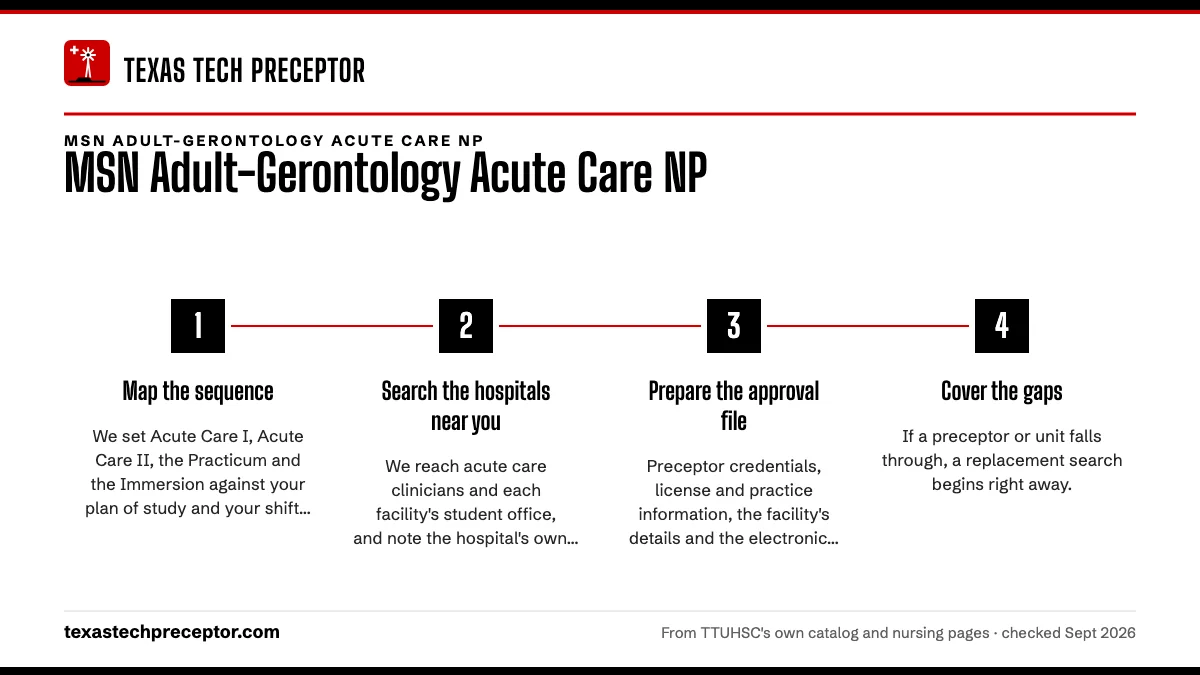
An acute care placement rewards thoroughness, and thoroughness is how we work. We look for acute care nurse practitioners and other qualified clinicians at hospitals within reach of your home, check each hospital's own student requirements, and assemble what TTUHSC's approval asks for before a request goes in.
- Map the sequenceWe set Acute Care I, Acute Care II, the Practicum and the Immersion against your plan of study and your shift pattern.
- Search the hospitals near youWe reach acute care clinicians and each facility's student office, and note the hospital's own lead time and documents.
- Prepare the approval filePreceptor credentials, license and practice information, the facility's details and the electronic agreement items arrive together, complete.
- Cover the gapsIf a preceptor or unit falls through, a replacement search begins right away.
TTUHSC's faculty decide on every preceptor and site; we make sure the file they review is whole. See how it works or share your city and start term in the form below.
Questions TTUHSC students ask
Can I apply to TTUHSC's AGACNP without ICU experience?
The published rule asks for at least one year of RN experience in intensive care, flight nursing or an emergency department within the past five years, and those are the only settings it names. If your acute care time is older than five years or comes from another unit, ask the Admissions Team before you apply.
How many clinical hours are in TTUHSC's AGACNP?
TTUHSC does not publish a total for the AGACNP. Each clinical course converts credits to clock hours at 1 to 4.25, and the MSN and certificate pages list different weekly hours for identical courses. Course faculty confirm the hours for your term, so check with them before you and a preceptor fix a schedule.
Is the TTUHSC AGACNP program fully online?
The coursework is online. The track adds an on-campus intensive in Advanced Health Assessment and Diagnostic Reasoning and on-campus skills labs in the clinical courses, and TTUHSC puts campus time for its MSN NP tracks at seven to eight days over the program. See the intensives and OSCEs page.
Does TTUHSC offer a post-graduate AGACNP certificate?
Yes. The Adult-Gerontology Acute Care Nurse Practitioner Post-Graduate Certificate is listed at up to 38 credits, with individualized plans, the same four population-focus clinical courses, and the same acute care experience and ACLS rules. The post-graduate NP certificates page covers it.
Who finds AGACNP preceptors at TTUHSC?
Students do. TTUHSC's graduate guidance places the search with the student, and SON staff and faculty sign off on the preceptor and the hospital alike. For acute care the search also covers the hospital's own student rules. That full search, and the paperwork behind it, is the work we take on for AGACNP students.
Related pages
Last checked 2026-09-26
We check these pages against TTUHSC's catalog, Student Handbook, program pages and licensure disclosures. Your course faculty, your program director and the plan of study for your cohort have the final word.
Your TTUHSC preceptor search, run by specialists.
Tell us your TTUHSC track, your next clinical course and the town you'll train near. We find preceptors who fit the course and pull together what SON staff and faculty need to approve both the clinician and the facility, early enough for the electronic preceptor agreement to go through before the term.
- Preceptors matched to the track: family primary care, adult-gerontology acute care, pediatrics, psychiatric mental health
- License, certification and facility details ready for TTUHSC's preceptor and facility approval
- In Lubbock, Amarillo, Abilene, the Permian Basin, Dallas-Fort Worth and the states TTUHSC accepts
Start your placement plan
Your track, your town and your next clinical term is all we need to begin.