TTUHSC's BSN to DNP Psychiatric Mental Health NP track
The PMHNP track of TTUHSC's BSN to DNP runs twelve semesters from a Summer start and places 1,080 clinical hours across six courses, from child and adolescent care to three DNP Advanced Practicums. Clinicals happen in your own area with preceptors TTUHSC approves, and finding those preceptors is your job. We handle that search for each rotation and prepare what approval requires.
Get your placement plan
Tell us your TTUHSC program and where you live. A placement advisor replies with the preceptor and site options that fit your TTUHSC course.
What the PMHNP track looks like
TTUHSC's catalog calls it the Psychiatric Mental Health Nurse Practitioner Track of the BSN to DNP. It is an online program with required on-campus sessions of one to two days each semester, and TTUHSC describes it as four years of full-time study, twelve semesters, starting only in Summer. Applications for the Summer cohort are accepted from September 1 to January 15.
One admission detail sets it apart from its FNP sibling. TTUHSC states that the PMHNP track does not require previous nursing experience, while the FNP track asks for two years as an RN. You still need an unencumbered RN license; the license wording differs between the catalog and the website, and our RN license guide lays out both.
Psychiatric content builds in stages before any clinical course: advanced mental health assessment across the lifespan, psychotherapeutic modalities, neuroscience and epigenetics, and psychopharmacology. The DNP spine runs alongside, with statistics, evidence-based inquiry, informatics, systems leadership, population health, policy and financial courses.
76 credits or 75: a conflict to settle with TTUHSC
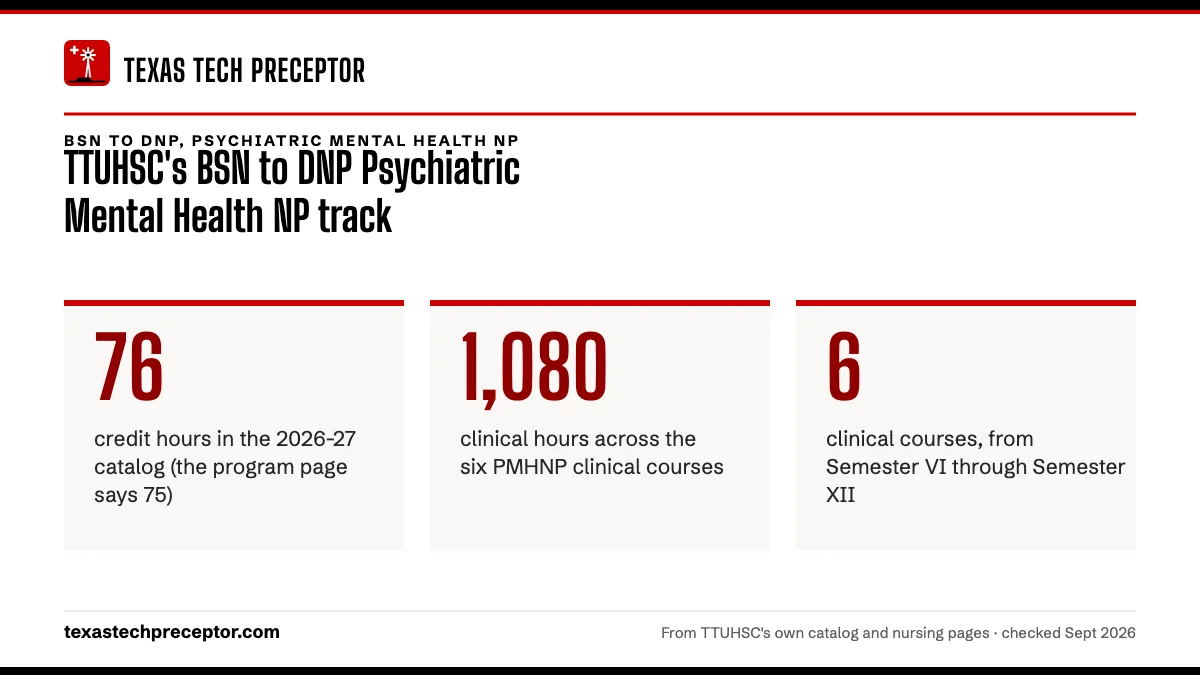
TTUHSC's two sources disagree on the size of this track. The 2026-27 catalog totals the plan at 76 credit hours, while the ttuhsc.edu program page says "75 credit hours total." Neither page explains the gap.
The course lists differ in Semester III as well. The website puts NURS 5340 Advanced Health Assessment and Diagnostic Reasoning, four credits, beside NURS 5207; the catalog lists NURS 5207 alone for that term and notes an on-campus OSCE tied to NURS 5430, the number TTUHSC uses for advanced health assessment in other plans.
TTUHSC calls the plans on its program pages an unofficial copy and names the catalog as the official record for the academic year. Plan around 76 credits, and ask the DNP Programs Enrolled Student Advisor or your program director to confirm the Semester III course and credit total for your cohort before you register.
Do not budget time or course load on the 75-credit figure alone: the catalog is TTUHSC's official plan, and it says 76.
Six clinical courses and where they fall
Clinical work begins in Semester VI, the second Spring of the program, and continues in every term after that except Semester IX. Each Diagnostics and Management course focuses on a population, so the preceptor who fits one rotation may not fit the next.
| Semester | Term | Clinical course | Clinical hours |
|---|---|---|---|
| VI | Spring, year 2 | NURS 6604 Diagnostics and Management III: Children and Adolescents | 180 |
| VII | Summer, year 3 | NURS 6603 Diagnostics and Management II: Adults | 180 |
| VIII | Fall, year 3 | NURS 7500 Diagnostics and Management IV: Complex Psychiatric Patients | 240 |
| X | Summer, year 4 | NURS 7450 DNP Advanced Practicum I | 120 |
| XI | Fall, year 4 | NURS 7451 DNP Advanced Practicum II | 180 |
| XII | Spring, year 4 | NURS 7452 DNP Advanced Practicum III | 180 |
The six courses add up to exactly 1,080, the figure the program page presents as "1,080+ clinical hours." How direct and non-direct care hours convert to credit is covered in the 1,080-hour guide, and the final three courses have their own DNP Advanced Practicum guide. Semester IX carries no clinical course, which makes it a useful window to confirm your year-four preceptors.
Local clinicals and approved preceptors
The program page sums up the arrangement in six words: "Clinicals done locally with approved preceptors." Its answer on how preceptors are selected is the one TTUHSC gives for the whole BSN to DNP: yes, you find your own, with faculty and the preceptor team helping to select and contract preceptors and facilities.
Approval covers two things, the clinician and the facility, and both go through SON staff and faculty. An electronic preceptor agreement is then completed for every preceptor each semester, so a preceptor who carries you through two rotations still needs a new agreement for the second term. Our agreement guide lists what to collect.
Texas rules allow APRN programs to use APRNs or other currently licensed clinicians who can supervise at an advanced practice level. TTUHSC does not publish its own graduate preceptor criteria, so ask your course faculty before committing to a psychiatrist or other non-NP preceptor. Our preceptor requirements guide explains the state rule.
Intensives, OSCEs and telehealth testing
The PMHNP plan spells out its campus and virtual sessions term by term. Knowing them early helps you book clinical days around the trips, and our intensives and OSCEs page adds TTUHSC's general rules.
Sessions printed in the PMHNP plan
- Semester I: campus orientation, with a four-hour intensive for
NURS 6304while you are there - Semesters II, V and IX: virtual intensives for statistics, evidence-based inquiry and policy
- Semester III: an on-campus OSCE for advanced health assessment
- Semester VI: a virtual intensive for systems leadership and a second intensive on campus
- Semester VII: a telehealth OSCE in
NURS 6603 - Semester VIII: two on-campus intensives for population health, one of them in Austin
- Semesters X to XII: an OSCE in each DNP Advanced Practicum
Grading is the same across TTUHSC graduate nursing: the clinical part of a course is pass or fail, and failing it means an F for the course. Every nursing course needs a B or better.
Where you can live while enrolled
TTUHSC's licensure disclosure lists ten states it cannot accept graduate students from, and the BSN to DNP adds South Dakota to that list. Kansas is marked as not meeting requirements for the BSN to DNP. The full picture, state by state, is on our licensure disclosure page.
TTUHSC's graduate pages also warn that changing regulations can affect which states it accepts students from, and they send applicants outside Texas to the Admissions Team to confirm eligibility. Once enrolled, an online graduate student must notify TTUHSC at least 60 days before moving to another state, and approval to do clinicals there is decided case by case.
Plan clinicals where you expect to live in years two through four. A move after the rotations begin means new preceptors, a new facility approval and possibly a new state review.
Why PMHNP doctoral students choose us
We are built around TTUHSC's clinical process, and psychiatric rotations reward that focus. Each of your six courses asks for a different patient population, so we search your area for psychiatric preceptors whose caseload matches the course: younger patients for NURS 6604, adults for NURS 6603, complex cases for NURS 7500, and settings your faculty accept for the Advanced Practicums.
For every match we confirm license, certification and practice details, gather the facility information SON staff and faculty review, and prepare what the semester's electronic preceptor agreement asks for, well before the term. We stay on call through all four years and find a replacement if a preceptor steps away. TTUHSC's staff and faculty make the final decision, and we hand them a submission with nothing missing. Give us your cohort year and the city you live in through the contact page and we will map out your six rotations.
Questions TTUHSC students ask
Is TTUHSC's BSN to DNP PMHNP 75 or 76 credits?
Both figures appear. The 2026-27 catalog totals the plan at 76 credit hours, and the ttuhsc.edu program page says 75. TTUHSC names the catalog as its official plan and calls the website plan an unofficial copy, so plan on 76 and ask the DNP Programs Enrolled Student Advisor to confirm your cohort's course list.
Do I need psychiatric nursing experience for the BSN to DNP PMHNP?
No. TTUHSC states that the PMHNP track does not require previous nursing experience, which differs from the FNP track's two years as an RN. You still need an unencumbered RN license. Your first psychiatric clinical course comes in Semester VI, so the first two years are the time to learn the field and begin the preceptor search.
When is the first clinical course in the BSN to DNP PMHNP?
Semester VI, the second Spring after a Summer start, with NURS 6604 Diagnostics and Management III: Children and Adolescents and its 180 clinical hours. On the standard plan, a Summer 2027 start reaches it in Spring 2029. Because that course centers on younger patients, look specifically for preceptors who treat children and adolescents.
Where do BSN to DNP PMHNP clinicals take place?
In your own area. The program page says clinicals are done locally with approved preceptors, so you train near home instead of relocating to a TTUHSC campus. SON staff and faculty approve each preceptor and facility, and you travel for the intensives and OSCEs in the plan, usually one to two days a semester.
Can a psychiatrist precept a TTUHSC PMHNP student?
Texas rules let APRN programs use APRNs or other currently licensed clinicians able to supervise at an advanced practice level, which can include physicians. TTUHSC does not publish its own graduate preceptor criteria, so your course faculty decide whether a particular psychiatrist fits the course. Ask before the agreement is submitted.
Can you find preceptors for all six PMHNP clinical courses?
Yes. We search near where you live for each course's population, children and adolescents, adults and complex psychiatric patients, plus settings suited to the DNP Advanced Practicums, and we prepare the preceptor and facility details TTUHSC's approval and agreement ask for. If a preceptor withdraws, we find a replacement.
Related pages
Last checked 2026-09-26
We check these pages against TTUHSC's catalog, Student Handbook, program pages and licensure disclosures. Your course faculty, your program director and the plan of study for your cohort have the final word.
Your TTUHSC preceptor search, run by specialists.
Tell us your TTUHSC track, your next clinical course and the town you'll train near. We find preceptors who fit the course and pull together what SON staff and faculty need to approve both the clinician and the facility, early enough for the electronic preceptor agreement to go through before the term.
- Preceptors matched to the track: family primary care, adult-gerontology acute care, pediatrics, psychiatric mental health
- License, certification and facility details ready for TTUHSC's preceptor and facility approval
- In Lubbock, Amarillo, Abilene, the Permian Basin, Dallas-Fort Worth and the states TTUHSC accepts
Start your placement plan
Your track, your town and your next clinical term is all we need to begin.