Where TTUHSC can accept graduate nursing students
TTUHSC's professional licensure disclosure marks ten states with one sentence: "TTUHSC SON is unable to accept graduate students from this state." The ten run from Texas's eastern neighbors to the whole West Coast and are listed below. The BSN to DNP closes South Dakota as well, and two tables, midwifery and the BSN to DNP, show Kansas as "Does not meet."
Get your placement plan
Tell us your TTUHSC program and where you live. A placement advisor replies with the preceptor and site options that fit your TTUHSC course.
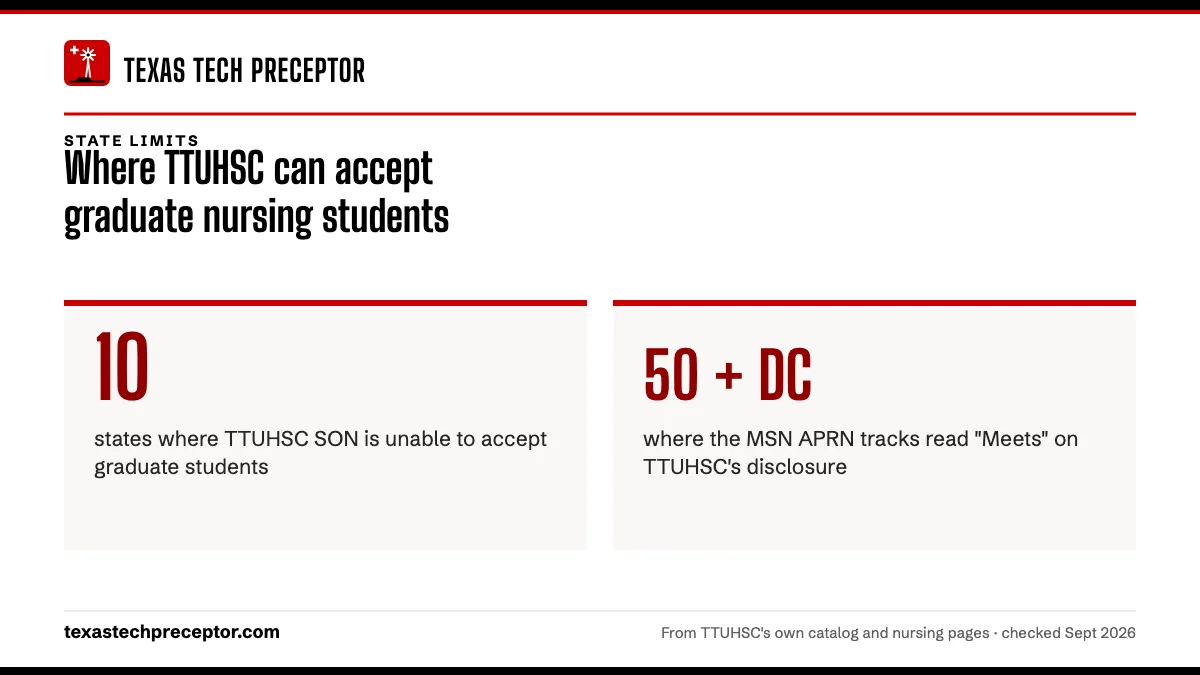
TTUHSC's line, and the ten states it covers
The disclosure sits on the website of TTUHSC's Office of Academic Planning and Compliance. In the School of Nursing tables, ten states carry a double asterisk and the same note: "TTUHSC SON is unable to accept graduate students from this state." The mark appears in all three graduate tables this guide covers, for the MSN APRN tracks, Nurse-Midwifery and the BSN to DNP.
The ten marked states, grouped by region
- Arkansas and Louisiana, on Texas's eastern border
- Arizona and Colorado, in the Southwest and the Rockies
- California, Oregon and Washington, the entire West Coast
- New York and Pennsylvania, in the Northeast
- North Carolina, in the Southeast
Because two marked states touch Texas, the rule reaches applicants who live within driving distance of TTUHSC's campuses. Proximity does not change it: the question is where you live while enrolled.
The list does not track the Nurse Licensure Compact either. Seven of the ten are compact states and three are not, so holding a multistate RN license is no route around the mark.
What the disclosure is, and how to read it
TTUHSC participates in NC-SARA, the state authorization reciprocity agreement, and publishes its professional licensure disclosure alongside that membership. The tables report, program by program and state by state, whether licensure requirements are met. Its governing rule ties enrollment to location: wherever a state's licensure requirements go unmet, TTUHSC says it cannot enroll students "physically located" there.
Two details carry the weight. "Physically located" points to where you are while enrolled, not to the state that issued your RN license. And "Meets" is not the same as open: the MSN APRN tracks read "Meets" in all 50 states and DC, including the ten marked states, where the double asterisk adds the "unable to accept" line on top.
Outside the states, U.S. territories are marked "Does not meet" in the APRN tables.
Program by program
The graduate tables differ in small but important ways, so match the program you want to its own row.
| Program | "Unable to accept graduate students" | Other marks |
|---|---|---|
| MSN APRN tracks (FNP, AGACNP, pediatric primary and acute care NP, PMHNP) | The ten states | "Meets" in every state and DC; territories "Does not meet" |
| Nurse-Midwifery | The ten states | Kansas: "Does not meet" |
| BSN to DNP (FNP, PMHNP) | The ten states plus South Dakota | Kansas: "Does not meet" |
This guide covers those three tables. For the post-graduate certificates, the Post-Master's DNP and the leadership, education and informatics tracks, read that program's own table on the licensure page before you apply.
The rows also explain something students notice on the state guides: one state can be open for one TTUHSC program and closed for another. That is why the program you choose has to come before the state question, not after it.
Kansas and South Dakota: marks that depend on the program
Kansas shows how much the program matters. The MSN NP tracks meet there, yet the Nurse-Midwifery table and the BSN to DNP table both show Kansas as "Does not meet." A Kansas resident weighing the MSN FNP against the BSN to DNP FNP gets two different answers from the same school. The Kansas guide covers the state's own rules.
South Dakota runs the other way for a single program. The BSN to DNP carries the "unable to accept" mark there, while the MSN tracks do not. Details are in the South Dakota guide.
In both states, the fix is the same: pick your program first, then read that program's table, and ask the Admissions Team if the two ever seem to point in different directions.
Applying from outside Texas
The disclosure is one caution; the program pages add a second. Every TTUHSC graduate program page says that, because regulations keep changing, the School of Nursing can't commit, when an application arrives, to taking students from certain states. Out-of-state applicants are asked to check their eligibility with its Admissions Team, whose contact route appears on each program page.
Treat it as a sequence: read the disclosure for your program, then check with Admissions before you invest in an application. Once you are admitted, the clinical question turns local, because graduate clinicals run in your home area with a preceptor and facility TTUHSC approves, as home-area clinicals explains. Each state guide pairs TTUHSC's mark with that state's board rules for out-of-state programs, and California shows how a marked state reads.
When the handbook and the disclosure differ
TTUHSC frames state limits in two ways. The licensure page gives a fixed list. The Student Handbook, writing about graduate online students who relocate, describes Board of Nursing approval after a move as decided one student at a time, depending on the clinical placement proposed, and warns that TTUHSC cannot promise continuation in the program.
Read together, the list answers where TTUHSC accepts graduate students from, and the handbook's process answers what happens when an enrolled student moves. A relocating student owes TTUHSC 60 days' notice. If a move to one of the ten states is possible during your program, raise it with your program director early; moving out of state walks through the process.
The mark follows where you live while enrolled. An RN license from an accepted state does not change a physical location in one of the ten.
Why students in accepted states choose us
Wherever TTUHSC accepts you, we find the preceptor. We are the placement service built around TTUHSC's own process: a preceptor and facility close to home that suit your course, the preceptor's credentials and practice information organized for each semester's electronic preceptor agreement, and the facility's contract status settled long before the semester opens.
For students outside Texas, we also read the state's board rules for out-of-state programs before proposing a site, so the rotation we bring you fits both TTUHSC and the state where it happens. Final approval belongs to TTUHSC's staff and faculty, and the packet they review arrives complete from the start. If a move is part of your plans, we start the preceptor search in the new area while TTUHSC reviews your relocation notice. Use the form below to begin.
Questions TTUHSC students ask
Can I study TTUHSC's online FNP program while living in California?
Not while you live there. California is one of the ten states TTUHSC's licensure disclosure marks "unable to accept graduate students," and TTUHSC's rule turns on where you are physically located. If you plan to move to Texas or another state TTUHSC accepts, ask the Admissions Team how the timing of the move affects your application.
Does "Meets" on the disclosure mean TTUHSC will accept me?
Not on its own. "Meets" describes licensure requirements for the program in that state, and the ten marked states read "Meets" too, with the "unable to accept" line added. Admission is a separate decision, and TTUHSC's graduate program pages tell out-of-state applicants to check eligibility with the Admissions Team before applying.
Are Washington DC and the U.S. territories open for TTUHSC's MSN NP tracks?
The APRN tables list DC as "Meets" and mark U.S. territories "Does not meet." Under TTUHSC's rule on physical location, students living in the territories fall outside those tracks. DC residents should still confirm eligibility with the Admissions Team, as every out-of-state applicant is asked to do.
Does TTUHSC's list of states change?
TTUHSC's program pages cite changing regulations as the reason out-of-state eligibility has to be confirmed, so treat the list as current rather than permanent. Read the licensure page when you apply and again before any move, and keep a copy of what you read with the date.
What if I move to one of the ten states during my program?
Tell TTUHSC first, since it wants 60 days' notice from any graduate online student planning a move. The handbook adds that clinical approval in the new state is reviewed individually and that staying in the program is not assured. Talk with your program director before you sign a lease or accept a job there.
Related pages
Last checked 2026-09-26
We check these pages against TTUHSC's catalog, Student Handbook, program pages and licensure disclosures. Your course faculty, your program director and the plan of study for your cohort have the final word.
Your TTUHSC preceptor search, run by specialists.
Tell us your TTUHSC track, your next clinical course and the town you'll train near. We find preceptors who fit the course and pull together what SON staff and faculty need to approve both the clinician and the facility, early enough for the electronic preceptor agreement to go through before the term.
- Preceptors matched to the track: family primary care, adult-gerontology acute care, pediatrics, psychiatric mental health
- License, certification and facility details ready for TTUHSC's preceptor and facility approval
- In Lubbock, Amarillo, Abilene, the Permian Basin, Dallas-Fort Worth and the states TTUHSC accepts
Start your placement plan
Your track, your town and your next clinical term is all we need to begin.