TTUHSC nursing grades and progression in clinical courses
In a TTUHSC graduate clinical course, two separate bars decide the grade: a pass on the clinical portion and an exam average of at least 80%. A B is the floor in each nursing course, only one repeat is allowed per course, and a second C can end the program. The PR grade covers practicum work that runs past the term, and an incomplete turns into an F after a year.
Get your placement plan
Tell us your TTUHSC program and where you live. A placement advisor replies with the preceptor and site options that fit your TTUHSC course.
The clinical portion decides the course
TTUHSC's Student Handbook is direct about clinical courses: "For courses with a clinical component, the clinical portion is graded on a pass/fail basis. Regardless of scores earned on exams or additional assignments, the student must pass the clinical portion of the course in order to pass the course. An unsatisfactory or failing clinical performance will result in a final course grade of 'F', regardless of the didactic grade."
That puts your preceptor time on the same footing as any exam. A strong test record cannot rescue a failed clinical, and the resulting F counts toward the repeat and dismissal limits below. The handbook adds that a student can be failed at any time in the semester for unsafe practice, citing examples such as threatening patient safety, accepting assignments beyond one's competence and not following CDC Standard Precautions. For how hours themselves are counted, see what counts as clinical hours.
Grade floors: 80% exams, a B and a 3.0
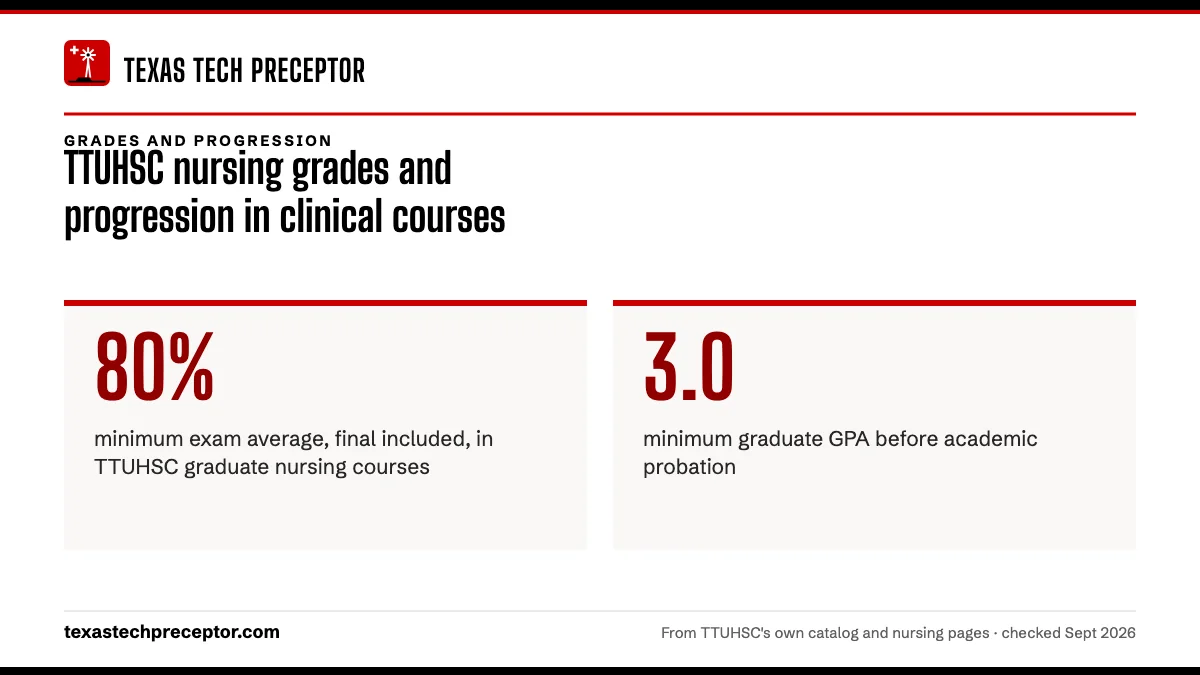
The didactic side has its own bar. The average of all exams, the final included, must reach 80% or higher. The graduate scale runs A for 90 to 100, B for 80 to 89, C for 70 to 79, D for 60 to 69 and F below 60, and rounding happens once, to two decimals, on the final course grade only.
A B is the minimum in every nursing course, and TTUHSC treats a C as short of what a graduate program requires. The cumulative GPA must stay at 3.0 or above; falling below it places a student on academic probation. The same grade rules appear in the MSN, BSN to DNP and Post-Master's DNP catalog entries, so they apply whichever graduate route you are on.
Repeats and the dismissal triggers
A student who earns a C or lower may repeat that course one time only, on the course faculty's recommendation and with the programmatic director and Graduate Program Council approving it in advance. Both grades stay in the GPA, because the SON does not honor grade replacement for required nursing courses. The catalog lists these grounds for academic dismissal:
- a C or lower in two or more graduate courses in the same semester
- a C or below earned twice in one course
- a C or lower in a second graduate course, even after an earlier course was retaken with a B or better
- in the MSN, a cumulative or semester GPA under 2.0 for two consecutive semesters
Failing to meet expected standards in any program can also lead to dismissal at any time. Progression is reviewed every semester by the Graduate Associate Dean or Department Chair and the MSN Program Director, together with the Graduate Progressions Council.
PR: when a practicum runs past the term
The handbook gives practicum students a grade built for unfinished clinical work. "PR" (In Progress) is given only when the work in a course extends beyond the semester, and it is used primarily in clinical and practicum courses, along with thesis and dissertation courses. It is the grade to raise with faculty when a preceptor's schedule, a late start or a site problem leaves hours outstanding near the end of term.
The handbook says no more than that. It gives no minimum share of hours you must have logged, no time limit for finishing and no word on how a PR affects the next course in your sequence. Those answers come from course faculty, and they are worth getting before the final weeks rather than after grades are due. Finishing old hours while a new clinical course begins means running two schedules at once, so a replacement preceptor found early is the best protection. See behind on clinical hours if you are already short.
Incompletes, W and WF
An incomplete, or I, is a separate tool. TTUHSC gives it only when the work is satisfactory in quality but incomplete because of circumstances outside the student's control, and never in place of an F. Faculty set the conditions for removing it in writing, and an I that stays on the record for a year is replaced with an F. Withdrawing from TTUHSC does not stop that clock.
Dropping a course carries its own grade rules. Drops during weeks one through five go on the record as W, and so do later drops by a passing student; drop after week five while not passing and the grade is WF, which the GPA treats as an F. For graduate students, dropping every course, or not enrolling in a fall or spring term, is treated as leaving the School of Nursing, and returning takes a full new application. A leave of absence under TTUHSC OP 77.21 is the alternative to ask about. The drop deadlines for each term are on the academic calendar.
Appeals, readmission and out-of-sequence courses
TTUHSC runs appeals on short clocks. For dismissal, the Program Progressions Committee makes a recommendation, the Dean decides within 10 business days, and the student has 5 business days to appeal through the Executive Associate Dean, with a three-faculty Academic Dismissal Appeals Committee hearing the case. Final-grade appeals follow their own path, and a procedural appeal to the Executive Associate Dean is due within 2 business days of the chair's decision; that decision is final.
A dismissed student who wants to return writes to the program director and submits a new online application meeting full admission criteria by the catalog deadline. Suspension and retention fall under TTUHSC OP 77.05. Taking a course out of sequence also needs approval before enrollment, from the advisor, the course facilitators, the program director and, where required, the Associate Dean.
Protecting the clinical half of your grade
Since the clinical portion can fail a course by itself, the preceptor behind it matters more than any single exam. A preceptor whose patients fit the course, who has time to teach and who stays for the full term gives you the steadiest chance to show safe, competent practice. One who leaves in the middle of the term can turn a routine semester into a PR conversation.
That is why TTUHSC students choose us. We match preceptors to your course's population and weekly hours, prepare what the electronic preceptor agreement and SON approval call for before the term, and stay on call all semester. If a preceptor steps away, the placement desk starts on a replacement right away so your clinical work stays on schedule. SON staff and faculty sign off on each preceptor and facility, and our files reach them complete. If it has already happened, see preceptor dropped out.
Questions TTUHSC students ask
What GPA do TTUHSC graduate nursing students need?
A cumulative GPA of 3.0 or higher, with at least a B in each nursing course. Dropping below 3.0 brings academic probation, and in the MSN a GPA under 2.0 for two straight semesters is grounds for dismissal. Both grades from a repeated course stay in the GPA calculation.
How long does a TTUHSC incomplete last?
One year. An I still on the record after a year becomes an F, and withdrawing does not stop the change. Faculty write out what you must finish to remove it, so get those conditions early and plan preceptor time around them if the unfinished work is clinical.
Is a failed TTUHSC clinical recorded as a C or an F?
An F. The handbook says unsatisfactory or failing clinical performance produces a final course grade of F no matter what the didactic grade is. That F then counts toward the one-repeat limit and the dismissal rules for graduate courses.
What are the grade rules for TTUHSC BSN students?
Traditional BSN students need at least a C in each nursing course and may repeat a D, F or WF once; a second such grade leads to dismissal. In the Accelerated BSN a single D, F or WF in any course means dismissal. Undergraduate proctored exams must average 75% or more, and a course may require 75% on the clinical evaluation instrument.
Should I ask for a PR or an incomplete for unfinished clinical hours?
They fit different situations. PR is for course work that extends past the semester and shows up mostly in clinical and practicum courses, while an I is for satisfactory work left unfinished for reasons beyond your control. Which applies is your course faculty's call, so raise it well before the term ends.
Related pages
Last checked 2026-09-26
We check these pages against TTUHSC's catalog, Student Handbook, program pages and licensure disclosures. Your course faculty, your program director and the plan of study for your cohort have the final word.
Your TTUHSC preceptor search, run by specialists.
Tell us your TTUHSC track, your next clinical course and the town you'll train near. We find preceptors who fit the course and pull together what SON staff and faculty need to approve both the clinician and the facility, early enough for the electronic preceptor agreement to go through before the term.
- Preceptors matched to the track: family primary care, adult-gerontology acute care, pediatrics, psychiatric mental health
- License, certification and facility details ready for TTUHSC's preceptor and facility approval
- In Lubbock, Amarillo, Abilene, the Permian Basin, Dallas-Fort Worth and the states TTUHSC accepts
Start your placement plan
Your track, your town and your next clinical term is all we need to begin.