TTUHSC MSN Psychiatric Mental Health NP: the Spring cohort and its rotations
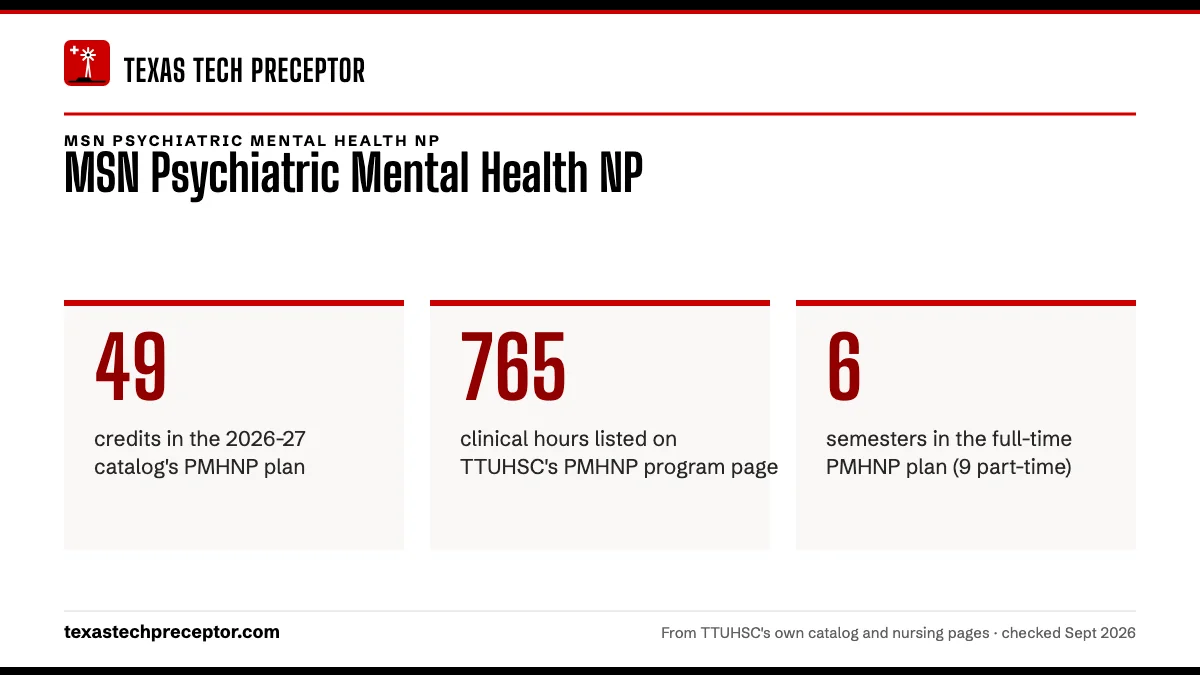
TTUHSC's MSN PMHNP is an online, 49-credit track that admits once a year, in Spring, and completes its clinical hours in the student's home area with approved preceptors. The program page counts 765 clinical hours across three rotations, while the catalog lists a different set of clinical courses. Here is how the plan runs, where the two sources part ways, and how we line up psychiatric preceptors for each rotation.
Find your PMHNP preceptors
Tell us your city and your Spring cohort year.
The PMHNP track at a glance
The PMHNP is the one MSN NP track at TTUHSC that asks for no prior nursing experience, though every MSN student still needs an RN license, Texas or multistate compact, in good standing with no encumbrance.
| Item | What TTUHSC states |
|---|---|
| Credits | 49 in the 2026-27 catalog |
| Start term | Spring only, one cohort a year |
| Length | Six semesters full-time or nine part-time, per the web plan |
| Nursing experience | Not required |
| Admission extras | An interview and a critical analysis essay |
| Clinical hours | 765 on the program page; the catalog lists different clinical courses |
| Where clinicals happen | Your home area, with approved preceptors |
| Campus time | An Advanced Health Assessment intensive, within 7-8 campus days for MSN NP tracks |
A Spring start, and when rotations begin
TTUHSC's program page is plain about timing: "The PMHNP BSN to MSN track accepts students once a year for the spring semester." Applications fall in the catalog's Spring window for APRN tracks, May 1 to August 1.
The web plan spends the first year on foundations: pathophysiology, pharmacotherapeutics, advanced mental health assessment, psychotherapeutic modalities, neuroscience and psychopharmacology, plus Advanced Health Assessment and Diagnostic Reasoning. Full-time students reach the first clinical rotation in semester four, the second Spring, about a year after starting. On the part-time plan, the first rotation waits until semester seven, again a Spring term.
That leaves roughly a year to secure the first preceptor, and it goes quickly. The rotations then run back to back, Spring, Summer and Fall, each with its own population and its own approval.
The three rotations fall in consecutive terms, so the second and third preceptors need to be lined up while the first rotation is still under way.
Three rotations, two published versions
The program page lays out three clinical rotations: evidence-based care of children and adolescents with mental health disorders in Spring, care of adults with mental health disorders in Summer, and interprofessional management of the complex psychiatric patient across the lifespan in Fall. It assigns 287, 191 and 287 hours to them, which is where the 765 figure comes from.
The 2026-27 catalog tells a different story. Its PMHNP plan lists two clinical courses, one carrying 157.5 clinical hours and a specialty practice course carrying 52.5, beside a differently built core. TTUHSC names its catalog the official plan and labels the web version an unofficial facsimile, so your course faculty and the program director are the ones to confirm what your cohort completes.
The PMHNP clinical rotations guide sets the two versions side by side.
Who can precept a psychiatric rotation
Psychiatric rotations follow the same pattern as the other MSN NP tracks. You secure the preceptor, SON staff and faculty review the clinician and the facility, and each preceptor needs a new electronic preceptor agreement every term.
The Texas Board of Nursing's rule 22 TAC §219.10 permits APRN programs to use either licensed APRNs or other licensed health care professionals who can teach and supervise at an advanced practice level. TTUHSC has not published its own PMHNP preceptor criteria, so whether a psychiatrist, a psychiatric NP or another licensed clinician suits a given rotation is a question for course faculty before anyone commits. The preceptor requirements page has more.
The children and adolescents rotation can be the narrowest search, since it needs a clinician whose caseload includes young patients, and it comes first. Start there.
Telehealth, rural reach and access to care
The PMHNP plan includes a course titled Telehealth and Rural Service Delivery, a natural fit for a school whose rural health institute runs the West Texas Area Health Education Center. HRSA's quarterly summary counted 412 mental health professional shortage area designations across Texas as of June 30, 2026, covering a population of more than 14 million.
For a PMHNP student in Lubbock, Amarillo, Abilene or a small Panhandle town, that means the need is close to home while psychiatric clinicians are spread out. The rural West Texas guide covers the distances involved. TTUHSC's public pages set no rule on counting telehealth visits toward clinical hours, so ask course faculty before building a rotation around virtual care.
Clearance and grades during the rotations
The standard graduate items must be complete before the first rotation: BLS, the immunization series with TB testing every year, background screening through TTUHSC's approved vendor, drug tests ahead of most placements, mandatory health insurance for online programs with clinicals, and a HIPAA training record renewed yearly. A clinical partner may add its own requirements, such as COVID-19 vaccination.
Grades count as much as hours. The clinical half of each clinical course is scored pass/fail, and failing it sinks the course grade to F regardless of exam results. TTUHSC also sets a B as the floor in every nursing course and requires exams to average 80% or higher. Repeats and dismissal rules are on the grades and progression page.
How we cover all three rotations
Three rotations in three consecutive terms is a lot of searching to do beside coursework, and it is exactly the work we take on. We line up a preceptor for each rotation's population, children and adolescents first, then adults, then complex patients across the lifespan, as close to where you live as the specialty allows.
- Psychiatric NPs, psychiatrists and practices that see the right age group, each confirmed for the right term.
- Credentials and practice details for each preceptor, and facility information for each site, assembled for TTUHSC's review.
- What the electronic preceptor agreement asks for, ready ahead of each Spring, Summer and Fall rotation.
- A replacement search started right away if a preceptor steps back between rotations.
TTUHSC's faculty approve each preceptor and site, and we make sure the request that reaches them is complete. Read how it works or send us your cohort year through the form.
Questions TTUHSC students ask
Does TTUHSC's MSN PMHNP only start in Spring?
Yes. The PMHNP BSN to MSN track takes one cohort a year, for the Spring semester, and applications fall in the Spring window for APRN tracks, May 1 to August 1. The BSN to DNP PMHNP starts in Summer instead; see the BSN to DNP PMHNP guide.
Do I need psychiatric nursing experience for TTUHSC's PMHNP?
No. TTUHSC states that PMHNP applicants are not required to have previous nursing experience. You still need a clear RN license from Texas or a compact state, and the application includes an interview and a critical analysis essay. Psychiatric work experience can still help when you start approaching preceptors.
How many clinical hours is the TTUHSC PMHNP?
The program page lists 765 clinical hours across three rotations. The 2026-27 catalog lists different clinical courses with different hours, and the catalog is TTUHSC's official plan. Settle your cohort's figure with course faculty or the program director before agreeing on hours with a preceptor.
Is there a post-graduate PMHNP certificate at TTUHSC?
Yes, in versions for current APRNs, for nurses who are not APRNs, and one paired with the Post-Master's DNP. Plans are individualized, and the catalog and website give different credit totals. The post-graduate NP certificates page has the details.
Can I do TTUHSC PMHNP clinicals outside Texas?
Usually, yes, since rotations happen where you live. Ten states, among them Pennsylvania, Oregon and Arkansas, are closed to TTUHSC graduate students. A mid-program move needs notice to TTUHSC 60 days or more in advance, and each new state's clinical approval is handled individually.
Related pages
Last checked 2026-09-26
We check these pages against TTUHSC's catalog, Student Handbook, program pages and licensure disclosures. Your course faculty, your program director and the plan of study for your cohort have the final word.
Your TTUHSC preceptor search, run by specialists.
Tell us your TTUHSC track, your next clinical course and the town you'll train near. We find preceptors who fit the course and pull together what SON staff and faculty need to approve both the clinician and the facility, early enough for the electronic preceptor agreement to go through before the term.
- Preceptors matched to the track: family primary care, adult-gerontology acute care, pediatrics, psychiatric mental health
- License, certification and facility details ready for TTUHSC's preceptor and facility approval
- In Lubbock, Amarillo, Abilene, the Permian Basin, Dallas-Fort Worth and the states TTUHSC accepts
Start your placement plan
Your track, your town and your next clinical term is all we need to begin.