TTUHSC nursing programs for students who live in Texas
Texas residents can apply to every TTUHSC School of Nursing program, and the graduate tracks put your clinical hours in the part of Texas where you already live. So the Texas questions are practical ones: how far you sit from Lubbock and the other campuses, which license each program asks for, and who near you can precept.
Get your placement plan
Tell us your TTUHSC program and where you live. A placement advisor replies with the preceptor and site options that fit your TTUHSC course.
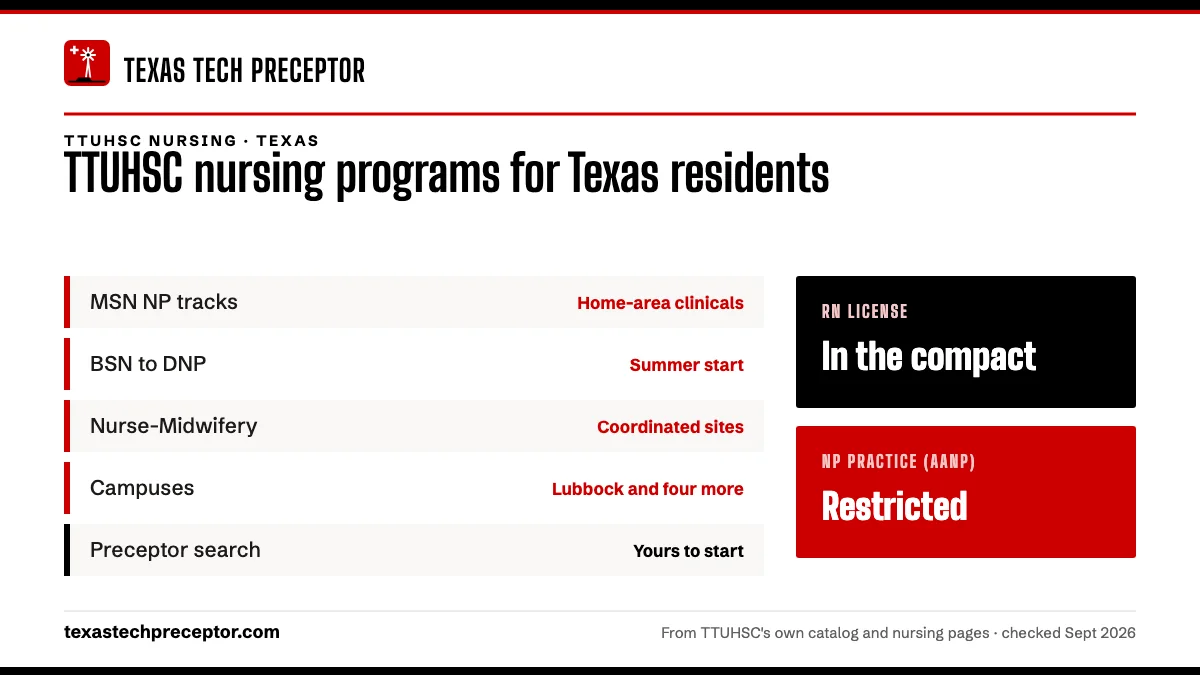
Each TTUHSC program, seen from a Texas address
On TTUHSC's professional licensure disclosure, Texas is the home state, so the state-by-state caution that shapes out-of-state admissions never enters your picture. What varies is the program. Most graduate tracks send you to find a preceptor near home, midwifery coordinates its sites, and the bachelor's programs place students around the campuses.
| Program | Open to Texas residents? | Where the clinical hours happen |
|---|---|---|
| MSN NP tracks: FNP, AGACNP, Pediatric Primary Care, Pediatric Acute Care, PMHNP | Yes, home state | Your home area, with a preceptor and facility that SON staff and faculty approve |
| MSN Nurse-Midwifery and the post-graduate midwifery certificate | Yes | Locations the Program Director approves, arranged with TTUHSC preceptor/site coordinators |
| BSN to DNP (FNP or PMHNP) | Yes, Summer start | Locally, with faculty and the preceptor team helping select and contract preceptors and facilities |
| Post-graduate FNP, AGACNP and PMHNP certificates | Yes | Your home area, under the same approval |
| Post-Master's DNP | Yes, Summer start | Practicum hours may fall at your workplace when faculty approve |
| MSN Leadership, Education or Informatics | Yes | Precepted leadership and teaching practicums; the informatics practicum is virtual |
| Traditional and Accelerated BSN | Yes, campus-based | Placed by course faculty at TTUHSC's campus clinical sites |
Behind most of the graduate rows sits one rule from TTUHSC's graduate FAQ: students secure their own preceptors course by course, and hours may be completed close to home once SON staff and faculty approve both the preceptor and the facility. An electronic preceptor agreement follows for every preceptor, every semester.
Five campus regions across West and North Texas
Lubbock is TTUHSC's flagship campus and home base for the School of Nursing. Nursing is also taught in four more regions: Amarillo in the Panhandle, Abilene in the Big Country, the Permian Basin around Odessa and Midland, and Dallas/Mansfield in North Texas. TTUHSC sketches its own 121-county service area from where its alumni, current students, clinical rotation sites and partner hospitals are found.
Each region has its own clinical anchors. The Abilene campus stands next to Hendrick Health. Odessa's Louise and Clay Wood Simulation Center operates inside Medical Center Hospital. Dallas is a branch campus, and Mansfield, an off-campus instructional site, has a simulation center laid out to mimic both acute and primary care rooms. In Lubbock, the F. Marie Hall SimLife Center carries the simulation load.
Those anchors matter most to BSN students, whose clinical placements are made around the campuses. Graduate students meet a campus mainly on intensive and exam days, because their rotations happen wherever they live. Regional detail sits in the guides for Lubbock, Amarillo, Abilene and Midland-Odessa.
West Texas distances and your campus days
Few nursing schools cover as much open country as TTUHSC. Its home region is a map of long highways and towns set far apart, and its online students are scattered across the whole state. Campus travel is the one part of an online program where your Texas address really counts.
For the MSN NP and midwifery tracks, TTUHSC's archived FAQ puts campus time at 7-8 days over the entire program, with OSCEs in Lubbock and dates shared a couple of months ahead. The FNP Practicum, NURS 6660, is one course that requires an on-campus OSCE. Doctoral students come more often: BSN to DNP students plan on at least one visit a semester, usually one or two days, with some intensives in Austin and Dallas and the remainder in Lubbock. Post-Master's DNP intensives run twice a semester for about three days, anchored in Lubbock.
From the South Plains, a Lubbock OSCE is close to home. From Houston or San Antonio, it is a trip to plan weeks out, so the published dates belong on your calendar the day they arrive. The on-campus guide lists every requirement by program.
Clinical hours at home, from the Panhandle to the Gulf Coast
Because the graduate tracks run online, TTUHSC students live in every corner of Texas: the big metros of Houston, Dallas-Fort Worth, Austin and San Antonio, the West Texas cities around each campus, and small towns far from any of them. Your rotation is built where you are. You identify the preceptor, SON staff and faculty review that preceptor and the facility, and the agreement is completed for that preceptor each semester.
Large systems publish rules of their own. Covenant Health in Lubbock requires an affiliation agreement with the student's school, expects students to line up their own preceptor, and wants rotation paperwork no less than two weeks ahead of the first day. UT Southwestern's advanced practice office in Dallas states that it does not match students with clinicians, and Parkland Health points students back to their schools. Rules like these sit on top of TTUHSC's approval rather than replacing it.
Rural towns flip the problem. There are fewer practices, each one a bigger slice of the local choices, and the next option can be a long drive off. The Dallas-Fort Worth and rural West Texas guides take each setting in turn.
Your RN license, and where the compact stops
TTUHSC's MSN tracks ask for a current, unencumbered Texas RN license or a compact multistate license. Its DNP programs accept a current, unencumbered RN license from any U.S. state. Since January 19, 2018, when Texas implemented the enhanced compact, Texas RNs and LVNs have been able to hold one license that reaches every other compact state.
The compact ends at the RN level. The advanced practice license you seek after TTUHSC is a separate Texas credential issued by the Board, and Texas has not enacted the APRN Compact. The BSN to DNP catalog and web pages also word their license rule differently, one asking simply for an RN license and the other naming a Texas or compact license, so settle your own case with the program before you apply.
How Texas practice law shapes precepting
AANP classifies Texas as restricted practice. Texas NPs write prescriptions through a prescriptive authority agreement signed with a delegating physician, a plan covering drug categories, consultation and referral, and quality review, with meetings at least monthly and a yearly review. A physician may supervise no more than seven NPs, APRNs and PAs, subject to exemptions, and Schedule II prescribing is limited to hospital-based practice and hospice.
For students, the rule that counts is 22 TAC §219.10, the Board's standard for APRN education. It permits APRNs, or other health care professionals holding a current license, who can supervise and teach at an advanced practice level, under written agreements among program, preceptor and facility. TTUHSC does not publish its own graduate preceptor qualifications, so course faculty confirm fit course by course. The Texas practice guide shows how these rules play out inside a clinic.
One Texas hurdle belongs to schools based elsewhere. The Board requires approval before an out-of-state program begins clinicals in Texas, a rule its guideline aims at pre-licensure programs. TTUHSC is a Texas program, so its students work inside the state's own framework from day one.
Access and distance are the real pressure
By the state's own projections, the NP pipeline is healthy: the Texas Center for Nursing Workforce Studies expects NP supply to rise far faster than demand through 2036. The strain shows up in access. On June 30, 2026, HRSA's Texas count stood at 451 primary care designations and 412 for mental health, and distance deepens those gaps wherever clinics are spread thin.
TTUHSC works on that map directly. Its F. Marie Hall Institute for Rural & Community Health runs the West Texas Area Health Education Center, which aims to close gaps in the rural health workforce through programs that include continuing education and clinical training opportunities. TTUHSC's pages describe no NP-student placement through the AHEC, so the home-area search still rests with the student.
State incentives aimed at NP preceptors are thin. Texas's tuition exemption for clinical preceptors covers RN preceptors in undergraduate programs, not NP preceptors, and the state's grant pages list no NP-preceptor tax credit. A THECB grant can help nursing programs contract with preceptors, but that money goes to institutions.
Why TTUHSC students across Texas choose us
We are specialists in TTUHSC's clinical process, and in Texas that means working the whole map, from Panhandle clinics to Gulf Coast practices. We search for a preceptor and facility that fit your TTUHSC course near where you live, then prepare what TTUHSC's approval needs: the preceptor's license, certification and practice details, the facility's details and agreement status, and everything the electronic preceptor agreement asks for, well before the semester opens.
SON staff and faculty make the final decision; what we hand them is complete and matches TTUHSC's rules the first time. When a preceptor backs out, we are on call to line up a replacement. Send your program, your first clinical term and your county through the form below.
Questions TTUHSC students ask
Which RN license do I need for TTUHSC's MSN if I live in Texas?
TTUHSC's MSN tracks require a current, unencumbered Texas RN license or a compact multistate license, while its DNP programs accept an unencumbered RN license from any U.S. state. Texas has used the compact since early 2018. The compact covers RN practice only, so your later NP license is a separate Texas credential.
Can I complete TTUHSC clinicals in Houston or San Antonio, far from any campus?
Yes. Graduate clinical hours happen in your home area wherever you live in Texas, once SON staff and faculty approve both the preceptor and the facility. Distance from a campus matters only for on-campus days: OSCEs in Lubbock for the MSN NP tracks, and intensives in Lubbock, Austin or Dallas for the doctoral programs.
Does my Texas preceptor have to be a nurse practitioner?
Not always. Under 22 TAC §219.10, Texas lets APRN programs use APRNs or other clinicians with a current license who can supervise at an advanced practice level. TTUHSC does not publish its own graduate preceptor qualifications, and fit depends on the course, so confirm a physician or PA preceptor with your course faculty before you commit.
Is there a Texas incentive for NP preceptors?
Not one written for them. Texas's exemption program for clinical preceptors applies to RN preceptors in undergraduate nursing programs, and no NP-preceptor tax credit appears on the state's grant pages. A THECB grant lets eligible nursing programs employ or contract with preceptors, but it is awarded to institutions rather than individual clinicians.
What if I move from Texas to a neighboring state mid-program?
Notify TTUHSC at least 60 days before the move, and expect clinical approval in the new state to be decided case by case around the placement you propose. Direction matters: New Mexico and Oklahoma are open to TTUHSC graduate students, while Arkansas and Louisiana carry TTUHSC's mark saying it is unable to accept graduate students from them.
Related pages
Last checked 2026-09-26
We check these pages against TTUHSC's catalog, Student Handbook, program pages and licensure disclosures. Your course faculty, your program director and the plan of study for your cohort have the final word.
Your TTUHSC preceptor search, run by specialists.
Tell us your TTUHSC track, your next clinical course and the town you'll train near. We find preceptors who fit the course and pull together what SON staff and faculty need to approve both the clinician and the facility, early enough for the electronic preceptor agreement to go through before the term.
- Preceptors matched to the track: family primary care, adult-gerontology acute care, pediatrics, psychiatric mental health
- License, certification and facility details ready for TTUHSC's preceptor and facility approval
- In Lubbock, Amarillo, Abilene, the Permian Basin, Dallas-Fort Worth and the states TTUHSC accepts
Start your placement plan
Your track, your town and your next clinical term is all we need to begin.