How Texas NP practice rules shape your clinical rotation
Texas is a restricted-practice state: every nurse practitioner works under a physician's delegation, and prescribing runs through a written prescriptive authority agreement. Those rules decide who sits beside you in clinic, what you watch being prescribed and what TTUHSC looks for before it approves a preceptor. Here is how each one plays out for a TTUHSC student.
Get your placement plan
Tell us your TTUHSC program and where you live. A placement advisor replies with the preceptor and site options that fit your TTUHSC course.
Restricted practice, seen from the exam room
The Texas Board of Nursing licenses nurse practitioners, and AANP files Texas under restricted practice. Put simply, a Texas NP provides care under a physician's delegation and supervision, spelled out in written protocols that stay in place for the NP's entire career.
For a TTUHSC student, that structure surfaces in small ways on every clinic day. The NP precepting you works inside an arrangement with a physician, the practice's policies are written around that arrangement, and some decisions you observe pass through the physician. Understanding the framework helps you read what is happening and ask sharper questions of your preceptor.
Our Texas guide covers the state as a place to train; this page stays with the rules themselves.
Prescriptive authority agreements
An APRN's prescribing in Texas rests on an agreement with a delegating physician, known as a prescriptive authority agreement and governed by 22 TAC §222.5. The agreement has to be in writing and signed. It names the drug categories the APRN may prescribe, a plan for consultation and referral, and a quality assurance plan built on chart review. APRN and physician meet at least once a month, and the agreement gets a yearly review.
Schedule II authority is narrower. Under 22 TAC §222.8(c), an APRN may prescribe Schedule II drugs only in hospital facility-based practice or in hospice care.
Why this matters to you: the prescribing you learn in a Texas clinic happens inside your preceptor's agreement. In an outpatient practice, some controlled-substance decisions can rest with the physician rather than the NP. That is useful context for psychiatric and family rotations, where medication management carries much of the learning, and a fair subject to raise with your preceptor during the first week.
The seven-clinician supervision cap
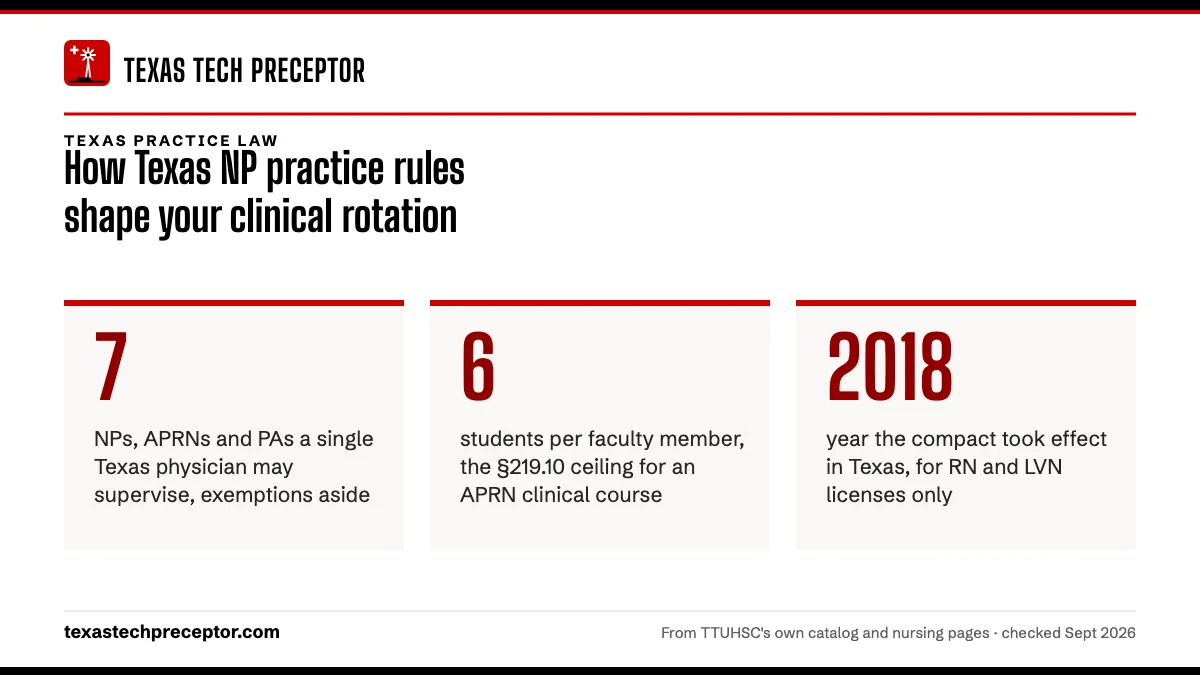
Texas Occupations Code §157.0512 caps the number of NPs, other APRNs and physician assistants a physician may supervise at seven, with exemptions written into the statute.
The cap shapes how practices are built. A clinic employing many nurse practitioners needs enough delegating physicians to stay within the limit, while a small rural clinic may rest on one physician's arrangement with a handful of APRNs. When a practice weighs hosting a TTUHSC student, the conversation may therefore include the physician and practice leadership, not only the NP you first asked.
A request that states the course, the dates, the weekly hours and TTUHSC's review steps up front is easier for all of those people to say yes to. That is why every outreach we make on a student's behalf opens with exactly those details.
Who can precept under 22 TAC §219.10
Texas's rule on clinical learning in APRN programs, 22 TAC §219.10, opens precepting to licensed APRNs and also to other clinicians holding a current license whose role equips them to supervise and teach in advanced practice settings. A physician can therefore precept an NP student when the course and the program allow it.
The rule expects three-way written agreements tying together the program, the preceptor and the facility, with each party's role set out. It asks that objectives be shared before the rotation starts, keeps faculty responsible for the student, and calls for regular contact among faculty, preceptor and student. When site visits are not feasible, faculty may stay in touch by phone, in writing or through simulation.
Chapter 219 formally governs programs seeking Board approval, and TTUHSC's own pages do not cite it. TTUHSC's process still mirrors its shape: the clinician and the site are signed off separately, and a fresh electronic agreement is filed per preceptor every term. TTUHSC does not publish graduate preceptor qualifications, so course faculty have the last word; see preceptor requirements and affiliation agreements.
The compact covers RNs, not APRNs
Texas put the enhanced Nurse Licensure Compact into effect on January 19, 2018. It gives RNs and LVNs one multistate license. Advanced practice sits outside it, and a Texas APRN license stands on its own.
The distinction matters twice. For your own enrollment, TTUHSC's MSN tracks ask for an unencumbered RN license from Texas or a compact multistate one, and its DNP programs accept an unencumbered RN license from any U.S. state; the RN license requirements page covers the exact wording. For your preceptor, a multistate RN license says nothing about advanced practice authority. What counts is the clinician's authorization to practice at the advanced level in the state where you train, and that is what gets verified.
Students living outside Texas carry one more step: a graduate online student planning a move must notify TTUHSC 60 days or more ahead, and whether clinicals can continue in the new state is settled one case at a time.
Statewide rules, regional realities
The law is the same across Texas, but the precepting landscape is not. Dallas-Fort Worth has large health systems with formal student processes of their own, some of which expect the student to arrive with a preceptor already arranged. West Texas cities offer fewer practices within an easy drive, and in rural counties one clinic's physician and APRN arrangement can decide whether a rotation happens at all. Federal shortage-area designations for primary care and mental health cover much of the state, which makes every willing preceptor valuable.
For local detail, read our guides to Lubbock, Dallas-Fort Worth and rural West Texas.
How we put these rules to work for you
Before TTUHSC ever sees a name, we test each candidate preceptor against these rules. We confirm the clinician's license and certification with the issuing source, record the practice setting and patient population, and ask how the practice involves students in prescribing under its agreements. On the facility side, we confirm who signs and whether an agreement with TTUHSC is already in place.
The result is a preceptor who fits Texas practice law, your course and TTUHSC's review all at once. Share your course and town in the form below to begin.
Questions TTUHSC students ask
Can a physician be my preceptor in a Texas NP program?
Texas rule permits it: 22 TAC §219.10 extends preceptor eligibility beyond APRNs to other licensed clinicians qualified to supervise and teach advanced practice nursing students. Whether a physician suits a particular TTUHSC course is a question for your course faculty, since TTUHSC approves each preceptor and does not publish graduate preceptor qualifications. Ask before you commit.
Does a multistate RN license let me do NP clinicals in another compact state?
The compact covers only your RN license, so it answers part of the question. A clinical rotation outside Texas depends on TTUHSC's state list, its case-by-case approval, and any rules the other state applies to out-of-state programs. Check TTUHSC's licensure disclosure and talk with your program before planning a rotation across the state line.
Will I learn to prescribe controlled substances in a Texas rotation?
You will see prescribing within your preceptor's prescriptive authority agreement. For Schedule II drugs, Texas confines APRN prescribing to hospital facility-based practice and hospice, so in many outpatient clinics those decisions involve the physician. Ask your preceptor early how the practice handles controlled substances and where you can take part.
Why does TTUHSC approve the facility as well as the preceptor?
Texas rules expect written agreements that include the clinical facility, not only the clinician, and TTUHSC reflects that by approving both. An excellent preceptor at a facility TTUHSC has not approved is not yet a complete placement. That is why we check each practice's standing with TTUHSC at the very start of a search.
Related pages
Last checked 2026-09-26
We check these pages against TTUHSC's catalog, Student Handbook, program pages and licensure disclosures. Your course faculty, your program director and the plan of study for your cohort have the final word.
Your TTUHSC preceptor search, run by specialists.
Tell us your TTUHSC track, your next clinical course and the town you'll train near. We find preceptors who fit the course and pull together what SON staff and faculty need to approve both the clinician and the facility, early enough for the electronic preceptor agreement to go through before the term.
- Preceptors matched to the track: family primary care, adult-gerontology acute care, pediatrics, psychiatric mental health
- License, certification and facility details ready for TTUHSC's preceptor and facility approval
- In Lubbock, Amarillo, Abilene, the Permian Basin, Dallas-Fort Worth and the states TTUHSC accepts
Start your placement plan
Your track, your town and your next clinical term is all we need to begin.