NP preceptors in small-town and rural West Texas
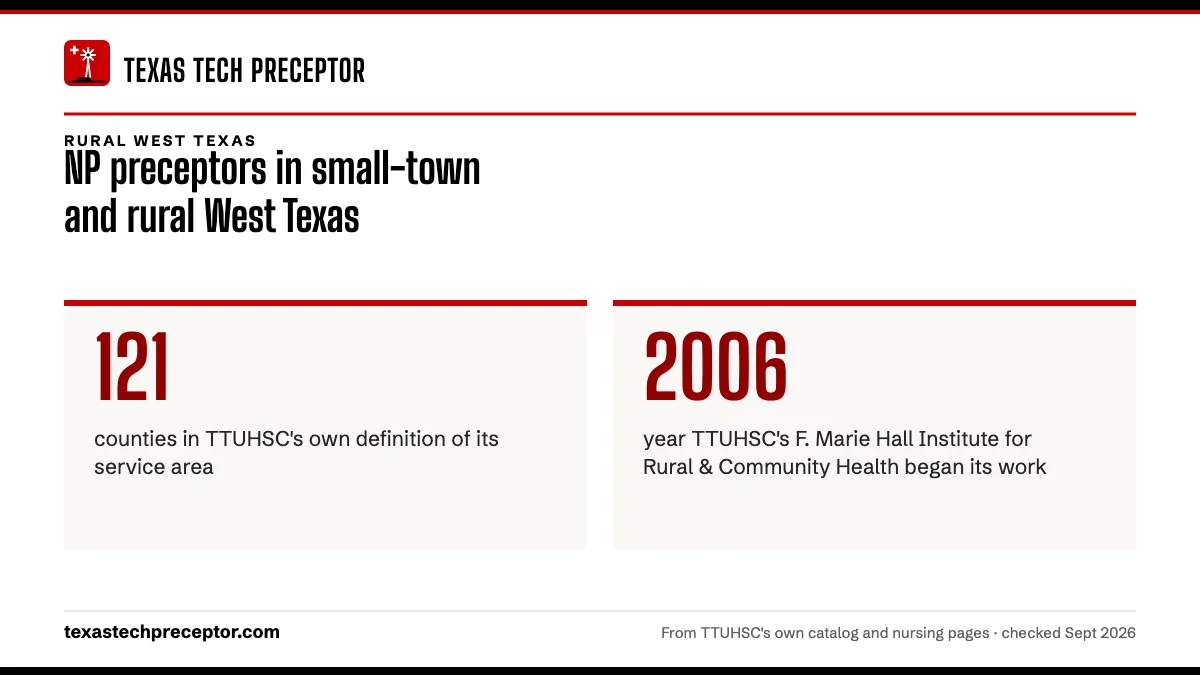
TTUHSC draws its students from a 121-county service area, and many graduate students live far from any of its campuses. In rural West Texas the preceptor question turns less on rules than on distance: finding a clinician whose patients fit your course, within a drive you can repeat every clinical day. This guide covers the map, the shortage-area picture and the TTUHSC-run programs working on rural health.
Get your placement plan
Tell us your TTUHSC program and where you live. A placement advisor replies with the preceptor and site options that fit your TTUHSC course.
What home area means when home is a small town
TTUHSC sizes its reach at 121 counties, drawing the line from where its programs have expanded, where alumni and current students live, and where clinical rotations and partner hospitals are. Most of that territory lies well outside the campus cities, and graduate NP students living there complete their clinical hours locally, with a preceptor they find and TTUHSC approves.
A small town can host a strong placement. A family practice or rural clinic may give an FNP student a broad caseload across ages, and one clinician can precept you across more than one semester if each course fits and a new electronic agreement is completed every term. The limits come from distance, the number of clinicians within reach, and how many students those clinicians already host.
Distance is the real constraint
The drive is easy to underestimate. Clinical hours build week after week, and a clinician two towns over turns every clinical day into a round trip. Put that commute into fuel, time and shifts missed at work before you commit, and ask about stacking hours into fewer, fuller days.
Campus travel adds to the miles. MSN NP students return to Lubbock for OSCEs as part of seven or eight campus days over the program, and BSN to DNP students attend intensives at least once a semester. If you live hours from Lubbock, block those trips on your preceptor's calendar when the term opens.
Faculty oversight at a distance has a legal footing too. Texas's rule for APRN programs keeps faculty responsible for your clinical learning and allows phone, written or simulation contact with the preceptor where a site visit is not feasible. TTUHSC does not publish its own site-visit practice, so ask course faculty how they will stay in touch with a remote preceptor. How Texas's APRN rules shape precepting covers the state side.
Shortage areas, measured the federal way
Rural West Texas is a story of access and distance, and federal shortage-area designations are how that gap gets measured. The statewide figures from HRSA's quarterly report are large.
| Type | Designations | Population of designated areas | Practitioners needed to remove designations |
|---|---|---|---|
| Primary care | 451 | 8,848,508 | 1,417 |
| Mental health | 412 | 14,065,653 | 631 |
Mental health designations cover far more Texans than primary care ones, a gap PMHNP students outside the cities feel directly. For your own county, HRSA's HPSA Find tool is the right source. Texas's state projections show nurse practitioner supply growing faster than demand statewide through 2036, so the rural gap is about where clinicians practice and how far patients travel. For a student, it shows up as fewer nearby clinicians to ask and more competition for the ones who say yes.
West Texas AHEC and the F. Marie Hall Institute
TTUHSC runs the West Texas Area Health Education Center through its F. Marie Hall Institute for Rural & Community Health, which has worked on rural and community health since 2006. The institute's signature programs also include the TexLa Telehealth Resource Center and the Next Gen 911 Telehealth Project.
The AHEC's stated aim is to bridge gaps in rural health care workforce development. Its listed programs include AHEC Jr. and Collegiate Scholars, Community Health Worker certification, High School Telemedicine Training, continuing education hours for health care specialties, and clinical training opportunities. TTUHSC's page describes no placement or housing help for graduate NP students, so count on the AHEC for context about rural care rather than as a source of NP preceptors, and ask course faculty if you hear otherwise.
San Angelo and Wichita Falls
San Angelo and Wichita Falls are regional hubs with no TTUHSC nursing campus, so graduate students there search the way rural students do, with more clinicians close by. A clinician in either city may already have another program's student booked for your term, so make first contact well before the semester.
In Wichita Falls, United Regional's page for residents and students lists a Graduate Nurse Residency, a Nurse Extern role and a Nursing Apprentice program, and it describes no route for NP or APRN students from outside programs. That makes individual clinicians, clinics and practices the search, with TTUHSC reviewing the facility. In San Angelo, confirm any hospital's student rules on its own official pages and approach clinicians directly. Tom Green and Wichita counties are both worth checking in HPSA Find. If the search stalls, our can't find a preceptor page lays out next moves.
Why rural West Texas students choose us
Rural searches reward persistence and local knowledge, and those are our strengths. We work the towns within a drive you can sustain, reach clinicians in rural clinics, regional hospitals and small practices, and set course fit against distance so you see real choices side by side.
Along with each match comes the groundwork: the clinician's credentials, a picture of the practice and its caseload, facts about the facility and whether TTUHSC already contracts with it, and the inputs for that term's preceptor agreement. If a rural preceptor leaves mid-plan, the replacement search starts at once; our preceptor dropped out page explains how. SON staff and faculty make the call, and a clean, complete file from us gives them what they need in one pass. Tell us your town and course through the form below.
Questions TTUHSC students ask
Can I complete all my TTUHSC NP clinicals in my small town?
Possibly, if a local clinician fits each course and SON staff and faculty approve both that preceptor and the facility. Different courses can call for different settings, so a town with one family practice may cover an FNP primary care course but not every rotation. Confirm fit course by course, and complete a new electronic agreement each semester.
Does the West Texas AHEC place NP students with preceptors?
TTUHSC's page for its F. Marie Hall Institute describes the West Texas AHEC's scholars programs, health worker certification, telemedicine training, continuing education and clinical training opportunities, but no placement or housing service for graduate NP students. Treat it as part of TTUHSC's rural health work, and ask course faculty if someone tells you it can place you.
How do TTUHSC faculty oversee a preceptor far from campus?
Texas's rule for APRN programs keeps faculty responsible for the clinical experience and permits phone, written or simulation contact with the preceptor when a site visit is not feasible. TTUHSC has not published how its own faculty handle site visits, so ask your course faculty early how they plan to stay in touch with a rural preceptor.
Does United Regional in Wichita Falls take NP students?
United Regional's resident and student page lists a Graduate Nurse Residency, a Nurse Extern role and a Nursing Apprentice program, with no process described for NP or APRN students from outside programs. If a clinician there agrees to precept you, ask how their department handles students and bring the details to TTUHSC for the facility review.
Why are preceptors hard to find in rural West Texas?
Mostly distance and density. Clinicians are spread thin across large counties, many areas carry federal shortage designations, and the clinicians who do take students may already host someone from another program. State projections show NP supply growing statewide, so the rural squeeze is about location and access rather than a lack of nurse practitioners in Texas overall.
Related pages
Last checked 2026-09-26
We check these pages against TTUHSC's catalog, Student Handbook, program pages and licensure disclosures. Your course faculty, your program director and the plan of study for your cohort have the final word.
Your TTUHSC preceptor search, run by specialists.
Tell us your TTUHSC track, your next clinical course and the town you'll train near. We find preceptors who fit the course and pull together what SON staff and faculty need to approve both the clinician and the facility, early enough for the electronic preceptor agreement to go through before the term.
- Preceptors matched to the track: family primary care, adult-gerontology acute care, pediatrics, psychiatric mental health
- License, certification and facility details ready for TTUHSC's preceptor and facility approval
- In Lubbock, Amarillo, Abilene, the Permian Basin, Dallas-Fort Worth and the states TTUHSC accepts
Start your placement plan
Your track, your town and your next clinical term is all we need to begin.