Moving to another state while you're a TTUHSC graduate student
TTUHSC requires every graduate online student to notify the School of Nursing at least 60 days before relocating to another state, and clinical approval in the new state is decided case by case around the placement you propose. Arrive at that conversation with a named preceptor and facility, and the review has something real to weigh.
Get your placement plan
Tell us your TTUHSC program and where you live. A placement advisor replies with the preceptor and site options that fit your TTUHSC course.
The 60-day relocation rule, in TTUHSC's words
The 2026-27 Student Handbook, in its School of Nursing General Information section, leaves no room for doubt: "Notification prior to relocating to another state is mandatory for all graduate online students." The notice must reach TTUHSC "a minimum of 60 days prior to the proposed move." It is one of the few firm dates TTUHSC prints anywhere in graduate clinical planning.
The rule applies across the MSN tracks, the BSN to DNP, the post-graduate certificates and the Post-Master's DNP, since all of them are delivered online. It is about more than a change of address. A new state brings a different board of nursing, a different line on TTUHSC's licensure disclosure and, nearly always, a new preceptor and facility for the next rotation.
The handbook ties relocation to your program director, so that is the first title to write to. Put the notice in writing, give the proposed move date, and keep a copy with your program records.
What "case-by-case" approval turns on
The same handbook passage continues: "Board of Nursing approval is attained on a case-by-case basis contingent upon the proposed clinical placement." Read the last four words carefully. The decision is not about a state in the abstract. It depends on where you would actually complete clinical hours, which means the specific preceptor and facility you put forward.
That gives you real influence over the outcome. A notice that says only "I am moving to Ohio in March" leaves the SON with nothing to evaluate. A notice that names a licensed preceptor, the practice, its city and the TTUHSC course those hours would serve lets staff and faculty look at an actual placement. Both the preceptor and the facility still need their approval, exactly as they would in Lubbock or Dallas, and the electronic preceptor agreement is still completed for each preceptor, each semester.
TTUHSC also states plainly that it cannot promise a relocating student's continuation in the program. Treat the notice as a proposal, and build it so the program has every reason to approve it.
States TTUHSC has already ruled out
Some destinations settle the question before any review begins. TTUHSC's professional licensure page flags ten states where the SON cannot take graduate students: Arizona, Arkansas, California, Colorado, Louisiana, New York, North Carolina, Oregon, Pennsylvania and Washington. The BSN to DNP table adds South Dakota, and Kansas is marked "Does not meet" for both Nurse-Midwifery and the BSN to DNP.
The same page says TTUHSC is unable to enroll students who are physically located in a state where licensure requirements are not met. A move into one of the flagged states therefore puts continued enrollment in question, not just a single rotation. Every graduate program page also carries TTUHSC's caution that changing regulations affect which states it can accept students from, and it sends out-of-state applicants to the Admissions Team to confirm eligibility.
The state-by-state reading, program by program, sits in the licensure disclosure guide. Check your destination there before you sign a lease.
Timing a move around a rotation
The riskiest move is one that lands in the middle of a clinical course. Your approved preceptor and facility are tied to a place, and the clinical portion of every graduate course is graded pass/fail: a failing clinical grade fails the whole course, whatever your exam average. Walking away from an approved site mid-term puts those hours in jeopardy unless a new placement is approved first.
Use the 2026-27 SON calendar when you pick a moving date. Fall runs Sept. 8 to Dec. 18, Spring from Jan. 11 to April 23, and Summer from May 24 to Aug. 13. A move between terms, with notice filed 60 days ahead, lets the next rotation begin in the new state on day one. Counting 60 days back from Jan. 11, for example, lands on Nov. 12, 2026, for anyone hoping to relocate just before Spring classes start.
If hours run past the end of a term, TTUHSC's "PR" (In Progress) grade exists mainly for clinical and practicum work that extends beyond the semester. Whether it applies to you is your course faculty's call, and the grades and progression guide covers how it works.
File the relocation notice before you commit to a moving date. The 60 days run from the move itself, and a rotation in the new state needs its preceptor and facility approved before hours count toward your course.
Your RN license and the new state's board
Two checks sit outside TTUHSC's notice. The first is your RN license. MSN students need a current, unencumbered Texas RN license or compact multistate license, and DNP students need a current, unencumbered U.S. RN license. A move can change your license situation, so confirm where you stand against the RN license guide before the notice goes in.
The second is the board of nursing where you are going. A number of boards regulate clinical placements made by out-of-state programs, and that filing belongs to the program rather than the student. North Dakota's board, for instance, recognizes distance programs that place APRN students, wants the program's request 60 days before any student activity, and then expects a semester-by-semester list of preceptors and facilities. Rules like that add lead time on TTUHSC's side, one more reason to give notice well beyond the minimum.
Each state guide summarizes what the board in your destination requires and what TTUHSC's disclosure says about it.
How we set up a rotation in your new state
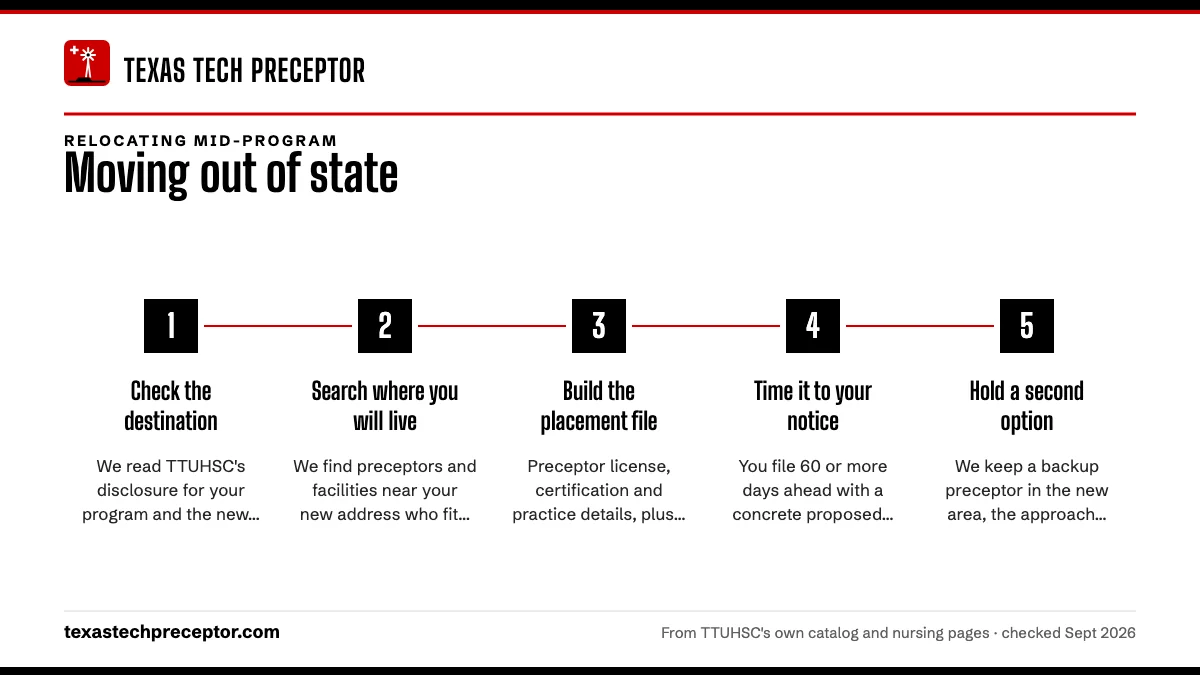
Relocating students choose us because we turn a vague plan into a placement TTUHSC can actually review, built in the new area before the moving truck is booked.
- Check the destinationWe read TTUHSC's disclosure for your program and the new state's board rule before a single call is made.
- Search where you will liveWe find preceptors and facilities near your new address who fit your TTUHSC course, and confirm their interest and availability for your term.
- Build the placement filePreceptor license, certification and practice details, plus facility details and agreement status, organized the way SON staff and faculty and the electronic agreement need them.
- Time it to your noticeYou file 60 or more days ahead with a concrete proposed placement attached; the approval decision stays with TTUHSC.
- Hold a second optionWe keep a backup preceptor in the new area, the approach described in our backup preceptor guide.
Your program director, SON staff and faculty make the final call. Our job is making sure what reaches them is complete and fits TTUHSC's rules the first time. Tell us your destination and move date using the form below.
Questions TTUHSC students ask
How far ahead do I tell TTUHSC I am moving to another state?
At least 60 days before the move. The Student Handbook makes notice mandatory for every graduate online student relocating to another state, and the 60 days are counted from the proposed move date, not from the start of a semester. Give more notice when a clinical course is coming up, because approval in the new state depends on the placement you propose.
Does moving within Texas need the same notice?
The handbook's notice rule is written for relocating to another state. A move from Amarillo to San Antonio still changes your home area, though, and any new preceptor and facility need SON approval plus a fresh electronic agreement for that semester. Tell your course faculty early so the next rotation is approved before it begins.
Can I keep my Texas preceptor after I move away?
TTUHSC publishes no rule on traveling back to a Texas site after relocating. Its out-of-state approval turns on the proposed clinical placement, so describe the plan honestly in your relocation notice and let your program director and course faculty decide. If you intend to return for shifts, say how often and for which course.
What if I move to a state TTUHSC cannot accept graduate students from?
TTUHSC's licensure page says it is unable to enroll students physically located in a state where licensure requirements are not met, and it names ten states the SON cannot accept graduate students from, with South Dakota added for the BSN to DNP. Speak with your program director before you commit to the move.
Does the 60-day rule apply to BSN students?
The notice rule names graduate online students. Traditional and Accelerated BSN students study on TTUHSC campuses, and faculty decide their clinical placements, so a move works differently for them and starts with a conversation with their program director. Our BSN programs guide explains how campus clinicals are assigned.
Related pages
Last checked 2026-09-26
We check these pages against TTUHSC's catalog, Student Handbook, program pages and licensure disclosures. Your course faculty, your program director and the plan of study for your cohort have the final word.
Your TTUHSC preceptor search, run by specialists.
Tell us your TTUHSC track, your next clinical course and the town you'll train near. We find preceptors who fit the course and pull together what SON staff and faculty need to approve both the clinician and the facility, early enough for the electronic preceptor agreement to go through before the term.
- Preceptors matched to the track: family primary care, adult-gerontology acute care, pediatrics, psychiatric mental health
- License, certification and facility details ready for TTUHSC's preceptor and facility approval
- In Lubbock, Amarillo, Abilene, the Permian Basin, Dallas-Fort Worth and the states TTUHSC accepts
Start your placement plan
Your track, your town and your next clinical term is all we need to begin.