The RN license each TTUHSC nursing program asks for
For the MSN, TTUHSC's Student Handbook accepts two kinds of RN license, Texas or compact multistate, each current and unencumbered. DNP and RN to BSN students may hold theirs in any U.S. state. The BSN to DNP breaks that tidy split: its program page and its catalog entry word the rule differently, so settle it with TTUHSC before you apply.
Get your placement plan
Tell us your TTUHSC program and where you live. A placement advisor replies with the preceptor and site options that fit your TTUHSC course.
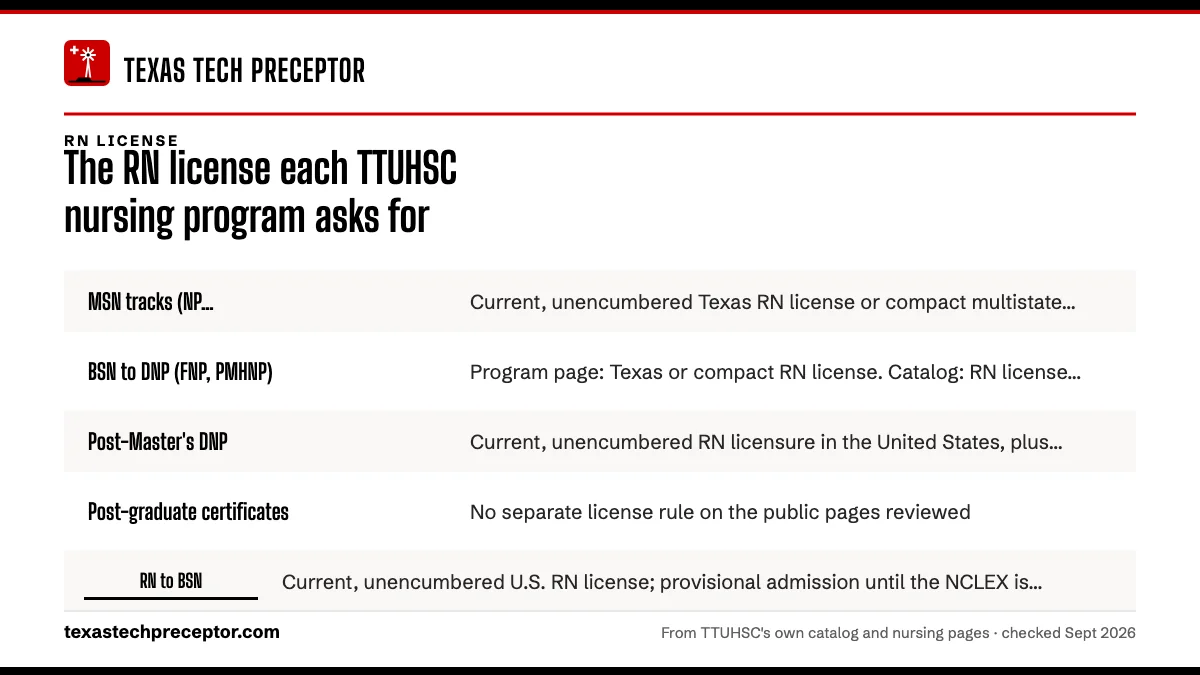
The license rule, program by program
TTUHSC states its license requirement in three places: the 2026-27 Student Handbook, the catalog's admission criteria and the ttuhsc.edu program pages. For most programs they line up. The table shows what each source prints, with the BSN to DNP difference left visible.
| Program | License TTUHSC asks for | Where it is stated |
|---|---|---|
| MSN tracks (NP, nurse-midwifery, leadership, education, informatics) | Current, unencumbered Texas RN license or compact multistate license | Student Handbook; the catalog's admission list asks for a valid, unencumbered RN license |
| BSN to DNP (FNP, PMHNP) | Program page: Texas or compact RN license. Catalog: RN license, no state named | FNP program page; 2026-27 catalog; the handbook's DNP rule is a U.S. RN license |
| Post-Master's DNP | Current, unencumbered RN licensure in the United States, plus NP or CNM board approval and national certification on the Advanced Nursing Practice track | 2026-27 catalog and program page |
| Post-graduate certificates | No separate license rule on the public pages reviewed | Confirm with the Admissions Team |
| RN to BSN | Current, unencumbered U.S. RN license; provisional admission until the NCLEX is passed | Student Handbook; RN to BSN program page |
The MSN rule: Texas or compact multistate
For every MSN track, the handbook asks for "a current, unencumbered Texas RN License or Compact Multistate License." The catalog's admission list uses the plainer phrase "valid unencumbered RN license," and the handbook then narrows it to those two kinds.
A Texas license meets the rule wherever you live. So does a multistate license issued by another compact state, since the compact's single multistate license covers RN practice across member states, Texas included. A single-state license from outside the compact is neither, so an MSN applicant holding only that kind should plan on adding a Texas license or confirm another route with the Admissions Team.
Experience rules sit beside the license and differ by track, from none for the PMHNP to two years of pediatric nursing for the pediatric NP tracks. Each program guide, such as the MSN FNP, lists its own.
What the Nurse Licensure Compact covers in Texas
According to the Texas Board of Nursing, the enhanced Nurse Licensure Compact took effect in Texas on January 19, 2018. It gives registered nurses and licensed vocational nurses one multistate license. Advanced practice licensure sits outside it: the Board's compact page covers RNs and LVNs, and the Texas APRN license is separate.
For an MSN student living in a member state such as Georgia or Missouri, a license issued there as multistate already answers TTUHSC's rule, with no second application to the Texas Board. A license issued as single-state, even by a compact member, does not.
That line matters twice for a TTUHSC student. During the program, the compact only answers the RN license question TTUHSC's rule asks. After graduation, working as a nurse practitioner or nurse-midwife means holding the APRN license of the state where you practice. How Texas regulates that practice, including prescriptive authority agreements, is covered in Texas NP practice and preceptors.
Living outside Texas
Most states belong to the compact. Among the states TTUHSC accepts graduate students from, the ones outside it are Alaska, Hawaii, Illinois, Michigan, Minnesota and Nevada, along with Massachusetts, which has enacted the compact but whose board is targeting implementation for May 2027. MSN students living in those states have no home-state multistate license to offer, so the Texas license route is the one to plan for.
Several other non-compact states appear among those TTUHSC has closed to graduate applicants; the licensure disclosure names all ten. Texas's neighbors New Mexico and Oklahoma are both compact states, so a multistate license from either meets the MSN rule, as the Oklahoma guide explains.
A mid-program move is a separate matter from the license. Graduate online students owe TTUHSC 60 days' warning before a move, and whether clinicals can continue in the new state is judged one student at a time (moving out of state).
The BSN to DNP wording conflict
For the BSN to DNP, TTUHSC's sources disagree. The live FNP program page asks for a "Valid unencumbered Texas or Compact RN License." The 2026-27 catalog entry asks only for a "Valid unencumbered RN License," and the Student Handbook's rule for DNP students is a current, unencumbered U.S. RN license.
The gap matters most to applicants licensed in a non-compact state, who meet the catalog's and handbook's wording but not the program page's. TTUHSC names the catalog as its official record for program requirements, yet this is worth settling in writing: ask the Admissions Team which license your application needs and keep the reply with your records. The BSN to DNP FNP guide covers the rest of that program.
Applying to the BSN to DNP with a single-state license from outside Texas? Get TTUHSC's answer on the license rule before you submit, because its own pages word it two ways.
Post-Master's DNP, certificates and RN to BSN
The Post-Master's DNP asks for current, unencumbered RN licensure in the United States. Applicants to its Advanced Nursing Practice track also need board recognition in their state as an NP or CNM, a national certification, and a year or more of practice as an APRN. The Executive Leadership track asks instead for at least a year in a health care leadership position. Practicum hours may take place at your own workplace when the experience meets the learning objectives and faculty approve it, as the Post-Master's DNP guide explains.
The post-graduate certificates carry no separate license statement on the public pages reviewed here, so confirm the rule with the Admissions Team when you apply. The RN to BSN takes a U.S. RN license, and its program page allows provisional admission until a new graduate passes the NCLEX.
The preceptor's license, prepared for you
Your license gets you into the program; your preceptor's license helps get each rotation approved. Under 22 TAC §219.10, an APRN program may place students with advanced practice nurses or with other licensed clinicians qualified to teach at that level, and each preceptor and each facility goes through approval by SON staff and faculty. TTUHSC does not publish further graduate preceptor qualifications, such as license type or years of practice, so we match each preceptor to your course and your course faculty confirm the fit.
TTUHSC students choose us because we handle that preparation thoroughly. Our team locates a nearby preceptor matched to your course, assembles that preceptor's credentials and practice information in the shape TTUHSC's agreement expects, and checks where the facility stands on its affiliation agreement, so the file SON reviewers open is whole on the first pass. Use the form below to start.
Questions TTUHSC students ask
Can I enroll in TTUHSC's MSN with a single-state RN license from another state?
The handbook's MSN rule names two acceptable licenses, Texas or compact multistate, and a single-state license from outside the compact fits neither. The direct route is adding a Texas license. Confirm your options with the Admissions Team before you apply, so your file matches the rule from the first day.
Does a compact RN license let me practice as a nurse practitioner in other states?
No. The Nurse Licensure Compact covers registered nurses and licensed vocational nurses, not advanced practice nurses. Texas implemented it in 2018, and the Texas APRN license is separate. After graduation, plan on holding the APRN license each state requires where you intend to practice.
Does TTUHSC require RN experience before its NP tracks?
It depends on the track. The MSN FNP asks for one year of RN experience, the AGACNP a year in intensive care, flight or emergency nursing within the past five years, and both pediatric tracks two years of pediatric nursing. The MSN PMHNP and BSN to DNP PMHNP require no prior nursing experience, while the BSN to DNP FNP asks for two years.
What RN license do TTUHSC DNP students need?
The handbook's rule for DNP students is a current, unencumbered U.S. RN license, and the Post-Master's DNP catalog entry matches it. The BSN to DNP is less settled: its program page asks for a Texas or compact license, while its catalog entry names no state. Get a written answer from the Admissions Team before applying.
Does moving to another state change TTUHSC's license rule?
The rule stays the same, but the move adds TTUHSC's relocation steps: TTUHSC expects 60 days' notice before a graduate online student relocates, and it reviews clinical approval in the new state individually. If you move between compact and non-compact states, check whether your license still meets TTUHSC's rule after the move.
Related pages
Last checked 2026-09-26
We check these pages against TTUHSC's catalog, Student Handbook, program pages and licensure disclosures. Your course faculty, your program director and the plan of study for your cohort have the final word.
Your TTUHSC preceptor search, run by specialists.
Tell us your TTUHSC track, your next clinical course and the town you'll train near. We find preceptors who fit the course and pull together what SON staff and faculty need to approve both the clinician and the facility, early enough for the electronic preceptor agreement to go through before the term.
- Preceptors matched to the track: family primary care, adult-gerontology acute care, pediatrics, psychiatric mental health
- License, certification and facility details ready for TTUHSC's preceptor and facility approval
- In Lubbock, Amarillo, Abilene, the Permian Basin, Dallas-Fort Worth and the states TTUHSC accepts
Start your placement plan
Your track, your town and your next clinical term is all we need to begin.