When a TTUHSC preceptor or site falls through
TTUHSC publishes no separate graduate procedure for a lost preceptor, so its standing rules decide the fix: the replacement must fit your course, SON staff and faculty approve the new preceptor and any new facility, and each preceptor you use gets an electronic agreement for the semester. A backup you prepared before you needed it is the quickest way through all three.
Get your placement plan
Tell us your TTUHSC program and where you live. A placement advisor replies with the preceptor and site options that fit your TTUHSC course.
What TTUHSC's rules mean for a replacement
Nothing on TTUHSC's public pages describes a special track for graduate students whose preceptor or site drops away. The general rules do the work instead. Securing preceptors is the student's task, measured against what each clinical course requires. SON staff and faculty review and approve the preceptor and the facility, both of them. An electronic agreement is completed for each preceptor a student works with in a given semester.
Taken together, those rules make a replacement a new placement rather than a name swap. The new clinician has to suit the course, a new facility has to clear approval, and a fresh agreement has to be done for that preceptor. The search starts with you; the decision rests with TTUHSC.
Support is available along the way. Current graduate students can use TTUHSC's list of preceptors from the past two years as a guide, and the BSN to DNP pages describe faculty and a preceptor team helping with selection and contracting. Nurse-Midwifery placements are coordinated, so midwifery students go to their faculty and site coordinators first. The preceptor list and preceptor team guide explains both resources.
Sort out approval before the first shift with a replacement: TTUHSC's approval covers the preceptor and the facility, and every preceptor you use that semester needs an agreement of their own.
Why a replacement takes more than a phone call
What a replacement needs in place
- A clinician who fits the course. Texas rule 22 TAC §219.10 lets APRN programs use APRNs or other currently licensed professionals able to supervise at an advanced practice level, and TTUHSC approves the individual. The preceptor requirements guide covers the detail.
- An approved facility. A different practice or hospital needs SON approval too, plus an affiliation agreement where the facility requires one. The Clinical Placement, Affiliation Agreements, and Preceptor Management unit handles that side.
- A new electronic preceptor agreement for that clinician in the current semester.
- Your clearance in order. TTUHSC runs drug screens before placement in most clinical settings and gives students five days to complete one when asked, and your BLS plus any course certification, such as ACLS or PALS, has to be current.
Health systems add their own steps on top. Covenant Health in Lubbock, for example, requires an affiliation agreement with the student's school, leaves procuring the preceptor to the student, and wants rotation paperwork at least two weeks before the start date. A replacement at a system like that carries a built-in delay, so start early.
Build the backup before you need it
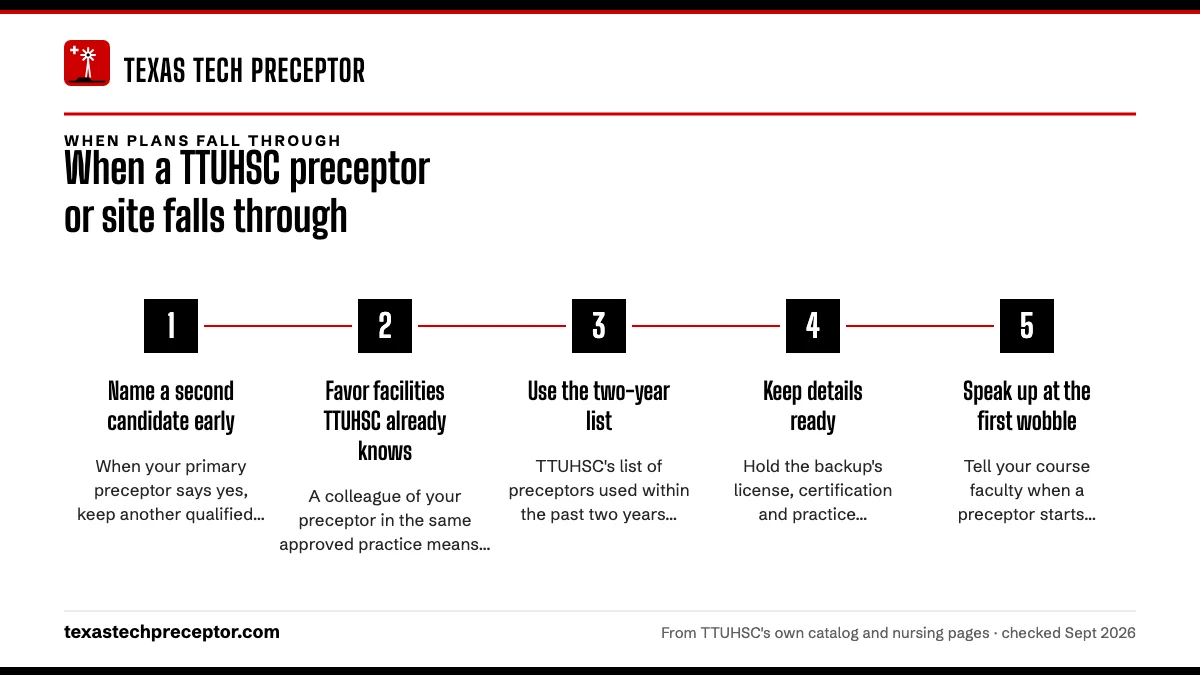
A backup prepared in advance turns a cancellation into paperwork instead of a crisis. These habits cost little at the start of a term and save weeks later.
- Name a second candidate earlyWhen your primary preceptor says yes, keep another qualified clinician in the same specialty and area in view, with availability noted.
- Favor facilities TTUHSC already knowsA colleague of your preceptor in the same approved practice means the facility has already been through SON review.
- Use the two-year listTTUHSC's list of preceptors used within the past two years points to clinicians who have worked with TTUHSC students before.
- Keep details readyHold the backup's license, certification and practice information so an agreement can move the week you need it.
- Speak up at the first wobbleTell your course faculty when a preceptor starts cutting shifts, not after your hours have stalled.
The grades riding on missed hours
Clinical time carries real weight at TTUHSC. The clinical portion of a graduate course is graded pass/fail, and an unsatisfactory clinical result makes the final course grade an F whatever the exam scores. Graduate students need a B or better in each nursing course, and a course can be repeated only once.
When a practicum runs long, the handbook reserves "PR" (In Progress) for work that extends beyond the semester, used mostly in clinical and practicum courses. An Incomplete is narrower: it covers satisfactory work left unfinished for reasons beyond the student's control, and it becomes an F after a year on the record. Your course faculty decide which, if either, applies. Dropping is the last resort, and the handbook cautions that it may delay progression through the curriculum.
The complete rules, including repeats and dismissal, are in the grades and progression guide.
Timing a recovery on the 2026-27 calendar
How much room you have depends on the term. Fall and Spring each run about 15 weeks (Sept. 8 to Dec. 18, then Jan. 11 to April 23), while Summer covers about 12 (May 24 to Aug. 13). A preceptor lost in July leaves far less time to recover hours than one lost in September.
Keep the drop dates in view as well. In Fall 2026 the automatic W ends Oct. 15 and the last day to drop a course is Dec. 7. Spring 2027's matching dates are Feb. 18 and April 12, and Summer's are June 24 and Aug. 2. A replacement lined up well before those dates keeps every option open. The academic calendar guide lists each deadline.
The hardest moment to lose a preceptor is right before a term starts, when the new semester's agreement is also due. If that is where you are, need a preceptor fast covers the short-notice route.
How we keep a dropped preceptor from costing you a term
TTUHSC students choose us because every placement we make comes with a plan B. When we match you with a preceptor, we also identify a backup who fits the same course and area, so a cancellation starts a replacement rather than a search from zero.
If a preceptor drops, we stay on call. We reopen the search the same day, confirm a replacement's availability for the weeks you have left, and assemble the preceptor's license, certification and practice details alongside the facility information SON staff and faculty review. You complete the electronic agreement with everything already in hand. TTUHSC's staff and faculty give the final approval; we make sure what reaches them is complete and fits the rules the first time.
Already in the middle of one? Read what to do when a preceptor drops out, then send us your course and remaining hours through the form below.
Questions TTUHSC students ask
What should I do first if my TTUHSC preceptor cancels?
Tell your course faculty that day, in writing, with the hours you have finished and the hours still owed. Then start on a replacement who fits the course, ideally at a facility TTUHSC has already approved. Each new preceptor needs SON approval and an electronic agreement for the semester, so early notice buys time for both steps.
Does a replacement preceptor need a new electronic agreement?
Yes. TTUHSC's graduate FAQ describes an electronic agreement process covering each preceptor a student uses in every semester, so a second preceptor in the same term gets an agreement of their own. The system's name is not published; your course materials and the Graduate Coordinator can point you to the current process.
Can I use two preceptors in one TTUHSC clinical course?
TTUHSC's wording, an agreement for every preceptor used in a semester, anticipates students working with more than one. Splitting hours between two approved preceptors can protect you if one cuts back. Each clinician and each facility still needs approval, and your course faculty decide whether the split meets the course requirements, so ask before you plan it.
Will TTUHSC find a new preceptor for me?
In the NP tracks, obtaining preceptors is the student's responsibility, and TTUHSC approves the result. BSN to DNP students have faculty and the preceptor team helping with selection and contracting, and Nurse-Midwifery placements are coordinated by faculty and site coordinators. The two-year preceptor list gives current graduate students a starting point.
Can I finish missed clinical hours after the semester ends?
Sometimes. TTUHSC's handbook uses the "PR" (In Progress) grade mainly for clinical and practicum courses whose work extends beyond the semester. It does not publish how many hours must be done first, so your course faculty decide. Raise it as soon as you know hours will fall short, not in the final week.
Related pages
Last checked 2026-09-26
We check these pages against TTUHSC's catalog, Student Handbook, program pages and licensure disclosures. Your course faculty, your program director and the plan of study for your cohort have the final word.
Your TTUHSC preceptor search, run by specialists.
Tell us your TTUHSC track, your next clinical course and the town you'll train near. We find preceptors who fit the course and pull together what SON staff and faculty need to approve both the clinician and the facility, early enough for the electronic preceptor agreement to go through before the term.
- Preceptors matched to the track: family primary care, adult-gerontology acute care, pediatrics, psychiatric mental health
- License, certification and facility details ready for TTUHSC's preceptor and facility approval
- In Lubbock, Amarillo, Abilene, the Permian Basin, Dallas-Fort Worth and the states TTUHSC accepts
Start your placement plan
Your track, your town and your next clinical term is all we need to begin.