Who can precept a TTUHSC nurse practitioner student
Texas allows two kinds of preceptor for APRN students, advanced practice nurses and other licensed clinicians fit to teach at that level, and TTUHSC approves each one against the clinical course you are taking. TTUHSC's public pages do not list graduate preceptor criteria such as license type or years in practice, so the Texas rule, your course and your faculty's approval together decide who qualifies.
Get your placement plan
Tell us your TTUHSC program and where you live. A placement advisor replies with the preceptor and site options that fit your TTUHSC course.
The Texas rule every APRN preceptor falls under
The Texas Board of Nursing sets clinical-learning rules for APRN programs in 22 TAC §219.10. On preceptors, it offers two routes. A preceptor may be licensed to practice as an advanced practice registered nurse, or may be another currently licensed health care professional able to supervise and teach in clinical settings suited to advanced practice nursing.
The same rule frames everything around the preceptor:
- A written agreement binds the program, preceptor and facility and states who is responsible for what
- Course objectives are shared with the preceptor before the experience begins
- The designated faculty member stays responsible and communicates regularly with preceptor and student
- Faculty may use phone, written or simulated contact when site visits are not feasible
- One faculty member should supervise no more than six students in a clinical course
TTUHSC's pages do not cite §219.10 by number, but as a Texas APRN program it works inside this framework.
What TTUHSC itself publishes about preceptors
TTUHSC's public statement is about approval rather than a checklist. Before any hours count, SON staff and faculty must clear both the preceptor and, separately, the facility. The current program pages, the catalog and the Student Handbook do not set out graduate preceptor qualifications such as license type, specialty certification or years of experience.
The one written preceptor standard in public view is on the undergraduate side. SON OP 30.725, the Traditional BSN preceptor policy, requires an unencumbered Texas or compact nursing license and has office staff verify it on the Texas Board of Nursing site. It does not govern NP students, but it shows that license verification is part of how TTUHSC approves preceptors.
For your own course, the criteria come from course faculty and the Graduate Coordinator. Asking before you approach a clinician saves you from a yes you cannot use.
Matching a preceptor to your TTUHSC track
Approval turns on fit with the course, so start from the setting each track's clinical courses center on. Course titles and numbers below are TTUHSC's; the right preceptor practices in that setting and sees that population day to day.
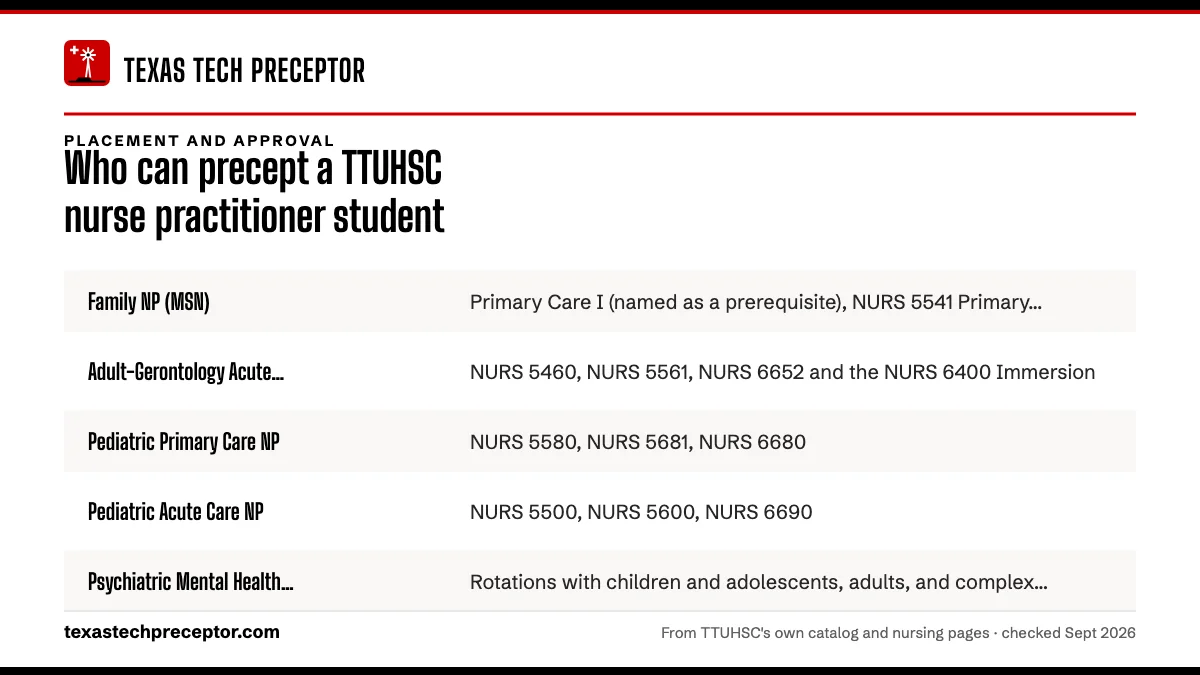
| Track | Clinical courses TTUHSC lists | Practice that fits |
|---|---|---|
| Family NP (MSN) | Primary Care I (named as a prerequisite), NURS 5541 Primary Care II, NURS 6660 FNP Practicum | Family and primary care practice |
| Adult-Gerontology Acute Care NP | NURS 5460, NURS 5561, NURS 6652 and the NURS 6400 Immersion | Acute care of adults and older adults |
| Pediatric Primary Care NP | NURS 5580, NURS 5681, NURS 6680 | Pediatric primary care |
| Pediatric Acute Care NP | NURS 5500, NURS 5600, NURS 6690 | Pediatric acute care |
| Psychiatric Mental Health NP | Rotations with children and adolescents, adults, and complex psychiatric patients | Psychiatric and mental health care for that rotation's age group |
Post-graduate certificate students take matching population-focus courses on individualized plans, and the FNP certificate uses its own course numbers. Course-by-course detail is on FNP clinical courses and the other course guides.
What approval looks at, in practice
Without a published checklist, the strongest approach is to have every fact about a preceptor ready before you submit. Faculty deciding whether someone fits your course will want to know who the person is, what they are licensed and certified to do, and where and whom they treat.
- License type, issuing state and status, as shown on that state board's verification site
- National certification and the population it covers
- Specialty and practice setting, lined up with the course's focus
- The facility, its address and whether it has a TTUHSC agreement
- The days and hours the preceptor can supervise you during the term
A physician or another licensed clinician may fit the Texas rule's second route. Whether TTUHSC accepts one for your particular course is a question for course faculty, so settle it before relying on that preceptor.
How Texas practice rules shape a preceptor's schedule
Texas NPs practice under physician delegation. AANP classes Texas as restricted practice, NPs prescribe under a prescriptive authority agreement with a delegating physician, and the two meet at least monthly. A physician may supervise no more than seven NPs, PAs and other APRNs, with some exemptions.
None of this stops an NP from precepting, but it means your preceptor's practice has structure around it: a delegating physician, written protocols and sometimes a facility's own credentialing process for students. Those details shape which days you attend and which patients you see. The Texas NP practice guide covers the rules in full. Ask a prospective preceptor early whether the practice or facility needs anything extra from students before the first shift.
Preceptors outside Texas
Graduate students living outside Texas work with preceptors licensed where they practice, under the same TTUHSC approval of preceptor and facility. The Texas rule governs TTUHSC as a Texas program; the preceptor's own state board governs the preceptor's license. Some states also set their own requirements for out-of-state programs placing students there.
Some states are closed to TTUHSC graduate students under its licensure page, so check the licensure disclosure before recruiting a preceptor in a new state, and your state's page in the state guides for local rules. The Nurse Licensure Compact covers RN licenses, not APRN licenses, so a compact RN license says nothing about where an NP preceptor may practice. Check the preceptor's license in that state's own board lookup.
How we vet preceptors before TTUHSC sees them
Every preceptor we bring to a TTUHSC student is checked against the course before the student hears the name. Our placement desk confirms the license and its status with the issuing board, the certification and its population, the practice setting, and the facility's agreement status, then matches all of it to the clinical course on your plan.
You receive a preceptor profile organized the way approval needs it, ready for your course faculty and for the electronic preceptor agreement. The decision is TTUHSC's, made by its staff and faculty; we make sure the profile they read is complete and squarely within TTUHSC's rules on the first submission. Start with the form below.
Questions TTUHSC students ask
Can a physician precept a TTUHSC NP student?
Potentially. The Texas rule's second route covers other currently licensed health care professionals qualified to supervise and teach at an advanced practice level, not only APRNs. TTUHSC approves each preceptor for a specific course, and its public pages do not list which professions it accepts, so confirm with your course faculty before asking a physician.
How many years of experience does a TTUHSC preceptor need?
TTUHSC does not publish a minimum for graduate preceptors. Ask course faculty or the Graduate Coordinator what the course expects. A preceptor with a current, unencumbered license and a practice that clearly matches the course is the strongest starting point for approval.
Does my preceptor need a Texas license?
A preceptor needs a license valid where they practice. TTUHSC's undergraduate policy asks for a Texas or compact nursing license, but graduate rules are not published, and graduate students in other states train under preceptors licensed there. Confirm any state-specific expectations with your course faculty before you commit.
Can one preceptor cover all my clinical courses?
Only if their practice fits each course. A family practice preceptor may suit more than one primary care course, while pediatric acute care or psychiatric rotations point to different settings. Each semester still needs its own agreement for each preceptor; see the electronic preceptor agreement.
Does TTUHSC offer preceptors anything for precepting?
TTUHSC's public pages do not describe preceptor benefits such as continuing education or library access. Clinicians thinking about hosting a TTUHSC student can read precepting a TTUHSC student for what the role involves and how a match with a student comes together.
Related pages
Last checked 2026-09-26
We check these pages against TTUHSC's catalog, Student Handbook, program pages and licensure disclosures. Your course faculty, your program director and the plan of study for your cohort have the final word.
Your TTUHSC preceptor search, run by specialists.
Tell us your TTUHSC track, your next clinical course and the town you'll train near. We find preceptors who fit the course and pull together what SON staff and faculty need to approve both the clinician and the facility, early enough for the electronic preceptor agreement to go through before the term.
- Preceptors matched to the track: family primary care, adult-gerontology acute care, pediatrics, psychiatric mental health
- License, certification and facility details ready for TTUHSC's preceptor and facility approval
- In Lubbock, Amarillo, Abilene, the Permian Basin, Dallas-Fort Worth and the states TTUHSC accepts
Start your placement plan
Your track, your town and your next clinical term is all we need to begin.