Can your TTUHSC clinicals happen where you work?
It depends on your program. TTUHSC limits undergraduates on their own units, openly allows Post-Master's DNP practice hours at the student's employer, and publishes no workplace rule for the nurse practitioner tracks, where the usual approval of preceptor and facility decides. Ask your course faculty before you ask your manager.
Get your placement plan
Tell us your TTUHSC program and where you live. A placement advisor replies with the preceptor and site options that fit your TTUHSC course.
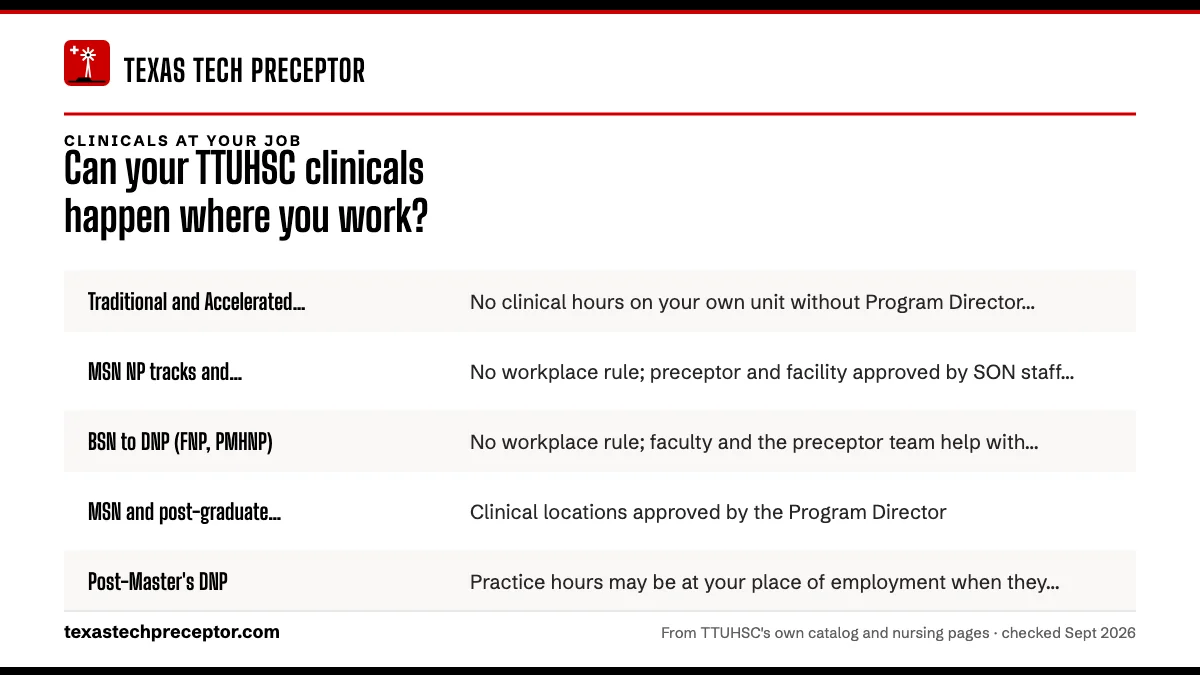
The short answer, program by program
TTUHSC writes a workplace rule for only two groups. Undergraduates face a limit on using their own unit, and Post-Master's DNP students are told directly that practice hours may happen at their employer. For the MSN nurse practitioner tracks, the BSN to DNP and the post-graduate certificates, no public page addresses clinicals at your own job one way or the other.
Silence is not permission. The standing graduate rules follow the hours wherever they happen: you locate a preceptor suited to the course, SON staff and faculty sign off on that preceptor and the facility, and an electronic agreement is completed for each preceptor every semester. An employer eager to host you still has TTUHSC's review ahead of it.
| Program | What TTUHSC publishes | Who decides |
|---|---|---|
| Traditional and Accelerated BSN | No clinical hours on your own unit without Program Director permission; no "double-dipping" | Clinical faculty and the Program Director |
| MSN NP tracks and post-graduate NP certificates | No workplace rule; preceptor and facility approved by SON staff and faculty | Course faculty and SON staff |
| BSN to DNP (FNP, PMHNP) | No workplace rule; faculty and the preceptor team help with selecting and contracting | Faculty and the preceptor team |
| MSN and post-graduate Nurse-Midwifery | Clinical locations approved by the Program Director | Program Director |
| Post-Master's DNP | Practice hours may be at your place of employment when they meet the learning objectives | Faculty |
| MSN Informatics and Intelligent Systems | Faculty-guided practicum in a virtual setting | Faculty |
The undergraduate rule: not on your own unit
The Student Handbook's undergraduate rules are the most explicit TTUHSC gets on this subject. A BSN student may not complete clinical hours on the unit where they are employed without permission from the Program Director, and the handbook rules out what it calls "double-dipping", which in ordinary usage means counting the same hours as both paid work and clinical time.
For most undergraduates the question never arises, because TTUHSC places them. Clinical faculty make the placement decision for each clinical course, with every effort made to find a facility convenient for the student. Traditional BSN students train across Abilene, Amarillo, Lubbock, Mansfield and the Permian Basin, and the BSN programs guide explains how that assignment works.
The rule still matters to graduate students, many of whom work as RNs. It shows how TTUHSC frames the issue: the student role and the job are separate, and permission comes before the hours, not after them.
The Post-Master's DNP: employer practicums by design
Here TTUHSC is explicit. The 2026-27 catalog says: "Practicum experiences/practice hours may take place in the student's place of employment if the experience clearly provides an opportunity to achieve specified student learning objectives." It adds that students may work with professional mentors or preceptors approved by faculty, and that School of Nursing faculty may take that role themselves.
The program is designed around that flexibility. Each student completes at least 500 clinical and practice hours inside the TTUHSC DNP, 1,000 once the master's hours are included, spread across practicum-linked courses such as NURS 6325, NURS 6344, NURS 7311 and the NURS 7552 DNP Project Seminar and Practice Immersion. The catalog's list of qualifying activity is broad, from direct or indirect patient care to interviews, community events and relevant professional meetings.
The test is the learning objective, not the employer's name. A project at your own organization qualifies when it plainly lets you meet the course objectives and faculty approve your mentor. The Post-Master's DNP guide covers the plan of study.
NP students: questions to settle before planning hours at work
Since TTUHSC's NP pages say nothing on the subject, the answer for your course comes from your course faculty or the Graduate Coordinator. Raise it before you approach a manager, and keep the reply in writing.
Questions to put to your course faculty
- Can my employer serve as the approved facility for this course, and does it already hold an affiliation agreement with TTUHSC?
- Should the rotation sit outside my own department or clinic?
- Can a coworker, or someone I report to, act as my preceptor?
- How should clinical hours be kept apart from my scheduled RN shifts?
- Does the setting give me the patient population this course requires?
Whatever the answers, the preceptor must meet Texas's standard for APRN clinical teaching and win TTUHSC's approval, as set out in preceptor requirements. The facility goes through SON review too, including the affiliation agreement step where one is needed.
Leadership, Education and Informatics practicums
The non-APRN MSN tracks treat practice time in their own ways. Advanced Nursing Leadership runs four practicums, NURS 5211 through NURS 5214, at 128 practicum hours each, and Practicum II centers on a quality improvement project at a practice site, approved by that site and by TTUHSC's QIRB. TTUHSC does not publish who arranges these sites, so nurse leaders should ask faculty whether their own organization can host.
The Nursing Education track's NURS 6368 immersive teaching practicum takes place under an approved preceptor, which again means faculty sign off on the person and the setting. The Informatics and Intelligent Systems practicum is faculty-guided and fully virtual, so no outside site enters the picture. The leadership practicums guide has the course-by-course detail.
Why working nurses choose us
Many of the TTUHSC students we serve hold full-time RN jobs, and we plan around the job rather than against it. If your employer can serve as the approved facility, we help you frame the request to faculty and gather the facility's details. If it cannot, or you would rather keep work and school apart, we find a preceptor and site near home that fit your course and your shift pattern.
Either way, we assemble what TTUHSC's approval asks for: the preceptor's license, certification and practice details, the facility's information and agreement status, and everything the electronic agreement needs each semester. SON staff and faculty make the decision; we make sure the file reaching them is complete and fits TTUHSC's rules the first time. Read how it works, or send us your schedule through the form below.
Questions TTUHSC students ask
Can my TTUHSC FNP clinical hours be at the hospital where I work?
TTUHSC's public pages neither allow nor forbid it for the NP tracks. The standing requirements apply: SON staff and faculty must approve both your preceptor and the facility, and each preceptor needs an electronic agreement each semester. Ask your course faculty before arranging anything with your employer, and keep their answer in writing.
Can my manager or a coworker be my preceptor?
No TTUHSC page settles this for graduate students, so it belongs with your course faculty. Any preceptor has to meet the Texas standard for teaching APRN students and earn TTUHSC's approval. A person who supervises your paid work can blur the line between your job and your student role, so mention the reporting relationship when you ask.
Do my paid work hours count as clinical hours?
For undergraduates, the handbook rules out "double-dipping" and bars own-unit hours without Program Director permission. For graduate NP students TTUHSC publishes no rule, but clinical hours belong to the course and its approved preceptor, so plan on keeping student time separate from your shifts unless faculty tell you otherwise.
Can I do my Post-Master's DNP practicum at my employer?
Yes, when the fit is right. TTUHSC's catalog allows practicum and practice hours at the student's place of employment if the experience clearly offers a way to meet the specified learning objectives. Faculty approve the mentors or preceptors you work with, and School of Nursing faculty can serve in that role themselves.
Is my employer's agreement enough to start clinicals there?
It is only half of it. TTUHSC's SON staff and faculty approve the preceptor and the facility, the facility may need an affiliation agreement with TTUHSC, and the electronic preceptor agreement has to be completed for the semester. Health systems such as Covenant Health in Lubbock also run their own student paperwork on top.
Related pages
Last checked 2026-09-26
We check these pages against TTUHSC's catalog, Student Handbook, program pages and licensure disclosures. Your course faculty, your program director and the plan of study for your cohort have the final word.
Your TTUHSC preceptor search, run by specialists.
Tell us your TTUHSC track, your next clinical course and the town you'll train near. We find preceptors who fit the course and pull together what SON staff and faculty need to approve both the clinician and the facility, early enough for the electronic preceptor agreement to go through before the term.
- Preceptors matched to the track: family primary care, adult-gerontology acute care, pediatrics, psychiatric mental health
- License, certification and facility details ready for TTUHSC's preceptor and facility approval
- In Lubbock, Amarillo, Abilene, the Permian Basin, Dallas-Fort Worth and the states TTUHSC accepts
Start your placement plan
Your track, your town and your next clinical term is all we need to begin.