How TTUHSC handles nurse-midwifery clinical placement
Nurse-Midwifery is the TTUHSC graduate track where placement is coordinated rather than left to the student alone. Faculty work with each student and TTUHSC's preceptor/site coordinators, the Program Director approves every clinical location, and a clinical placement fee applies in each practicum semester.
Get your placement plan
Tell us your TTUHSC program and where you live. A placement advisor replies with the preceptor and site options that fit your TTUHSC course.
Coordinated placement, with the student involved
The Student Handbook sets out the model in one sentence: "The nurse-midwifery faculty work with the student and the TTUHSC preceptor/site coordinators to ensure each student has satisfactory clinical preceptors and sites." The program page adds that "All clinical experience learning hours completed in the Nurse-Midwifery population focus courses occur in locations approved by the Program Director."
Set that beside the nurse practitioner tracks, where students obtain their own preceptors for each clinical course and SON staff and faculty approve what they bring. Midwifery shares the work: faculty and coordinators are part of the search from the outset, and so is the student. Because the handbook has faculty working with you, your knowledge of your area, your contacts and your limits on travel are useful input, not an afterthought. The NP approach is explained in finding your own preceptor.
The same structure covers the MSN Nurse-Midwifery track and the Post-Graduate Nurse-Midwifery certificate, since both place population-focus clinical hours in Program Director-approved locations.
The clinical placement fee
Coordination comes with a charge. The handbook continues that "a clinical placement fee is charged for each semester the student is enrolled in a nurse-midwifery practicum course." In the full-time MSN plan that means three semesters: Fall Two, Spring Two and Summer Two. Part-time plans and the individualized post-graduate plans place practicum semesters differently, so count yours from your own plan of study.
TTUHSC's public handbook does not print the amount. Confirm the current figure with the midwifery program before your first practicum semester, and review your charges each term through the WebRaider Portal, where TTUHSC handles registration and payments.
Keep two other items separate from this fee. Midwifery students buy their own student malpractice insurance on top of the SON's blanket liability policy, and the placement and orientation deposit in the catalog is an enrollment deposit at admission, not a clinical charge. The handbook attaches the clinical placement fee to nurse-midwifery practicum courses; TTUHSC's NP track pages list no comparable charge. Coverage details are in insurance and HIPAA.
What must be in place before your first practicum
Before the first population-focus clinical course
- One year of birth support experience, required by TTUHSC before the first population-focus clinical course.
- NRP certification and a completed EFM course.
- Your own student malpractice insurance, due before midwifery clinical courses begin.
- BLS, plus TTUHSC's immunizations: hepatitis B, MMR, varicella, TB testing every year and influenza.
- A current, unencumbered Texas RN license or compact multistate license, and proof of HIPAA training each year.
- A drug screen when requested, since TTUHSC screens before placement in most clinical settings.
Labor and delivery experience is listed as preferred at admission, while the birth support year is a firm requirement. The immunizations and certifications guide covers the timing of each item, and midwifery students should start the NRP and EFM work well before Fall Two.
The practicum sequence placements serve
Each midwifery practicum is a precepted clinical course, so each needs a satisfactory preceptor and an approved site. In the full-time MSN plan, the first arrives one year after a Fall start.
| Course | Title | When |
|---|---|---|
NURS 5399 | Nurse-Midwifery Clinical Practicum A | Fall Two (full-time MSN) |
NURS 6520 | Nurse-Midwifery Integrated Clinical Practicum, Level B | Spring Two (full-time MSN) |
NURS 6610 | Nurse-Midwifery Clinical Immersion Practicum | Summer Two (full-time MSN) |
NURS 5471 | Integrated Clinical Practicum, Level A | Post-graduate certificate, individualized plan |
The MSN program page puts total clinical hours at 765, while the catalog's course pages give different per-course figures. That conflict, and what each practicum covers, is set out in the nurse-midwifery practicums guide. For placement purposes, the lesson is simple: think about sites a full year before Fall Two, not a semester.
Where midwifery clinicals can take place
The program is delivered online, so students live across Texas and in other states TTUHSC accepts. The state list is tighter for midwifery, though. TTUHSC's licensure disclosure marks Kansas "Does not meet" for Nurse-Midwifery, on top of the ten states where the SON cannot take graduate students. Read the licensure disclosure before you plan a placement or a move.
Travel belongs in the plan as well. TTUHSC requires trips to its campuses for student orientation and for the advanced skills and health assessment practicum, and its MSN NP and midwifery tracks expect 7-8 campus days over the whole program. The intensives and OSCEs guide explains what those days involve.
Relocating during the program follows the graduate rule: notify TTUHSC at least 60 days before moving to another state, and expect clinical approval there to be decided case by case.
How we support midwifery students in a coordinated process
TTUHSC coordinates midwifery placement, and our service is shaped to fit that process. Faculty work with the student, and a student who arrives with well-researched, ready options gives that partnership more to work with. That is the part we do best.
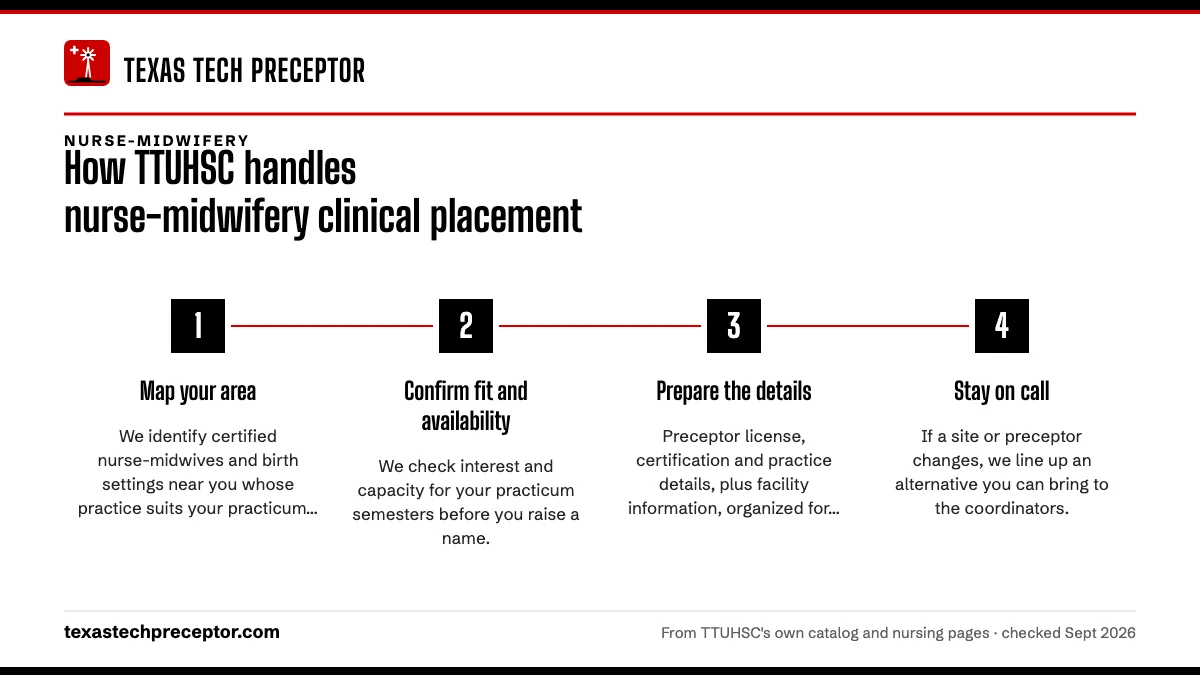
- Map your areaWe identify certified nurse-midwives and birth settings near you whose practice suits your practicum level.
- Confirm fit and availabilityWe check interest and capacity for your practicum semesters before you raise a name.
- Prepare the detailsPreceptor license, certification and practice details, plus facility information, organized for your faculty, the site coordinators and the Program Director.
- Stay on callIf a site or preceptor changes, we line up an alternative you can bring to the coordinators.
The Program Director approves every location, and TTUHSC's faculty and coordinators lead the placement. We make sure the options you bring them are complete and ready the first time. Tell us your practicum semester through the form below.
Questions TTUHSC students ask
Does TTUHSC place nurse-midwifery students in clinicals?
Midwifery placement is shared. The Student Handbook says nurse-midwifery faculty work with the student and TTUHSC's preceptor/site coordinators to secure satisfactory preceptors and sites, and every location must be approved by the Program Director. That differs from TTUHSC's NP tracks, where students obtain their own preceptors and the SON approves them.
How much is TTUHSC's nurse-midwifery clinical placement fee?
The public handbook confirms the fee exists and applies to each semester you are enrolled in a nurse-midwifery practicum course, but it does not print the amount. Ask the midwifery program for the current figure before your first practicum semester, and check your charges each term in the WebRaider Portal.
Can I suggest my own midwifery preceptor or birth center?
The handbook describes faculty working with the student, so putting forward a well-qualified option is reasonable. Bring the preceptor's license, certification and practice details and the site's information to your faculty and coordinators. The final word rests with the Program Director, who approves every location used for midwifery population-focus clinical hours.
Do post-graduate nurse-midwifery certificate students follow the same process?
Yes, as far as TTUHSC publishes. The certificate page places all population-focus clinical hours in locations the Program Director approves, and the handbook's placement fee attaches to any semester spent in a nurse-midwifery practicum course. Certificate students follow an individualized plan and take NURS 5471 as their Level A practicum.
When should I start preparing for midwifery clinicals?
Earlier than most students expect. In the full-time MSN plan the first practicum, NURS 5399, falls in Fall Two, a year after a Fall start, and the birth support year, NRP, EFM course and malpractice insurance all come first. Begin site conversations in your first year so the coordinators have options to work with.
Is TTUHSC's nurse-midwifery program accredited?
Yes. TTUHSC's accreditation page states that its nurse-midwifery program is fully accredited by the Accreditation Commission for Midwifery Education (ACME). Separately, CCNE accredits TTUHSC's baccalaureate, master's and DNP nursing programs and its post-graduate APRN certificate program, so both bodies apply to midwifery students in different ways.
Related pages
Last checked 2026-09-26
We check these pages against TTUHSC's catalog, Student Handbook, program pages and licensure disclosures. Your course faculty, your program director and the plan of study for your cohort have the final word.
Your TTUHSC preceptor search, run by specialists.
Tell us your TTUHSC track, your next clinical course and the town you'll train near. We find preceptors who fit the course and pull together what SON staff and faculty need to approve both the clinician and the facility, early enough for the electronic preceptor agreement to go through before the term.
- Preceptors matched to the track: family primary care, adult-gerontology acute care, pediatrics, psychiatric mental health
- License, certification and facility details ready for TTUHSC's preceptor and facility approval
- In Lubbock, Amarillo, Abilene, the Permian Basin, Dallas-Fort Worth and the states TTUHSC accepts
Start your placement plan
Your track, your town and your next clinical term is all we need to begin.