The TTUHSC Post-Graduate Nurse-Midwifery certificate
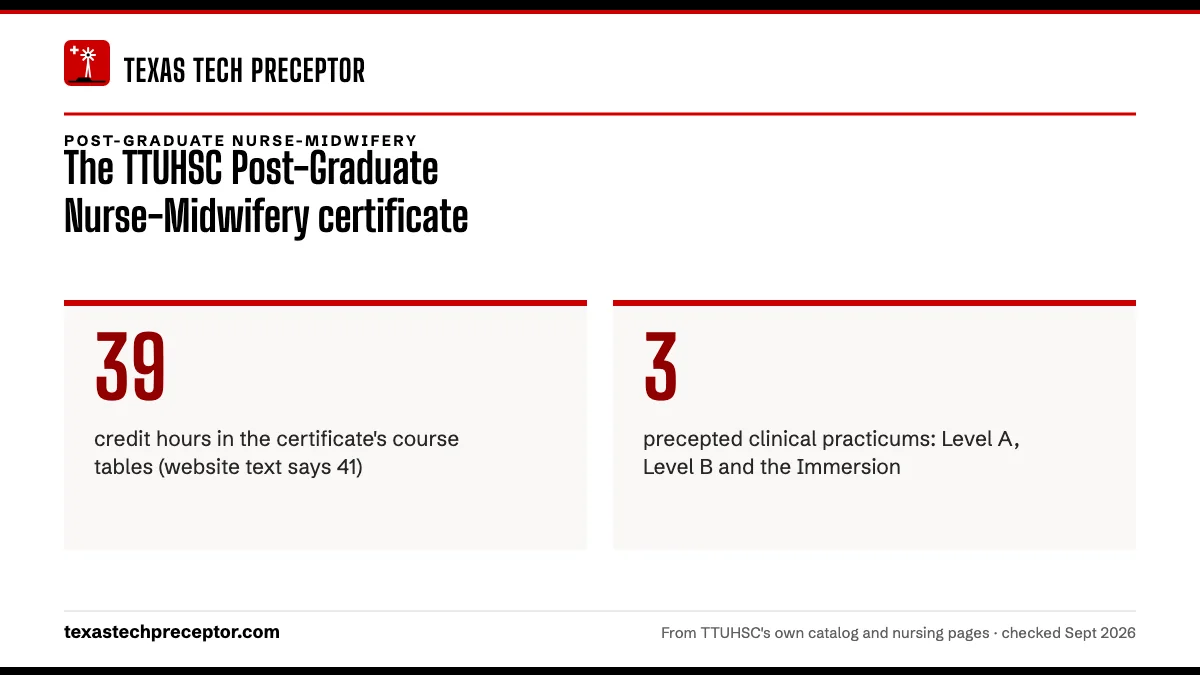
TTUHSC's Post-Graduate Nurse-Midwifery certificate is an online plan of 39 credits in its course tables, built around three precepted practicums that begin with NURS 5471. Unlike TTUHSC's NP tracks, midwifery placement is coordinated: faculty and TTUHSC's preceptor and site coordinators work with each student, and the Program Director approves every clinical location. We help you prepare your side of that process.
Get your placement plan
Tell us your TTUHSC program and where you live. A placement advisor replies with the preceptor and site options that fit your TTUHSC course.
The certificate at a glance
The certificate is for nurses who have completed graduate study and want to add nurse-midwifery. Coursework is online, but campus trips are required twice over: once for orientation and once for the practicum in advanced skills and health assessment. The program page leaves the campus unnamed, and like every TTUHSC post-graduate plan, yours is individualized.
On accreditation, TTUHSC reports that ACME, the Accreditation Commission for Midwifery Education, has granted its nurse-midwifery program full accreditation. The institution as a whole holds SACSCOC accreditation.
| Item | What TTUHSC states |
|---|---|
| Credits | 39 in the catalog and website course tables; 41 in the website's text |
| Delivery | Online, with campus travel for orientation and the advanced skills and health assessment practicum |
| Clinical courses | NURS 5471 Level A, NURS 6520 Level B, NURS 6610 Clinical Immersion |
| Clinical locations | Approved by the Program Director |
| Before the first population focus clinical course | One year of birth support experience, NRP and an EFM course |
| Costs TTUHSC names | A clinical placement fee each practicum semester and your own malpractice insurance |
Didactic courses before the practicums
The published list pairs advanced practice foundations with a run of midwifery courses. Foundations include advanced health assessment, pharmacology for women's health and pathophysiology. The midwifery sequence moves from NURS 5308 Primary Care of Women, which requires an on-campus skills lab, through gynecological care, antepartum and postpartum care, intrapartum care and neonatal care, and closes with a one-credit course on the transition to nurse-midwifery practice.
The website's course list also includes NURS 5312 Foundations for Advanced Practice Nursing Role, a course the catalog list does not show. TTUHSC gives no reason for the 39 and 41 credit figures differing. The catalog is TTUHSC's official plan for the year, and your individualized plan from the program settles which courses you take.
Note that the certificate and the MSN use different midwifery course sets. The MSN's clinical run begins with NURS 5399, while the certificate begins with NURS 5471, so a guide written for MSN students will not map course for course onto your plan.
Quote your certificate course numbers, not the MSN's, when you speak with coordinators or a prospective preceptor.
Three practicums, beginning with NURS 5471
All three clinical courses are precepted, and the plan shows them as clinical only, with no weekly lecture hours. The catalog's course pages give each an hour figure, and two of those differ from the numbers the MSN web plan prints for the same courses.
| Course | Credits | Catalog hours | MSN web plan |
|---|---|---|---|
NURS 5471 Integrated Clinical Practicum, Level A | 4 | 210 | Not used; the MSN starts with NURS 5399 |
NURS 6520 Integrated Clinical Practicum, Level B | 5 | 262.5 | 255 |
NURS 6610 Clinical Immersion Practicum | 6 | 315 | 319 |
The catalog warns that competency can call for hours beyond the listed figure, so leave slack in your schedule. The midwifery practicums guide compares the hour sources in detail, and a practicum that runs past the end of a term can carry a PR (In Progress) grade instead of a final one. Clinical grading is pass/fail, and failing the clinical side sinks the whole course.
Coordinated placement and Program Director approval
Midwifery is the exception to TTUHSC's usual graduate rule. The handbook describes a shared effort in which midwifery faculty, the student and TTUHSC's preceptor and site coordinators together make sure each student ends up with suitable preceptors and sites. On top of that, the program page requires the Program Director's approval for the location of all clinical hours in the midwifery specialty courses.
Coordination carries a clinical placement fee, billed in each term that includes a nurse-midwifery practicum. TTUHSC sets the amount; ask the program for the current figure. Our midwifery placement guide explains the coordinated process step by step, and the MSN Nurse-Midwifery guide covers the longer MSN route.
Because the handbook describes the student as part of that work, it pays to arrive with a clear picture of midwives, practices and birth settings near where you live, and to raise any preferences with faculty early.
Readiness items for midwifery clinicals
Have these in place before your first population focus clinical course
- One year of birth support experience, which TTUHSC requires before that course
- Neonatal resuscitation (NRP) certification, plus a completed course in electronic fetal monitoring (EFM)
- Your own student malpractice insurance, required of midwifery students on top of the SON blanket liability policy
- BLS, an immunization record approved by the Office of Institutional Health, a background check and drug screening
- Health insurance, which online students with clinical courses must carry, and HIPAA training renewed every year
Insurance details are gathered in our insurance and HIPAA guide, and certifications in the immunizations and certifications guide. Kansas carries a "does not meet" mark for nurse-midwifery in TTUHSC's licensure disclosure, and ten further states sit on the list TTUHSC cannot accept graduate students from; review the licensure disclosure before you apply from outside Texas.
How we support midwifery certificate students
TTUHSC coordinates midwifery placement, and we make your part of that coordination strong. We research midwives, practices and birth settings near where you live, confirm each midwife's license, certification and practice details, and put together the site information faculty, coordinators and the Program Director look at when they approve a location.
That preparation gives your conversations with faculty something concrete to work from, well before each practicum term. Because the three practicums build on one another, we start groundwork for the next level while you are still in the current one. If a preceptor or site falls through partway through the plan, we search again in your area and prepare the new details. Every placement is decided by TTUHSC's faculty, coordinators and Program Director; our role is making sure the file they receive is complete and follows TTUHSC's rules from the start. Reach us through the contact page with your expected practicum term and your location.
Questions TTUHSC students ask
Is TTUHSC's post-graduate nurse-midwifery certificate 39 or 41 credits?
Both numbers appear. The catalog and website course tables total 39 credits, while the website's descriptive text says 41. The website's course list also shows NURS 5312, which the catalog list does not. The catalog is TTUHSC's official plan, and because post-graduate plans are individualized, your own plan is the figure that counts.
Do TTUHSC midwifery certificate students find their own preceptors?
Not on their own. Midwifery placement is coordinated: faculty, TTUHSC's preceptor and site coordinators and the student work on it together, and every clinical location needs the Program Director's approval. TTUHSC bills a clinical placement fee in each term you take a midwifery practicum course.
What is NURS 5471 at TTUHSC?
NURS 5471 Integrated Clinical Practicum, Level A, is the first of the certificate's three precepted clinical courses. It carries four credits, and its catalog course page lists 210 hours. Level B, NURS 6520, and the Clinical Immersion Practicum, NURS 6610, follow. The MSN track uses NURS 5399 at this stage instead.
How much birth experience does TTUHSC require for midwifery clinicals?
TTUHSC requires one year of birth support experience before your first midwifery clinical course, and the same deadline applies to NRP certification and to an EFM course. Plan the year of experience alongside your didactic courses so it is complete before the first practicum term begins.
Is TTUHSC's nurse-midwifery program accredited?
Yes. According to TTUHSC, ACME has fully accredited its nurse-midwifery program, and SACSCOC accredits TTUHSC as a whole. TTUHSC's pages give no ACME review dates, so for dates or scope, check with TTUHSC or ACME directly. Our accreditation guide gathers what TTUHSC publishes.
Can a placement service help with a TTUHSC midwifery placement?
Yes, in a way that fits TTUHSC's coordinated model. We research midwives and birth settings near you and prepare the preceptor and site details that faculty, coordinators and the Program Director review. TTUHSC decides every placement; our work makes your side of the process complete and ready early.
Related pages
Last checked 2026-09-26
We check these pages against TTUHSC's catalog, Student Handbook, program pages and licensure disclosures. Your course faculty, your program director and the plan of study for your cohort have the final word.
Your TTUHSC preceptor search, run by specialists.
Tell us your TTUHSC track, your next clinical course and the town you'll train near. We find preceptors who fit the course and pull together what SON staff and faculty need to approve both the clinician and the facility, early enough for the electronic preceptor agreement to go through before the term.
- Preceptors matched to the track: family primary care, adult-gerontology acute care, pediatrics, psychiatric mental health
- License, certification and facility details ready for TTUHSC's preceptor and facility approval
- In Lubbock, Amarillo, Abilene, the Permian Basin, Dallas-Fort Worth and the states TTUHSC accepts
Start your placement plan
Your track, your town and your next clinical term is all we need to begin.