TTUHSC graduate nursing for Alabama residents
Alabama is open territory for TTUHSC's graduate nursing tracks: the licensure page marks it as meeting requirements and adds no note barring its residents. Clinical hours would run near your home, but Alabama's board wants an out-of-state program on file before your first clinical day, so plan the calendar with more care here.
Get your placement plan
Tell us your TTUHSC program and where you live. A placement advisor replies with the preceptor and site options that fit your TTUHSC course.
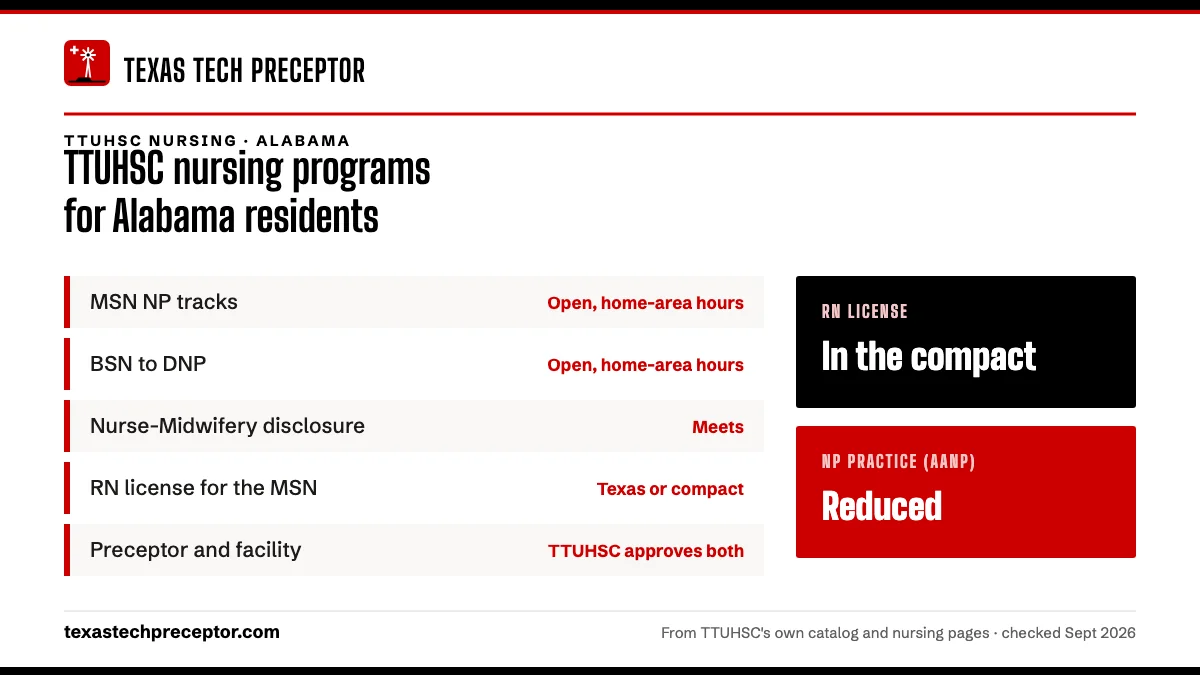
Each TTUHSC track, read for Alabama
TTUHSC delivers its graduate tracks online and runs the clinical courses where the student lives. Wherever that is, the person precepting you and the site both need School of Nursing approval before an hour counts.
| Program | Alabama status | Where the clinical hours happen |
|---|---|---|
| MSN FNP, AGACNP, Pediatric NP or PMHNP | Meets, with no unable-to-accept mark | In your Alabama community, with a preceptor and facility the SON approves |
| MSN Nurse-Midwifery | Meets | Sites approved by the Program Director, arranged with TTUHSC's preceptor/site coordinators |
| BSN to DNP (FNP, PMHNP) | Meets | Locally, with faculty and the preceptor team helping select and contract sites |
| Traditional or Accelerated BSN | Campus programs | Texas campuses, where course faculty decide placement |
A Meets mark means you may apply, not that you will be admitted. Because rules keep moving, TTUHSC's graduate pages stop short of promising at submission that it can enroll students from every state, and anyone applying from beyond Texas is pointed to its Admissions Team for an eligibility answer first.
Alabama's filing rule for programs based elsewhere
Alabama expects more from an outside program than most states do. Rule 610-X-3-.09 says any advanced practice or prelicensure program headquartered beyond Alabama's borders owes the Board a letter declaring its intent, together with proof of approval, 15 days or more ahead of the first clinical experience in the state. That submission identifies you and your license, your clinical supervisor and that person's license, and the facility, and it carries a statement from the facility's nursing leadership.
The school also pays Alabama a yearly charge as an out-of-state program, and the Board is firm that clinicals there cannot begin until both the approval and the payment have cleared. Because all of this lands on TTUHSC rather than on you, put the question to your program director or the Graduate Coordinator before offering a preceptor any dates.
Your license and Alabama's practice rules
Alabama put the compact into effect in January 2020. If your home-state Alabama license is multistate, you already hold what the MSN rule TTUHSC prints will take: a Texas RN license or, as the alternative, a multistate license under the compact, current and unencumbered. Alabama mirrors that from its side, asking graduate students who train in its facilities to be licensed by Alabama itself or to hold multistate privileges through another compact member. DNP applicants answer to TTUHSC's broader U.S. RN license rule; the RN license guide compares its wording.
AANP files Alabama under reduced practice. Every Alabama NP carries a collaborative agreement with a physician, regulated by the state, for some portion of practice, and two Alabama boards, Nursing and Medical Examiners, regulate NP practice together, so your preceptor's clinic will have that collaboration built in.
Alabama's Preceptor Tax Incentive Program trims state taxes for some rural preceptors who teach without pay in underserved communities. The catch for TTUHSC students: an eligible rotation must support a school physically located inside Alabama.
Birmingham to Mobile: systems as signposts
Birmingham is Alabama's largest metro area, and Huntsville, Mobile and Montgomery come next. Big systems there include UAB Medicine in Birmingham, USA Health and Infirmary Health on the Gulf side, Huntsville Hospital Health System up north, and Baptist Health in the capital. They mark where NPs practice, not places set aside for TTUHSC students; every site makes its own call, and some ask for an affiliation agreement first.
Relocating into or out of Alabama mid-program? The handbook wants TTUHSC notified 60 days or more before the move, and the next state's approval depends, case by case, on the specific placement you put forward. The moving guide goes deeper.
How we help TTUHSC students in Alabama
Alabama students need their paperwork settled before the Board's clock even starts, and early, complete paperwork is what we do best. Our search targets a preceptor and facility near you that match your TTUHSC course; then we collect the license numbers, facility details and nursing-leadership contact that TTUHSC's approval and Alabama's filing both draw on, well ahead of your term. If a preceptor bows out, finding the next one is on us; our process page shows each step.
Questions TTUHSC students ask
Can I start TTUHSC's online FNP track while living in Alabama?
You can apply. Alabama is marked Meets for the MSN nurse practitioner tracks, with no unable-to-accept note beside it. Whether you are admitted is TTUHSC's decision, and its program pages ask people in other states to confirm eligibility with Admissions before submitting. The FNP program page covers the track itself.
Which RN license do Alabama clinicals call for?
Graduate students training in Alabama facilities need an Alabama-issued RN license or multistate privileges through a compact state. When Alabama is home and your license is already multistate, that single credential answers Alabama's rule and TTUHSC's MSN rule at once.
Who sends the paperwork to the Alabama Board before my rotation?
TTUHSC, as the program. Alabama puts the letter of intent, proof of approval and the yearly out-of-state charge on the school, due 15 days or more before clinicals start. What you control is how early TTUHSC has correct details on your preceptor and site.
Does precepting a TTUHSC student earn Alabama's tax credit?
Alabama ties that credit to rotations for programs physically located in the state, so hours with a TTUHSC student fall outside it. A clinician thinking about taking you on can read what precepting involves on our preceptor page.
Related pages
Last checked 2026-09-26
We check these pages against TTUHSC's catalog, Student Handbook, program pages and licensure disclosures. Your course faculty, your program director and the plan of study for your cohort have the final word.
Your TTUHSC preceptor search, run by specialists.
Tell us your TTUHSC track, your next clinical course and the town you'll train near. We find preceptors who fit the course and pull together what SON staff and faculty need to approve both the clinician and the facility, early enough for the electronic preceptor agreement to go through before the term.
- Preceptors matched to the track: family primary care, adult-gerontology acute care, pediatrics, psychiatric mental health
- License, certification and facility details ready for TTUHSC's preceptor and facility approval
- In Lubbock, Amarillo, Abilene, the Permian Basin, Dallas-Fort Worth and the states TTUHSC accepts
Start your placement plan
Your track, your town and your next clinical term is all we need to begin.