Precepting a TTUHSC nursing student
TTUHSC's graduate nursing students arrange their own preceptors in the communities where they live, so the request may reach a clinician in Lubbock, Abilene, Houston or a small West Texas town. Precepting one means TTUHSC approves you and your practice, an electronic agreement is completed for each semester, and you guide a student through a course with defined objectives. We make each of those steps simple.
Offer to precept a TTUHSC student
Your specialty, where you practice and the terms that suit you. A placement advisor replies with TTUHSC students whose course fits your practice.
Who is asking, and for which courses
The students who reach out are TTUHSC School of Nursing graduate students, usually from TTUHSC's online nurse practitioner tracks: family, psychiatric mental health, adult-gerontology acute care, and pediatric primary or acute care. Others are BSN to DNP students heading into their advanced practicums, or MSN students in leadership or education practicums who need an experienced mentor in those fields.
TTUHSC lets graduate students complete clinical hours in their home area, which is why the request may come from someone who lives down the road rather than near a TTUHSC campus. Students are spread across Texas and the other states where TTUHSC accepts graduate students, so a practice far from Lubbock is just as likely to hear from one.
Who can precept under Texas rules
Texas sets the baseline. Under 22 TAC §219.10, the Board of Nursing rule for APRN education programs, a preceptor may be an advanced practice nurse or a clinician with another current health care license whose role equips them to guide a student at the advanced practice level. The rule also expects the school, the clinician and the host facility to put a written agreement in place setting out who does what.
TTUHSC has not published graduate preceptor criteria like the type of license or a minimum number of years in practice, and it approves each preceptor individually. Whether your specialty and patient population suit a particular course is the course faculty's call. Who can precept a TTUHSC NP student has the detail, and Texas NP practice and precepting explains how the state's practice rules shape a preceptor's day.
Approval covers you and your practice
TTUHSC's School of Nursing staff and faculty approve both the preceptor and the facility. For you, that means sharing license, certification and practice details. For your clinic or hospital, it can mean confirming facility information and, where the facility requires one, an affiliation agreement handled by the SON's Clinical Placement, Affiliation Agreements, and Preceptor Management unit. Plan on approval being settled before the student's first day with you; the student's course faculty confirm when clinical time may begin.
Larger health systems often run their own student processes alongside TTUHSC's, with applications, orientation modules and badging. If your organization has one, the student's timeline needs to leave room for it. The facility side is covered in the affiliation agreements guide.
An electronic agreement each semester
TTUHSC uses an electronic preceptor agreement that students complete for every preceptor they work with in a given semester. If you precept the same student across consecutive terms, or a new student next term, expect a fresh agreement each time. TTUHSC has not published the name of the system; the student receives the current process from the School of Nursing. Precepting two TTUHSC students in one term means two agreements, since each student completes one for every preceptor they use.
The agreement is where the program, the preceptor and the facility set down their roles in writing, as the Texas rule expects. Having your details ready turns it into a short task. The electronic preceptor agreement guide covers what it asks for.
Objectives, hours and faculty contact
A TTUHSC rotation from the preceptor's side
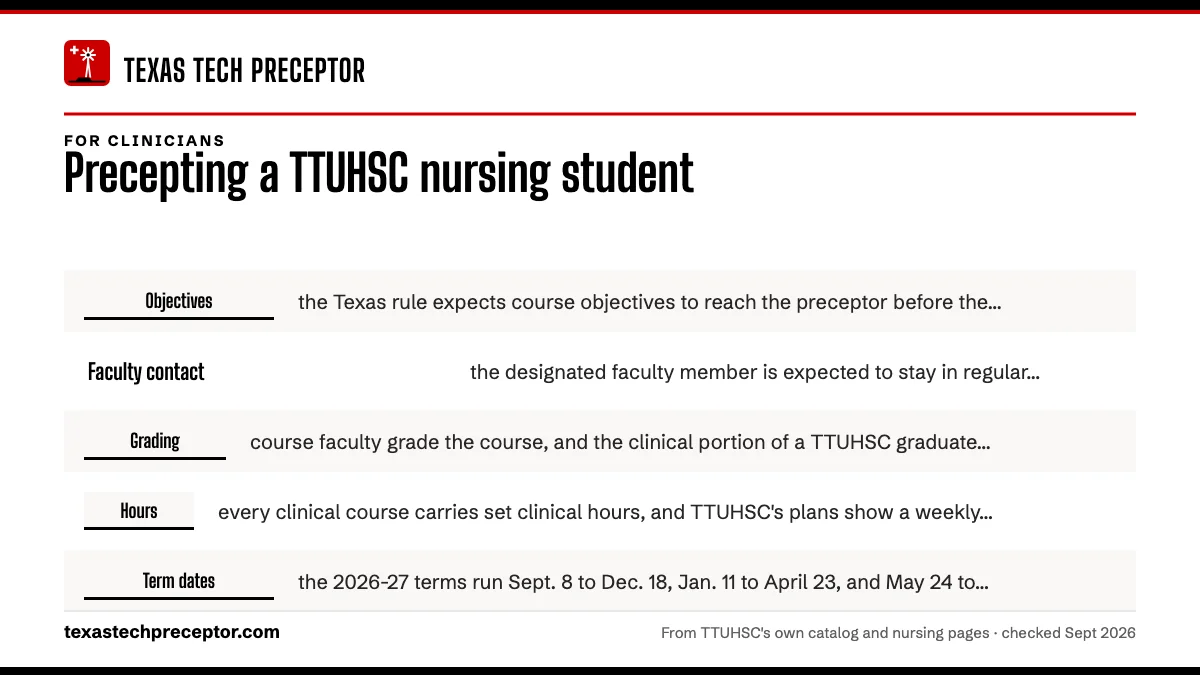
- Objectives: the Texas rule expects course objectives to reach the preceptor before the rotation begins.
- Faculty contact: the designated faculty member is expected to stay in regular contact with you and the student.
- Grading: course faculty grade the course, and the clinical portion of a TTUHSC graduate course is pass/fail.
- Hours: every clinical course carries set clinical hours, and TTUHSC's plans show a weekly figure the student can share with you.
- Term dates: the 2026-27 terms run Sept. 8 to Dec. 18, Jan. 11 to April 23, and May 24 to Aug. 13.
- Campus days: MSN NP students spend seven to eight days on campus across the program, with OSCEs in Lubbock, so expect a few planned absences. The intensives and OSCEs guide has the pattern by program.
What the student brings to your practice
A TTUHSC student arrives cleared. The School of Nursing requires a background check, drug screens before placement in most clinical settings, immunizations approved by TTUHSC's Office of Institutional Health, BLS for everyone with ACLS or PALS by track, mandatory health insurance, and HIPAA training renewed every year. The SON also carries a blanket liability policy that covers students in clinical activities.
Licensure is in place too: MSN students hold a current, unencumbered Texas or compact multistate RN license, and DNP students a current, unencumbered U.S. RN license. Many bring years of bedside experience, and tracks such as acute care require it before admission. Before the first day, the student can show proof of any item your facility asks to see.
How we make precepting easy
Clinicians choose to work with us because we take the logistics off their desk. We match you only with students whose TTUHSC course fits your specialty, your patients and your schedule, and we send the course, term dates and weekly hours before you commit to anything.
We collect your license, certification and practice details once and keep them ready, so each new semester's agreement is quick. We coordinate facility details with your office manager, act as a single point of contact during the rotation, and if your schedule changes we arrange a backup for the student. TTUHSC's faculty make the approval decision; we make sure your information reaches them complete. In the form below, pick "I'm a preceptor (not a student)" as your program and describe your practice.
Questions TTUHSC students ask
How many hours a week does a TTUHSC student need?
It depends on the course. TTUHSC's program plans list weekly clinical hours for many clinical courses, and in tracks such as family and pediatric practice the later courses ask for more time than the earlier ones. The student can show you the exact figure for their course and term before you agree, and we include it in every request we send.
Can physicians or other clinicians precept, or only nurse practitioners?
Texas's APRN program rule opens precepting to clinicians beyond nurse practitioners: a professional with a current health care license whose practice lets them guide a student at the advanced practice level can qualify. TTUHSC then approves each preceptor for a specific course, and course faculty judge the fit, so a physician may well be accepted for the right course.
Does TTUHSC offer preceptors continuing education or other benefits?
Continuing education credit, library privileges, adjunct titles: TTUHSC's public pages describe none of these for preceptors. If recognition matters to you, ask the student's course faculty or the Graduate Coordinator in the School of Nursing, who can tell you what TTUHSC currently offers the clinicians who precept its students.
Do I sign a new agreement every semester?
Yes. TTUHSC's process calls for an electronic preceptor agreement for each preceptor a student uses in each semester. That holds even when you have precepted TTUHSC students before, or continue with the same student into a new term. Keeping your license and certification details on hand makes each renewal quick, and we hold them ready for you.
Who evaluates the student?
TTUHSC's course faculty are responsible for the course and assign the grade, and the clinical portion is graded pass/fail. The Texas rule expects faculty to communicate regularly with preceptors, so expect contact about the student's progress. The course supplies whatever evaluation forms it uses; TTUHSC does not publish them for graduate courses.
Related pages
Last checked 2026-09-26
We check these pages against TTUHSC's catalog, Student Handbook, program pages and licensure disclosures. Your course faculty, your program director and the plan of study for your cohort have the final word.
Your TTUHSC preceptor search, run by specialists.
Tell us your TTUHSC track, your next clinical course and the town you'll train near. We find preceptors who fit the course and pull together what SON staff and faculty need to approve both the clinician and the facility, early enough for the electronic preceptor agreement to go through before the term.
- Preceptors matched to the track: family primary care, adult-gerontology acute care, pediatrics, psychiatric mental health
- License, certification and facility details ready for TTUHSC's preceptor and facility approval
- In Lubbock, Amarillo, Abilene, the Permian Basin, Dallas-Fort Worth and the states TTUHSC accepts
Start your placement plan
Your track, your town and your next clinical term is all we need to begin.