Insurance and HIPAA training for TTUHSC clinicals
TTUHSC's School of Nursing carries a blanket liability policy covering students in any student-related clinical activity, and it makes health insurance mandatory for online programs with clinical requirements. Nurse-midwifery students also buy their own malpractice insurance. Every student shows proof of HIPAA training each year, and without that proof, the handbook says, you do not attend clinical.
Get your placement plan
Tell us your TTUHSC program and where you live. A placement advisor replies with the preceptor and site options that fit your TTUHSC course.
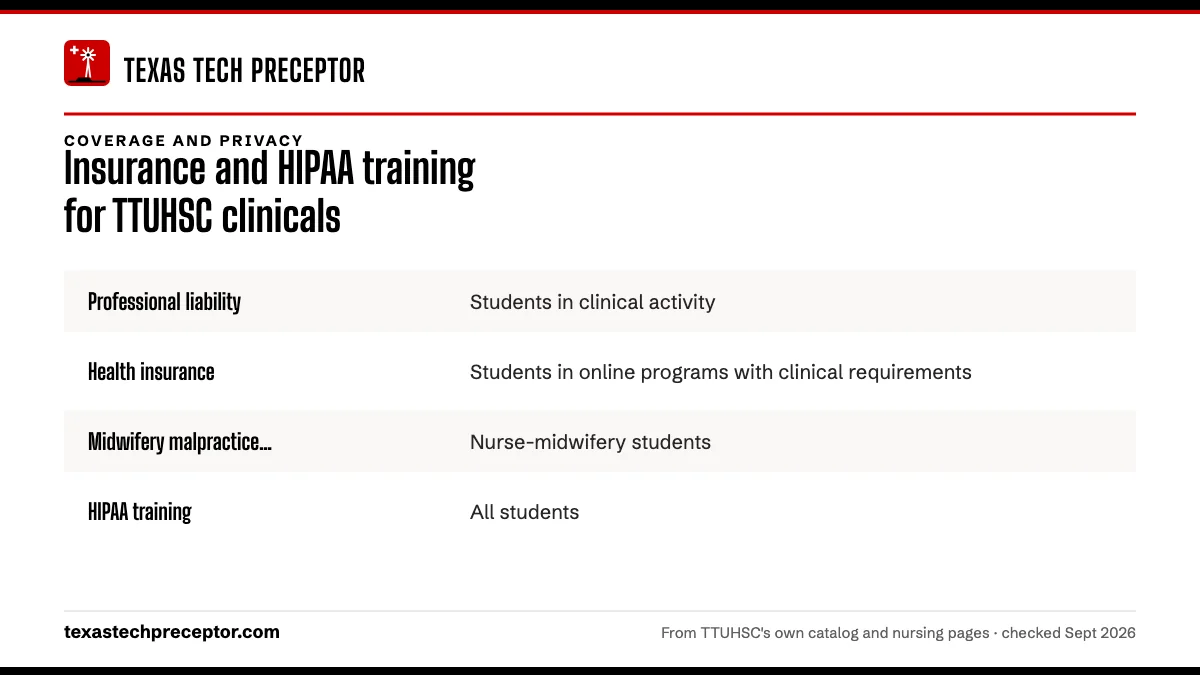
Four requirements at a glance
Three of these touch nearly every graduate student in a clinical track; one applies only to nurse-midwifery. The Student Handbook's "SON Requirements" and "SON General Information" sections set them out, and the midwifery rule comes from the catalog.
Two of the four renew on a cycle: HIPAA proof every year and, for midwifery students, a malpractice policy priced by the year. Health insurance has to stay in force across every term that includes clinical work, which for most graduate plans means all three terms of the year.
| Requirement | Who it applies to | What TTUHSC states |
|---|---|---|
| Professional liability | Students in clinical activity | The School of Nursing provides a blanket policy covering students in any student-related clinical activity |
| Health insurance | Students in online programs with clinical requirements | Mandatory |
| Midwifery malpractice insurance | Nurse-midwifery students | Bought by the student, in addition to the SON policy, before midwifery clinical courses |
| HIPAA training | All students | Proof every year; students without it are not allowed to attend clinical |
The SON blanket liability policy
Liability coverage is the item the School of Nursing supplies itself. The handbook puts it in one sentence: "The School of Nursing provides a blanket policy covering students in any student-related clinical activity." Only nurse-midwifery students are asked to add a policy of their own.
The phrase that matters is "student-related clinical activity." TTUHSC's process defines what a sanctioned rotation looks like: a preceptor and a facility approved by SON staff and faculty, plus an electronic preceptor agreement for every preceptor each semester. Keeping your hours inside that structure keeps them plainly within your course. If you are unsure whether a given activity qualifies, ask your course faculty before you take it on.
Texas rule 22 TAC §219.10 adds a layer of its own, calling for written agreements among the program, the preceptor and the facility that set out each party's functions and responsibilities. The facility side of that paperwork is covered in affiliation agreements.
Mandatory health insurance for online clinical programs
TTUHSC makes health insurance mandatory for students in an "online program with clinical requirements." That description fits the online MSN NP tracks, nurse-midwifery and the BSN to DNP, where clinical courses sit at the center of the plan of study.
The handbook sections reviewed here state the rule but not a proof-of-coverage deadline or method. Ask your Graduate Enrolled Student Advisor how and when TTUHSC verifies coverage, and keep the answer with your records.
Continuity is the practical point. Graduate clinical courses run in fall, spring and summer, and several plans place a clinical course in a summer term, so a gap in coverage between jobs or during a summer can land in the middle of a rotation. Check your coverage dates each time your work or family situation changes.
Nurse-midwifery: your own malpractice policy
Nurse-midwifery is the exception to the blanket-policy rule. The catalog requires midwifery students to buy their own student malpractice insurance on top of the SON policy, and to have it in place before midwifery clinical courses. The Nurse-Midwifery Track entry gives a typical yearly cost; this guide leaves pricing to that source.
One detail needs care. The catalog's malpractice note still cites course numbers from an earlier plan rather than the current practicum sequence. Plan to have coverage before your first precepted midwifery practicum, which is NURS 5399 in the MSN plan, and confirm the exact timing with the Program Director.
The track also charges a clinical placement fee each practicum semester, part of the coordinated arrangement described in nurse-midwifery placement.
HIPAA training, every year
Every TTUHSC nursing student must show proof of HIPAA training each year. The handbook states the consequence without hedging: "Those who cannot show proof will not be allowed to attend clinical." The SON Office of Student Affairs keeps the HIPAA files.
The annual cycle is what catches people. Training finished at the start of a program does not last through a multi-year plan, and the BSN to DNP runs twelve semesters. Note the date you complete each year's training, and renew before it comes due, especially when the anniversary would fall mid-rotation.
Facilities can add privacy and orientation steps of their own. Covenant Health in Lubbock, for example, asks rotation students for a certificate from its online orientation before they start. Whether a facility's module can stand in for TTUHSC's annual proof is a question for the SON Office of Student Affairs.
A lapsed HIPAA record stops clinical attendance even when an approved preceptor is waiting. Renew before the anniversary, not after it.
Why TTUHSC students choose us for a ready start
Coverage and training are yours to keep current; the placement is ours to make solid. We are the most thorough preceptor placement service for TTUHSC students: we find a preceptor and facility near home that fit your course, prepare the preceptor's license, certification and practice details for the electronic preceptor agreement, and confirm the facility's agreement status for SON staff and faculty well ahead of the term.
You also get each site's onboarding list early, including any orientation module or proof of coverage it asks for, so nothing is left for your first shift. If a preceptor has to withdraw, we move straight to a replacement and send you the new site's requirements before its first day. The related clearance steps are in background checks and drug screens and immunizations and certifications. Use the form below to begin.
Questions TTUHSC students ask
Does TTUHSC provide malpractice insurance for NP students?
The handbook says the School of Nursing provides a blanket policy covering students in any student-related clinical activity, and only nurse-midwifery students are told to buy an extra policy. Keep your hours inside approved placements with a completed preceptor agreement, and ask course faculty about any activity you are unsure fits your course.
Do I need health insurance for TTUHSC's online nursing programs?
Yes, if your online program has clinical requirements. The Student Handbook makes health insurance mandatory for those programs, which takes in the online NP and nurse-midwifery tracks. Ask your Graduate Enrolled Student Advisor how TTUHSC verifies coverage, and keep it continuous through summer terms, when many clinical courses run.
How often do TTUHSC nursing students complete HIPAA training?
Every year. The handbook requires annual proof of HIPAA training and says students who cannot show it will not be allowed to attend clinical. Track the date you completed it, and renew ahead of any rotation that would cross the anniversary.
Can my employer's HIPAA training count for TTUHSC?
TTUHSC's public handbook asks for proof of training each year but does not say which courses qualify. If you already complete privacy training at work, ask the SON Office of Student Affairs, which keeps the HIPAA files, whether your employer's certificate is accepted before you rely on it.
How much is nurse-midwifery malpractice insurance at TTUHSC?
The catalog's Nurse-Midwifery Track entry gives a typical yearly figure, so read the current number there. What TTUHSC makes clear is the timing and the layering: the policy must be in place before midwifery clinical courses, and it sits on top of the School of Nursing's blanket policy rather than replacing it.
Related pages
Last checked 2026-09-26
We check these pages against TTUHSC's catalog, Student Handbook, program pages and licensure disclosures. Your course faculty, your program director and the plan of study for your cohort have the final word.
Your TTUHSC preceptor search, run by specialists.
Tell us your TTUHSC track, your next clinical course and the town you'll train near. We find preceptors who fit the course and pull together what SON staff and faculty need to approve both the clinician and the facility, early enough for the electronic preceptor agreement to go through before the term.
- Preceptors matched to the track: family primary care, adult-gerontology acute care, pediatrics, psychiatric mental health
- License, certification and facility details ready for TTUHSC's preceptor and facility approval
- In Lubbock, Amarillo, Abilene, the Permian Basin, Dallas-Fort Worth and the states TTUHSC accepts
Start your placement plan
Your track, your town and your next clinical term is all we need to begin.