TTUHSC's MSN in Nursing Education
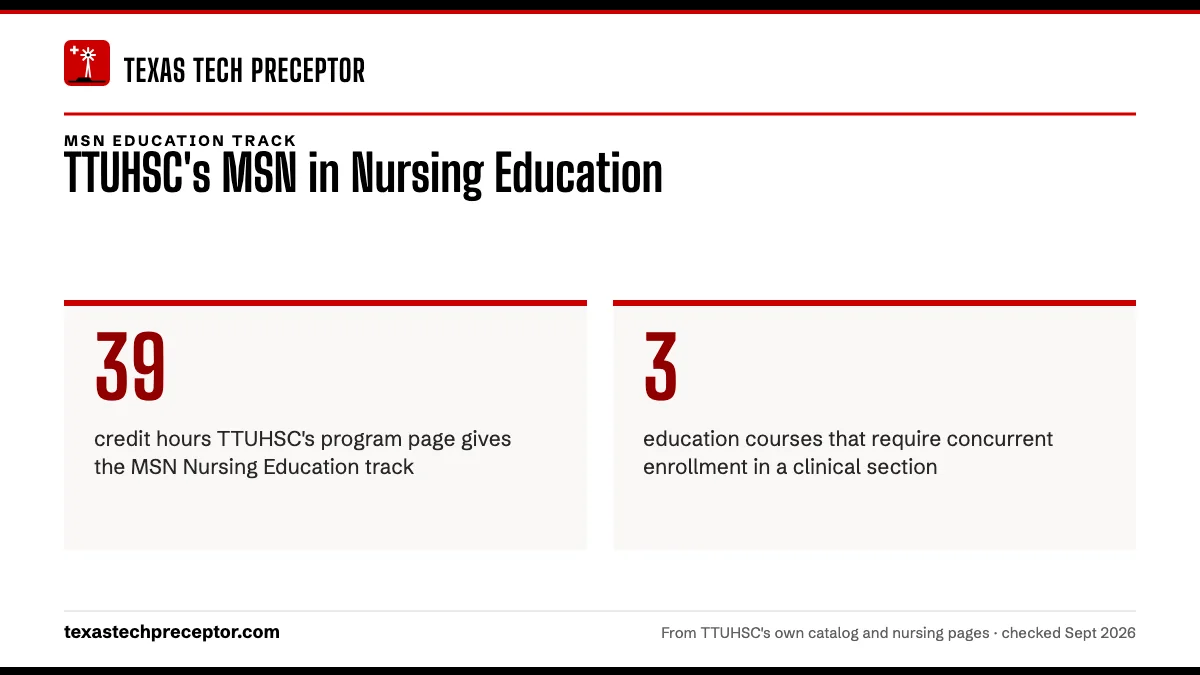
TTUHSC's MSN Nursing Education track prepares nurses to teach, almost entirely online, with only two or three days on campus across the whole program. Three of its courses carry clinical sections, and the last, the immersive teaching practicum, runs under a preceptor that TTUHSC approves. We find that preceptor and teaching setting near you and prepare everything the approval asks for.
Get your placement plan
Tell us your TTUHSC program and where you live. A placement advisor replies with the preceptor and site options that fit your TTUHSC course.
The track at a glance
Nursing Education sits beside Leadership and Informatics as one of the TTUHSC School of Nursing's non-APRN master's tracks. Coursework runs online, a single on-campus intensive anchors the health assessment course, and the clinical time goes toward learning to teach rather than toward patient management.
| Item | What TTUHSC states |
|---|---|
| Catalog name | Nursing, Nursing Education Track, MSN |
| Credits | 39 on the program page |
| Length | Not published; your plan of study sets it |
| Format | Online, with a required on-campus intensive for NURS 5342 Advanced Health Assessment |
| Campus time | 2-3 days across the program (archived graduate FAQ) |
| Start term | Fall; apply Nov. 1 to Feb. 15 |
| Teaching background | Recommended, but not required |
| Clinical ratio | 1 credit to 3 clock hours |
| RN license | Current, unencumbered Texas RN license or compact multistate license |
The catalog's Spring application window lists the leadership and APRN tracks only, and no Spring entry for Nursing Education turned up on TTUHSC's pages. Treat Fall as the one start term unless the Admissions Team tells you otherwise.
Who the track suits
TTUHSC calls clinical teaching experience recommended, but not required, so you can apply without a teaching title. The plan covers simulation-based learning and clinical teaching as well as a full teaching practicum, which makes it a practical route for a staff nurse who wants to move into education.
If you already hold a master's in nursing, the Nursing Education Post-Graduate Certificate is the shorter route. It is online, uses the same clinical-section courses as the MSN, and post-graduate plans at TTUHSC are individualized, so an advisor sets which courses you take and when. TTUHSC's pages do not print a start term for the education certificate, so confirm it with Admissions.
Either way, you need an active RN license. MSN students must hold a current, unencumbered Texas license or a compact multistate license; the RN license guide compares that rule with the DNP's.
Clinical sections inside an online program
A course marked CL on TTUHSC's plan requires concurrent enrollment in a clinical section, which is where the education track's hands-on work lives. The web plan lists three such courses, each shown as a triple of credits, weekly lecture hours and weekly clinical hours.
| Course | Title | Listing |
|---|---|---|
NURS 5366 | Data Driven Quality Improvement in Healthcare | 3:1.5:4.5 |
NURS 5367 | Simulation-Based Learning and Clinical Teaching | 3:1.5:4.5 |
NURS 6368 | Nurse Educator Immersive Teaching Practicum | 3:0.5:7.5 |
Clinical time on this track converts at one credit to three clock hours. TTUHSC publishes neither a program-wide hour total nor the semester in which each course falls, so your advisor's plan of study is the document to plan around. Two further courses, NURS 5364 and NURS 5365, carry clinical time on one TTUHSC page and none on another; the NURS 6368 guide lays out that conflict.
The immersive teaching practicum
NURS 6368 is the capstone of the track and the course with the heaviest clinical share. The catalog says the teaching happens "under the guidance of an approved preceptor", so you need a named educator whom SON staff and faculty sign off on, plus approval of the setting where you teach.
Approval is not a one-time event. Every preceptor needs a fresh electronic preceptor agreement in each semester you work together, and a school or facility new to TTUHSC may need an affiliation agreement before your first day; the electronic preceptor agreement guide covers what to have ready. TTUHSC does not publish qualification rules for education preceptors, and it does not say which teaching settings qualify, so course faculty are the people to ask.
Keep a running list of the educators you meet at work and through the earlier clinical-section courses. Any of them may be worth raising with faculty as a possible practicum preceptor, long before the term arrives.
Before your first clinical section
- Book travel for the Advanced Health Assessment intensive once TTUHSC sends the dates; its public pages do not name the host campus.
- Complete the background check through TTUHSC's institutionally approved vendor and keep the drug-screen window in mind: five days from the request.
- Clear immunizations with the Office of Institutional Health before registration, and hold a current BLS card.
- Show proof of HIPAA training every year, and carry the health insurance TTUHSC requires for online programs with clinical requirements.
- Ask course faculty which teaching settings fit
NURS 6368, then start the preceptor search at least a term ahead.
Grades follow the graduate rule: the clinical part of a course is pass/fail, and failing it makes the course an F whatever your other scores. The immunizations and certifications guide and the grades and progression guide have the details.
Education students tend to leave the practicum preceptor for last. TTUHSC approves both the educator and the setting, so a late start leaves no room if the first choice falls through.
Why education students choose us
A teaching practicum succeeds when the preceptor teaches every week and wants a student in the room. Our placement desk searches near where you live for nurse educators, clinical instructors and staff development leaders whose roles fit what your course faculty describe, and it checks their availability for the exact term on your plan.
Then we build the approval file: the preceptor's license and credentials, their teaching role, and the setting's details and agreement status, ready before the electronic agreement opens. If a preceptor's schedule changes mid-semester, your placement advisor is already working on a replacement. TTUHSC's staff and faculty decide every approval; we make sure the information in front of them is complete and fits their rules from the start. See how it works, or send us your plan of study through the form below.
Questions TTUHSC students ask
Can I start TTUHSC's MSN Nursing Education track in the Spring?
Not according to the 2026-27 catalog, whose Spring application window names the leadership and APRN tracks only. The Fall window runs Nov. 1 to Feb. 15, and Fall 2026 classes began Sept. 8. If Spring matters to you, ask the Admissions Team whether that has changed for your year.
Does TTUHSC offer a nursing education certificate for nurses with a master's?
Yes. The Nursing Education Post-Graduate Certificate is online and uses the same clinical-section courses as the MSN track. Post-graduate plans at TTUHSC are individualized, so an advisor decides which courses you need, and the certificate's start term is not printed on TTUHSC's public pages.
How many clinical hours are in the TTUHSC nursing education MSN?
TTUHSC prints no program total. The web plan lists weekly clinical hours of 4.5 for NURS 5366, 4.5 for NURS 5367 and 7.5 for NURS 6368, and the track converts clinical credits at one to three. Each course syllabus sets the real requirement for your term, so plan your schedule from those.
Does the education track have OSCEs like TTUHSC's NP tracks?
TTUHSC's archived graduate FAQ describes OSCEs in Lubbock and 7-8 campus days for the NP and midwifery tracks, but only 2-3 campus days for Nursing Education. The required on-campus intensive on the education plan is attached to NURS 5342 Advanced Health Assessment. Ask the program what your visit includes.
Can a colleague precept my TTUHSC teaching practicum?
Possibly, if SON staff and faculty approve both the person and the setting. TTUHSC publishes no qualification list for education preceptors, so course faculty judge the fit, and every preceptor needs an electronic agreement each semester. Get faculty's view before you ask a colleague, and keep a second candidate in reserve.
Can the education track's clinical work happen at my own hospital?
No published rule answers it for the MSN. TTUHSC's handbook restricts undergraduates from clinical hours on their own unit, and the Post-Master's DNP is the one graduate program whose catalog lets practicum hours happen at your job, with faculty approval. Put the question to course faculty first; the workplace clinicals guide sets each program's rule side by side.
Related pages
Last checked 2026-09-26
We check these pages against TTUHSC's catalog, Student Handbook, program pages and licensure disclosures. Your course faculty, your program director and the plan of study for your cohort have the final word.
Your TTUHSC preceptor search, run by specialists.
Tell us your TTUHSC track, your next clinical course and the town you'll train near. We find preceptors who fit the course and pull together what SON staff and faculty need to approve both the clinician and the facility, early enough for the electronic preceptor agreement to go through before the term.
- Preceptors matched to the track: family primary care, adult-gerontology acute care, pediatrics, psychiatric mental health
- License, certification and facility details ready for TTUHSC's preceptor and facility approval
- In Lubbock, Amarillo, Abilene, the Permian Basin, Dallas-Fort Worth and the states TTUHSC accepts
Start your placement plan
Your track, your town and your next clinical term is all we need to begin.