TTUHSC's BSN programs and how their clinicals are placed
TTUHSC offers a campus-based Traditional BSN on five campuses and a 12-month Accelerated BSN, with Second Degree and Veteran to BSN tracks, across a wider set of clinical sites. In both, TTUHSC places you: the Student Handbook says "The decision for clinical placement rests with the faculty teaching in the clinical course." The preceptor search becomes yours later, if you continue into a TTUHSC graduate NP program, and that is where we come in.
Get your placement plan
Tell us your TTUHSC program and where you live. A placement advisor replies with the preceptor and site options that fit your TTUHSC course.
Two routes to the BSN
The TTUHSC School of Nursing runs two pre-licensure bachelor's programs. The Traditional BSN is campus-based and admits in every term. The Accelerated BSN compresses the nursing courses into three back-to-back semesters through two tracks: the Second Degree BSN, and the Veteran to BSN for applicants with military health care training.
| Item | Traditional BSN | Accelerated BSN |
|---|---|---|
| Format | Classroom and hands-on learning with patient simulators and hospital settings | Structured online coursework; clinical instruction "preceptor-based with live faculty guidance and oversight" |
| Locations | Abilene, Amarillo, Lubbock, Mansfield (distance education site), Permian Basin (Odessa) | Catalog: Abilene, Amarillo, Austin, Dallas, Lubbock, Permian Basin (Odessa), San Antonio |
| Start terms | Fall, Spring and Summer at all five campuses | Spring only |
| Apply | Fall: Feb. 15 to Apr. 15; Spring: June 15 to Aug. 15; Summer: Oct. 15 to Dec. 15 | May 1 to July 15 |
| Length | Four consecutive semesters | 12 months, three consecutive semesters |
| Credits | 60 nursing plus 60 prerequisite, 120 total | 61 nursing (60 from Spring 2027, per the handbook); 116 total for Second Degree, 120 for Veteran to BSN |
| Clinical ratio | 1 credit to 3 clock hours | 1 credit to 3 clock hours |
One conflict to note: the Accelerated BSN's own web page lists six clinical sites and leaves out San Antonio, while the catalog lists seven. If San Antonio is the site you are counting on, confirm it with the program before you apply.
How TTUHSC places BSN students
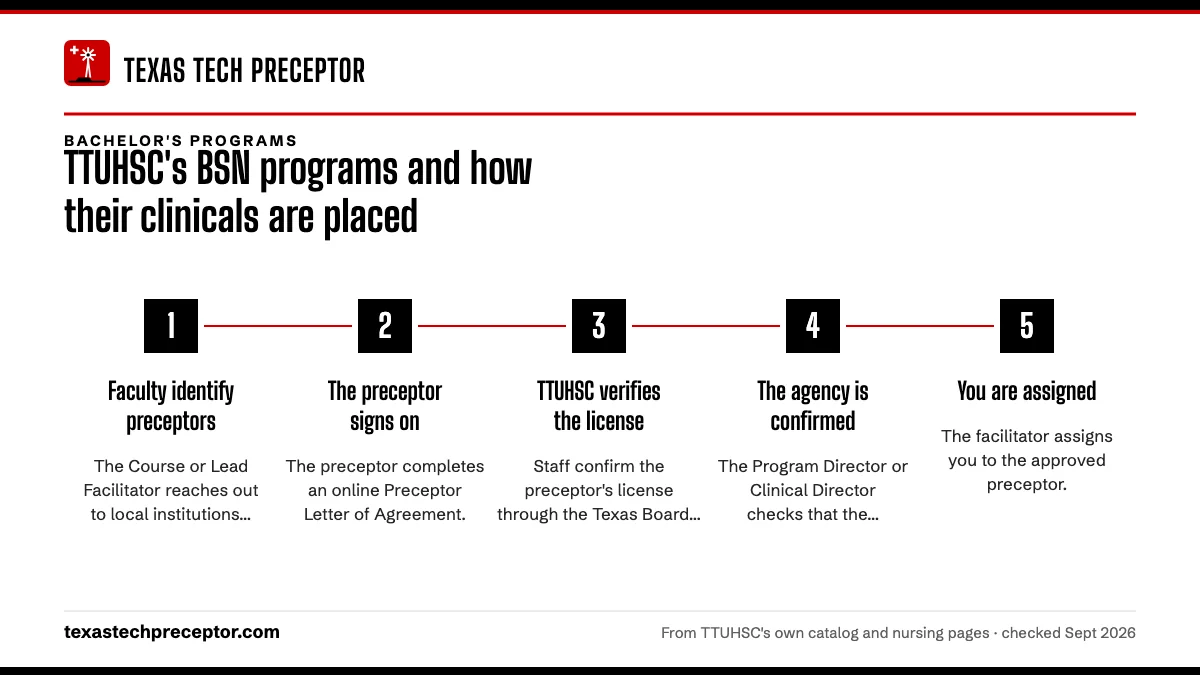
Undergraduate clinicals at TTUHSC are school-placed. The handbook's placement section for undergraduates promises that "Every effort will be made to place a student in a clinical facility convenient for the student", then leaves no doubt about who decides: the faculty teaching the clinical course. SON OP 30.725, the Traditional BSN's clinical preceptor policy (a 2009 policy, read from an archived copy), shows how an assignment comes together.
- Faculty identify preceptorsThe Course or Lead Facilitator reaches out to local institutions and identifies nurses who could precept.
- The preceptor signs onThe preceptor completes an online Preceptor Letter of Agreement.
- TTUHSC verifies the licenseStaff confirm the preceptor's license through the Texas Board of Nursing's website, and the Department Chair signs off. Undergraduate preceptors need an unencumbered Texas or compact nursing license.
- The agency is confirmedThe Program Director or Clinical Director checks that the agency's affiliation agreement with TTUHSC is current.
- You are assignedThe facilitator assigns you to the approved preceptor.
Faculty also keep the authority to move you. The handbook allows them to remove a student from a clinical setting at any time when they judge it to be in the student's best interest. Seats can be limited as well: the catalog warns that course enrollment may depend on the availability of clinical sites within the community.
Preceptor-based, but still placed by faculty
The Accelerated BSN catalog calls its clinical instruction preceptor-based, and some applicants read that as a signal that they must recruit their own nurses, the way TTUHSC's graduate NP students do. TTUHSC's rules point the other way. The handbook's undergraduate placement rule puts the decision with course faculty, and nothing on the accelerated pages hands that job to the student.
Preceptor-based describes who teaches you at the bedside: a working nurse at the clinical site, with TTUHSC faculty providing live guidance and oversight. Your part is to be cleared, reachable and ready to go wherever course faculty place you among the program's sites. With three back-to-back semesters in one year, being ready on day one matters more here than anywhere else in the school.
BSN students are placed by TTUHSC faculty, so there is no preceptor search to run. Put that energy into your clearance paperwork, which is fully yours.
Clinical courses, term by term
Both programs put clinical time in the first semester and build toward the end. TTUHSC's web plans give each course a three-part listing (credits, then weekly lecture hours, then weekly clinical hours), and the table keeps those listings exactly as published.
| Program and term | Course | Listing |
|---|---|---|
| Traditional, Level 1 | NURS 3604; NURS 3605 | 6:5:3; 6:4.5:4.5 |
| Traditional, Level 2 | NURS 3606; NURS 3502; NURS 3450 | 6:5:3; 5:4.5:1.5; 4:3:3 |
| Traditional, Level 3 | NURS 4602; NURS 4407 | 6:4:6; 4:3:3 |
| Traditional, Level 4 | NURS 4610 Integrated Learning IV: Clinical Immersion; NURS 4710 Professional Transitions of Nursing Care | 6:3:9; 7:3:12 |
| Accelerated, Semester 1 | NURS 3503 Experiential Learning I | 5:0:1.5 |
| Accelerated, Semester 2 | NURS 4603 Experiential Learning II | 6:0:18 |
| Accelerated, Semester 3 | NURS 4615 Experiential Learning III | 6:0:18 |
The Traditional BSN finishes with a clinical immersion and a transitions course, and each accelerated term carries one experiential learning course with no lecture hours, the last two listed at 18 clinical hours a week. One plan discrepancy: the catalog's Second Degree plan leaves NURS 4603 out of Semester 2, while the Veteran to BSN plan and the web page include it. The catalog is TTUHSC's official plan, so ask the program which version applies to your cohort.
What you own as a BSN student
- Traditional BSN: finish the Texas Core before you enroll.
- Second Degree track: complete CNA training and medical terminology before the first day.
- Veteran to BSN: bring your military health care rating and DD214, show health care experience within the past three years, and either live in Texas or sign TTUHSC's affidavit stating you are willing to move there.
- Background check through the Texas Board of Nursing process, which TTUHSC uses for pre-licensure students.
- Drug screening ahead of most clinical placements, plus random screens; once TTUHSC asks, the window is five days.
- Immunizations cleared before registration (Hep B, MMR, varicella, yearly TB, influenza) and a current BLS card.
Grades carry real weight. On the Traditional BSN, the floor is a C in each nursing course, and a D, F or WF can be retaken one time. The Accelerated BSN allows no retakes at all: one D, F or WF, whatever the course, ends your enrollment in the School of Nursing and the University.
Working students should know the handbook keeps undergraduates off their own unit for clinical hours unless the Program Director agrees; the workplace clinicals guide explains the rule. The immunizations and certifications guide and the background check and drug screen guide cover the clearance steps.
Campuses and simulation
The Traditional BSN admitted its first students in Lubbock in August 1981, then spread to Abilene and the Permian Basin in 2009, Mansfield in 2021 and Amarillo in 2022. TTUHSC's current wording calls Mansfield a distance education site and Dallas a branch campus, and each relies on TTUHSC's accreditation.
Simulation runs across TTUHSC's campuses. Its simulation program lists seven sites, among them the F. Marie Hall SimLife Center in Lubbock, the Abilene Simulation Center, simulation centers in Dallas and Mansfield, and the Louise and Clay Wood Simulation Center inside Medical Center Hospital in Odessa. TTUHSC also points out that its Abilene campus sits beside Hendrick Health, and presents that as an advantage for reaching clinical rotations.
After the BSN: when the search becomes yours
The picture changes at the graduate level. TTUHSC's graduate FAQ hands graduate students the job of obtaining their own preceptors; every preceptor and facility then needs sign-off from SON staff and faculty, plus a new electronic agreement per preceptor each term. Even the BSN to DNP, which promises help from faculty and TTUHSC's preceptor team, answers yes when asked whether students find their own. The finding your own preceptor guide explains the rule.
Some of those programs are open soon after the BSN. TTUHSC waives prior nursing experience for both psychiatric routes, the MSN PMHNP and the BSN to DNP PMHNP. FNP applicants face experience minimums instead: a year of RN work for the MSN, two years for the BSN to DNP.
When you reach that step, we are the placement service built for it. We find preceptors and clinical sites close to where you live, fitted to each TTUHSC clinical course, then prepare the preceptor and facility details the approval needs before each semester and keep a backup lined up in case a preceptor drops. Keep us in mind for then, and read how it works when you are ready.
Questions TTUHSC students ask
Will TTUHSC make me find my own BSN preceptor?
No. TTUHSC places undergraduate students: the handbook gives the clinical placement decision to the faculty teaching each clinical course and commits to trying for a facility convenient for you. That applies to the Traditional BSN and to both accelerated tracks. The find-your-own rule belongs to TTUHSC's graduate nurse practitioner programs.
Where does TTUHSC's Accelerated BSN hold clinicals?
The 2026-27 catalog lists seven clinical sites: Abilene, Amarillo, Austin, Dallas, Lubbock, the Permian Basin (Odessa) and San Antonio. The Accelerated BSN's web page lists six and leaves out San Antonio. Faculty place students among the sites, so confirm the current list with the program before you plan a move.
What happens if I fail a course in TTUHSC's Accelerated BSN?
The catalog's rule is unforgiving: one grade of D, F or WF, in whichever course, leads to dismissal from the School of Nursing and the University. The Traditional BSN allows one repeat of such a grade. With three consecutive semesters and no second chance, protect your clinical evaluations and exam averages from the first week.
When can I start TTUHSC's Traditional BSN?
In any term, at all five campuses. Fall applications run Feb. 15 to April 15, Spring applications June 15 to Aug. 15, and Summer applications Oct. 15 to Dec. 15. The Texas Core must be complete before you enroll, and the nursing sequence then runs four consecutive semesters.
Who qualifies for TTUHSC's Veteran to BSN?
TTUHSC looks for a military health care rating backed by a DD214, health care experience within the past three years, and either Texas residency or a signed affidavit that you will relocate to the state. The track shares its courses and clinical sites with the Second Degree track and starts each Spring.
Can I go from a TTUHSC BSN straight into a nurse practitioner program?
For psychiatric mental health, yes in principle, because neither TTUHSC PMHNP route asks for prior nursing experience. Family practice is different: plan on one year as an RN before the MSN FNP, or two before the BSN to DNP FNP. In TTUHSC's graduate NP tracks, finding preceptors becomes your job, which is the search we run.
Related pages
Last checked 2026-09-26
We check these pages against TTUHSC's catalog, Student Handbook, program pages and licensure disclosures. Your course faculty, your program director and the plan of study for your cohort have the final word.
Your TTUHSC preceptor search, run by specialists.
Tell us your TTUHSC track, your next clinical course and the town you'll train near. We find preceptors who fit the course and pull together what SON staff and faculty need to approve both the clinician and the facility, early enough for the electronic preceptor agreement to go through before the term.
- Preceptors matched to the track: family primary care, adult-gerontology acute care, pediatrics, psychiatric mental health
- License, certification and facility details ready for TTUHSC's preceptor and facility approval
- In Lubbock, Amarillo, Abilene, the Permian Basin, Dallas-Fort Worth and the states TTUHSC accepts
Start your placement plan
Your track, your town and your next clinical term is all we need to begin.