Your TTUHSC NP program, based in South Carolina
South Carolina is marked Meets on each of TTUHSC's graduate nursing tables. Rotations take place near your South Carolina home with a preceptor and facility TTUHSC approves; the state's rule for visiting programs is written around first licensure, and North Carolina next door is closed to TTUHSC graduate students.
Get your placement plan
Tell us your TTUHSC program and where you live. A placement advisor replies with the preceptor and site options that fit your TTUHSC course.
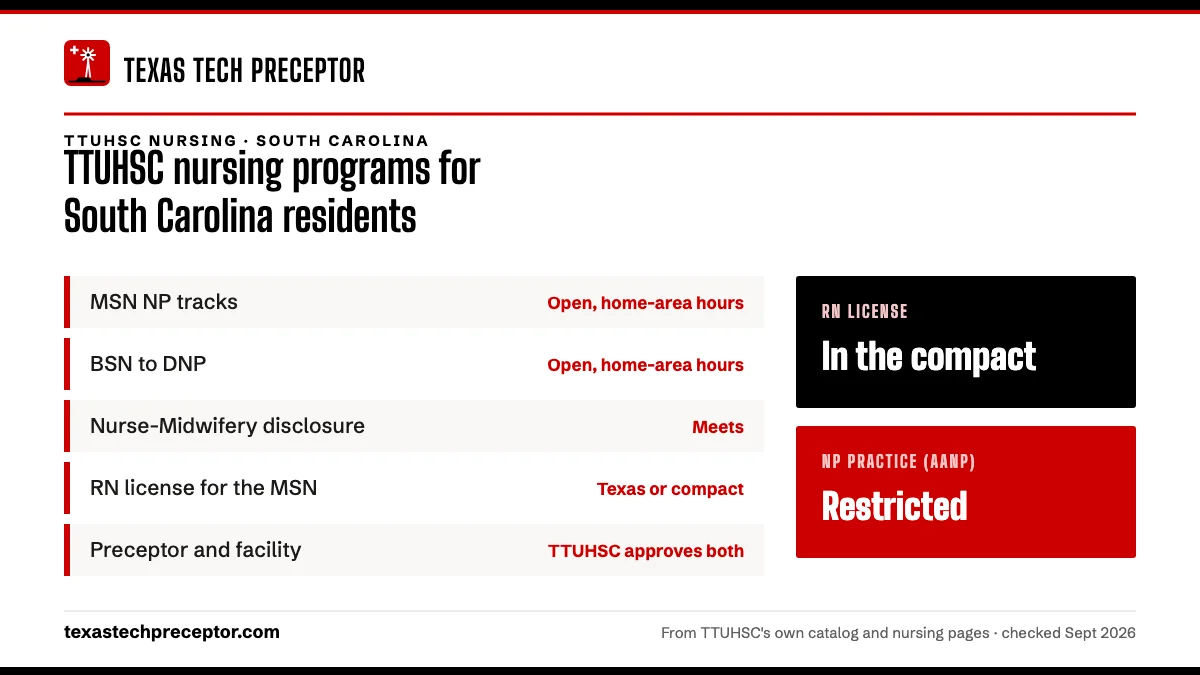
Where South Carolina stands with TTUHSC
| TTUHSC program | South Carolina | Clinical hours happen |
|---|---|---|
| MSN NP tracks: FNP, AGACNP, primary and acute care PNP, PMHNP | Meets | Around your South Carolina home, after SON approval of preceptor and facility |
| MSN Nurse-Midwifery | Meets | Where the Program Director approves |
| BSN to DNP (FNP, PMHNP) | Meets | Locally, with support from the preceptor team |
Applying is open; admission is TTUHSC's decision. The graduate pages say evolving regulations can stop TTUHSC from confirming, on the day it receives an application, that it can accept students from a particular state, so South Carolina applicants should put the question to the Admissions Team before applying.
Regulation 91-6 and the programs it names
South Carolina's Board of Nursing sets its terms for outside schools in Regulation 91-6. When a program's parent institution is located in another state and its South Carolina clinicals prepare students for a first license, the Board's approval comes first. The Board then expects four things: full approval in the home state, direct on-site, on-shift supervision by nursing faculty holding a South Carolina or other compact license, a written clinical affiliation agreement, and precepted experiences run under South Carolina's rules. If the program's compliance changes, it owes the Board a written notice inside 15 days.
APRN programs get no mention in the regulation. TTUHSC NP students already hold RN licenses, so ask your program director how TTUHSC reads Regulation 91-6 before your first South Carolina rotation.
Compact license and physician practice agreements
South Carolina was part of the compact from its January 2018 launch. A current, unencumbered South Carolina multistate license meets the MSN's rule of a Texas or compact RN license, and doctoral students follow a U.S. RN license rule (license guide).
AANP classifies South Carolina as restricted. There, an NP's delegated acts rest on a practice agreement signed with a physician, and the amount of controlled substances an NP may supply is capped, so your preceptor's practice will run under that agreement. The APRN Compact has not passed in South Carolina.
A note on the state's preceptor tax credit
South Carolina rewards some preceptors through income tax credits and deductions under S.C. Code 12-6-3800, first enacted in 2019 and extended by a 2024 act through tax year 2029. Qualifying rotations must serve students of a South Carolina public or independent school, which leaves a TTUHSC rotation outside the credit.
Greenville, Charleston, Columbia and the Charlotte edge
Greenville-Anderson-Greer is the state's largest metro. Charleston-North Charleston and Columbia are nearly the same size as each other, and roughly 450,000 South Carolinians live in the southern reach of the Charlotte metro. Larger systems include McLeod Health, Lexington Health, MUSC Health, Roper St. Francis Healthcare and Prisma Health. They show where preceptors practice; every one of them runs student rotations its own way, and TTUHSC's approval of your preceptor and facility is a separate matter.
The Charlotte side needs care. North Carolina is closed to TTUHSC graduate applicants, and its Board expects out-of-state programs to secure approval through a North Carolina agency at least 30 days before clinicals. Keep rotations south of the line unless TTUHSC says otherwise, and give TTUHSC 60 days' notice before any move (moving guide).
Why South Carolina students choose us
TTUHSC's clinical process is our specialty, and we search South Carolina with its rules and its northern border in mind. Your placement advisor matches you with a nearby preceptor and facility suited to your TTUHSC course, then builds the approval file, from preceptor license and certification to facility information, well ahead of the electronic preceptor agreement. Start with the form.
Questions TTUHSC students ask
Can I earn a TTUHSC nurse practitioner credential while living in Columbia or Charleston?
Yes. Every TTUHSC graduate table lists South Carolina as Meets, and your clinical hours would be completed in your own area. Admission is TTUHSC's call, made after you confirm eligibility with its Admissions Team. Start with the FNP program page.
What do I need in place before my first South Carolina rotation?
An approved preceptor and facility, the semester's electronic preceptor agreement, and TTUHSC's clearance items: a background check, drug screening, immunizations, BLS (with ACLS added for FNP and AGACNP students and PALS for the pediatric tracks), health insurance and yearly HIPAA training. Your course faculty confirm anything course-specific.
What if I move from South Carolina to Georgia?
Georgia is also an open state for TTUHSC graduate students. Give TTUHSC 60 days' notice or more before moving; whether clinicals can continue in Georgia turns on the placement you propose, reviewed case by case. The Georgia guide covers that state's rules.
How often would I fly to Texas?
MSN students come to campus for 7-8 days spread over their program; the OSCEs are held in Lubbock, with dates sent a couple of months ahead. If you choose the BSN to DNP, expect a visit every term, usually a day or two, rotating among Lubbock, Austin and Dallas.
Related pages
Last checked 2026-09-26
We check these pages against TTUHSC's catalog, Student Handbook, program pages and licensure disclosures. Your course faculty, your program director and the plan of study for your cohort have the final word.
Your TTUHSC preceptor search, run by specialists.
Tell us your TTUHSC track, your next clinical course and the town you'll train near. We find preceptors who fit the course and pull together what SON staff and faculty need to approve both the clinician and the facility, early enough for the electronic preceptor agreement to go through before the term.
- Preceptors matched to the track: family primary care, adult-gerontology acute care, pediatrics, psychiatric mental health
- License, certification and facility details ready for TTUHSC's preceptor and facility approval
- In Lubbock, Amarillo, Abilene, the Permian Basin, Dallas-Fort Worth and the states TTUHSC accepts
Start your placement plan
Your track, your town and your next clinical term is all we need to begin.