TTUHSC Pediatric Acute Care NP: hybrid clinicals and hospital preceptors
TTUHSC's MSN Pediatric Acute Care NP is a 46-credit online track whose clinical courses are hybrid: precepted hours near home, paired with on-campus skills labs. It requires two years of pediatric RN experience, prefers that some of it come from critical care, emergency or acute care, and asks for PALS before clinicals begin. The preceptor search is yours, and in pediatric acute care it runs through hospitals with rules of their own.
Find a pediatric acute care preceptor
Tell us your city and the term Pediatric Acute Care I begins.
Pediatric acute care at a glance
TTUHSC's website calls the track Pediatric Acute Care NP while the catalog reverses the words; both names describe one program. This guide uses the website's name throughout.
| Item | What TTUHSC states |
|---|---|
| Catalog name | Nursing, Acute Care Pediatric Nurse Practitioner Track, MSN |
| Credits | 46 |
| Format | Online coursework; hybrid clinical courses with on-campus skills labs |
| Start terms | Fall or Spring |
| Experience | Two years of pediatric RN work; critical care, ER or acute care experience preferred |
| Certifications | BLS for everyone; PALS before the first population-focus clinical course |
| Clinical courses | Pediatric Acute Care I, II and III |
| Clinical hours | Measured per course; no track total from TTUHSC |
Reading the experience preference
Two years of pediatric RN experience are required. On top of that floor, TTUHSC states that "RN pediatric experience in critical care, ER, or acute care is preferred." A preference is not a requirement, but it tells you the kind of nurse the track is designed around.
The same background pays off when clinicals arrive. Colleagues and managers from a pediatric intensive care unit or a children's emergency department are often the first people who can point you to a pediatric acute care NP willing to precept, and knowing the unit makes that conversation easier.
Before the clinical sequence, the plan adds Foundations of Pediatric Acute Care and Foundations of the Well Child to advanced pathophysiology, pharmacology and Advanced Health Assessment and Diagnostic Reasoning, which carries an on-campus intensive. PALS must be current before Pediatric Acute Care I.
Hybrid clinical courses
Pediatric Acute Care I (NURS 5500), II (NURS 5600) and III (NURS 6690) each join a precepted clinical section to an on-campus skills lab. That pairing is what TTUHSC means when it calls the clinical courses hybrid: most hours happen with your preceptor near home, and part of the skills work happens on a TTUHSC campus.
Hours are counted at 4.25 clock hours per credit, the ratio TTUHSC applies to NP clinical courses, and no total is published for this track. The pediatric NP clinical courses page compares this sequence with the primary care one.
TTUHSC's simulation program runs seven sites, including a Mansfield center with areas built to simulate acute and primary care settings, but the program pages do not say which campus hosts each pediatric skills lab. Confirm the location and dates with course faculty and build travel into your clinical schedule.
Hospital sites and their own rules
Pediatric acute care rotations generally happen in hospitals: inpatient pediatric units, intensive care, emergency departments and hospital-based specialty services. That brings two layers of approval. TTUHSC's SON staff and faculty rule on the preceptor and the facility, and the hospital applies its own student requirements on top.
Large systems publish those requirements in different ways. In the Dallas-Fort Worth area, UT Southwestern's Office of Advanced Practice Providers takes student precepting requests during set application windows and states that it does not match students with clinicians, so you arrive with a preceptor already found. In Lubbock, Covenant Health insists on its own affiliation agreement with a student's school before any rotation and wants documents two weeks out.
Hospital agreements on TTUHSC's side are handled by the office it names Clinical Placement, Affiliation Agreements, and Preceptor Management, and no turnaround time is posted. A children's hospital new to TTUHSC students calls for extra lead time. The affiliation agreements page explains how it works.
Clearance before a hospital badge
Hospitals check the same items TTUHSC requires, and a unit will expect them settled before your first shift. Have PALS and BLS current; from May 1, 2027, TTUHSC accepts only American Heart Association BLS. Keep the immunization series up to date: hepatitis B, MMR and varicella, TB testing every year, and influenza, plus COVID-19 where a clinical partner requires it.
A criminal background check runs through TTUHSC's chosen vendor, and drug testing happens ahead of most placements and at random; TTUHSC allows five days to finish a requested test. TTUHSC's program pages warn that a site may decline a vaccination-exemption affidavit, which could delay placement or graduation. See background checks and drug screens for the details.
Health insurance is mandatory for online programs with clinicals, HIPAA training is renewed every year, and the SON's blanket liability coverage extends to students in clinical settings.
When to start, and where you can live
The track admits in Fall or Spring, and the online MSN materials do not say when Pediatric Acute Care I falls. Your plan of study from orientation fixes it. Because a hospital rotation can need a new affiliation agreement as well as the preceptor's yes, begin the search at least a full semester before that first clinical course, earlier if the hospital you want has never hosted a TTUHSC student.
Clinicals take place where you live, in Texas or beyond. TTUHSC's licensure page marks ten states, among them Louisiana, Colorado and Washington, as places it cannot accept graduate students from, and graduate online students must give at least 60 days' notice before a move to a new state. Check where yours stands on the licensure disclosure page.
Our pediatric acute care search
A pediatric acute care search runs through hospitals and a specialized group of clinicians, and it rewards persistence. We work it for you: pediatric acute care NPs and other qualified clinicians near home, the hospital's student office, and TTUHSC's approval details, all lined up before the term.
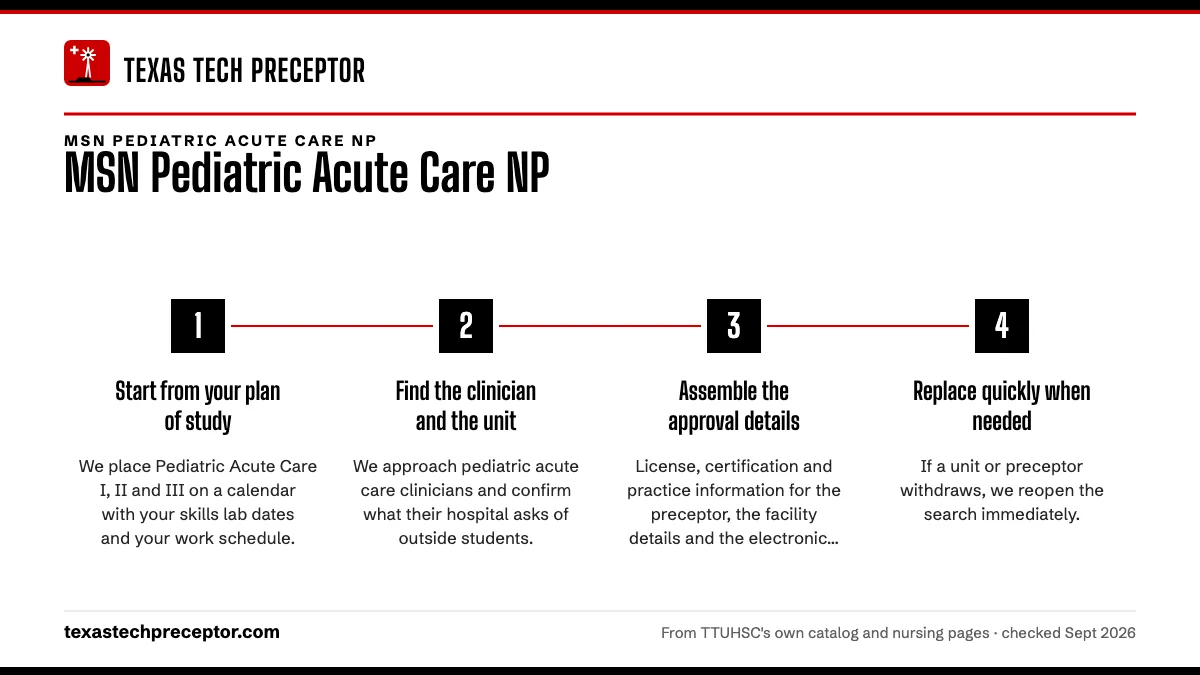
- Start from your plan of studyWe place Pediatric Acute Care I, II and III on a calendar with your skills lab dates and your work schedule.
- Find the clinician and the unitWe approach pediatric acute care clinicians and confirm what their hospital asks of outside students.
- Assemble the approval detailsLicense, certification and practice information for the preceptor, the facility details and the electronic agreement items come to you complete.
- Replace quickly when neededIf a unit or preceptor withdraws, we reopen the search immediately.
TTUHSC's staff and faculty make the approval decision for each preceptor and hospital, and our work is to hand them a complete request that fits the rules. See how it works or tell us your city in the form below.
Questions TTUHSC students ask
Is TTUHSC's Pediatric Acute Care NP program online?
Coursework is online, and the clinical courses are hybrid, combining precepted hours near home with on-campus skills labs. The track also includes an Advanced Health Assessment intensive, and TTUHSC's MSN NP tracks total seven to eight campus days, with OSCEs held in Lubbock.
Do I need PICU or ER experience for TTUHSC's acute care PNP?
It is preferred, not required. TTUHSC requires two years of RN pediatric experience and prefers that it include critical care, emergency or acute care work. If your pediatric years are mostly outpatient, the primary care pediatric track may fit better, or ask the Admissions Team how your background reads.
How many credits is TTUHSC's Pediatric Acute Care NP?
46 credits in the 2026-27 catalog, one more than the 45-credit primary care pediatric track. The acute track carries a four-credit Foundations of Pediatric Acute Care in place of the primary care plan's three-credit course on the sick child, and its three clinical courses differ in focus.
How many clinical hours does TTUHSC's pediatric acute care track require?
Neither the catalog nor the program page gives a track total. Clinical time is set course by course at the NP ratio of 4.25 clock hours per credit, and each syllabus fixes the requirement. Your course faculty give the term's figure, and that is the number to share with your preceptor.
Can I do pediatric acute care clinicals where I work?
Possibly. TTUHSC's published own-unit limit covers undergraduates, and no graduate version has been posted, so ask course faculty before planning around your employer. The hospital must still be approved as a facility. The workplace clinicals page covers what TTUHSC has put in writing.
Related pages
Last checked 2026-09-26
We check these pages against TTUHSC's catalog, Student Handbook, program pages and licensure disclosures. Your course faculty, your program director and the plan of study for your cohort have the final word.
Your TTUHSC preceptor search, run by specialists.
Tell us your TTUHSC track, your next clinical course and the town you'll train near. We find preceptors who fit the course and pull together what SON staff and faculty need to approve both the clinician and the facility, early enough for the electronic preceptor agreement to go through before the term.
- Preceptors matched to the track: family primary care, adult-gerontology acute care, pediatrics, psychiatric mental health
- License, certification and facility details ready for TTUHSC's preceptor and facility approval
- In Lubbock, Amarillo, Abilene, the Permian Basin, Dallas-Fort Worth and the states TTUHSC accepts
Start your placement plan
Your track, your town and your next clinical term is all we need to begin.