Who does what in TTUHSC's clinical process
TTUHSC's clinical process runs through a small set of offices and titles. The School of Nursing's Office of Student Success houses a unit for Clinical Placement, Affiliation Agreements, and Preceptor Management; course faculty and program directors approve and decide; advisors handle registration; and separate offices manage compliance. Knowing which title owns a question saves days.
Get your placement plan
Tell us your TTUHSC program and where you live. A placement advisor replies with the preceptor and site options that fit your TTUHSC course.
The placement unit in the Office of Student Success
The 2026-27 catalog shows the SON Office of Student Success with a unit carrying a long, literal name: Clinical Placement, Affiliation Agreements, and Preceptor Management. It lists four positions there by title only, an Undergraduate Coordinator and a Graduate Coordinator, a position titled Affiliation Agreements, and a Unit Manager over the group.
The titles suggest how the work divides. Graduate placement questions point toward the Graduate Coordinator, facility contracts toward the Affiliation Agreements role, and BSN placements toward the Undergraduate Coordinator, with the Unit Manager over the unit as a whole. TTUHSC does not publish job descriptions for these roles, so read that as a guide to the titles rather than a rulebook, and when you are unsure where a question belongs, ask the Graduate Coordinator to route it.
The unit's name tells you what TTUHSC groups together: finding placements, contracting with facilities and managing preceptors are handled side by side. For the contract piece in particular, see the affiliation agreements guide.
Who approves preceptors, facilities and plans
Approval is shared. TTUHSC's graduate FAQ gives the decision on each preceptor and each facility to SON staff and faculty together, and your course faculty are the ones who know what their clinical course requires. Midwifery works a little differently: its clinical locations each need the Program Director's approval.
Program directors carry a wider load than site approval. Advising for the MSN APRN tracks is directed by specified program directors, and the handbook ties relocation to the program director. Taking a course out of sequence needs sign-off from the advisor, course facilitators, the Program Director and/or the Associate Dean or Department Chair. Progression is reviewed each semester by the Graduate Associate Dean/Department Chair and/or MSN Program Director with the Graduate Progressions Council, and a repeat of a course needs the programmatic director and the Graduate Program Council to agree in advance.
Higher decisions sit further up. The Program Progressions Committee recommends dismissals, the Dean decides them, and the Executive Associate Dean handles dismissal appeals, procedural grade appeals and drug-screen appeals.
Help with finding and contracting
Several titles exist to move students toward an approved placement. On the BSN to DNP side, TTUHSC's program pages mention a preceptor team that joins faculty in helping students choose preceptors and facilities and put contracts in place. Nurse-Midwifery pairs faculty with TTUHSC preceptor/site coordinators. The handbook's dress-code section also refers to Clinical Site Coordinators.
TTUHSC also keeps, for current graduate students, a record of preceptors used over the last two years, meant as a starting guide. How to use that record is covered on our preceptor list and preceptor team page.
Undergraduate roles look different because TTUHSC places BSN students. Under the School of Nursing's older Traditional BSN preceptor policy (SON OP 30.725), the Course or Lead Facilitator works with local institutions to identify preceptors and assigns students to them, the Program Director or Clinical Director confirms an affiliation agreement is on file, office staff verify the preceptor's RN license with the Texas Board of Nursing, and the Department Chair signs the preceptor's letter of agreement.
Advising, registration and admissions
Graduate advising sits with the Office of Student Advising and Support. A Graduate Enrolled Student Advisor, reporting to the Assistant Dean for Student Advising and Support, supports students in the MSN APRN tracks and fields questions on registration, adding courses and withdrawal. TTUHSC also names an MSN Program Enrolled Student Advisor and a DNP Programs Enrolled Student Advisor.
Your plan of study is handed out at orientation, and any course you add needs the Enrolled Student Advisor's approval. Because a clinical course is tied to a preceptor and a term, bring the advisor in early whenever a placement problem could change your schedule.
Two more offices matter for students outside Texas. The Admissions Team confirms whether out-of-state applicants are eligible, and TTUHSC's Office of Academic Planning and Compliance manages state authorization. The licensure disclosure guide shows which states TTUHSC cannot accept graduate students from.
Which title answers which question
| Your question | Title or office that answers it |
|---|---|
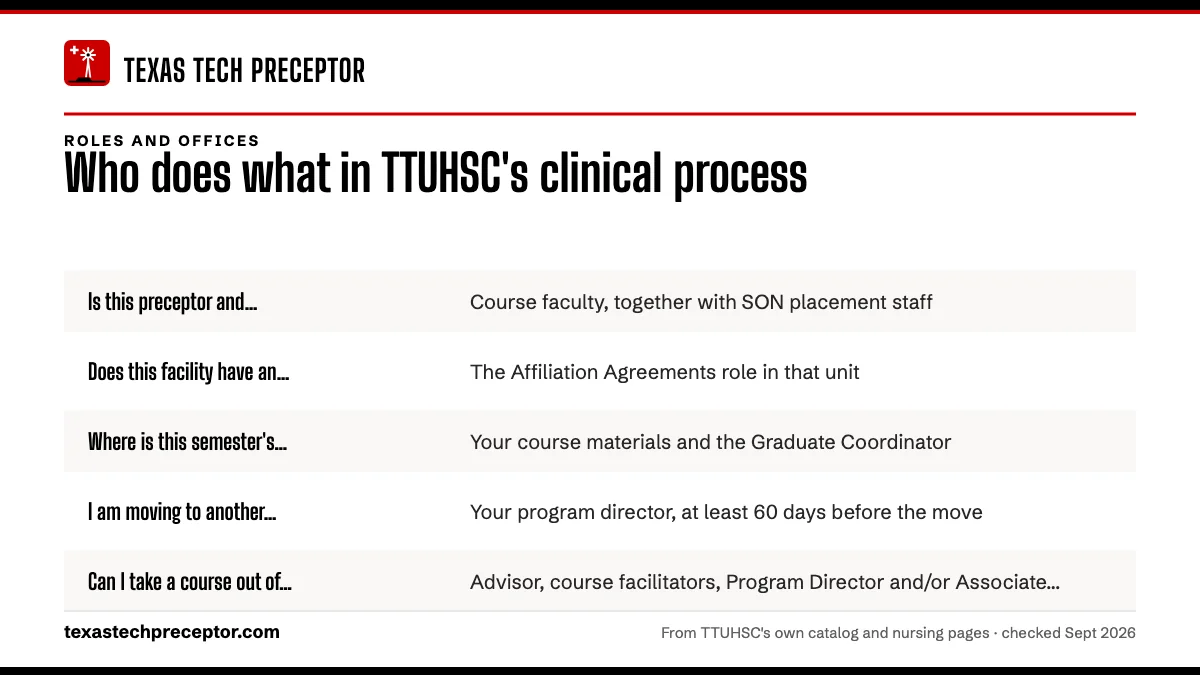
| Is this preceptor and facility acceptable for my course? | Course faculty, together with SON placement staff |
| Does this facility have an agreement with TTUHSC? | The Affiliation Agreements role in that unit |
| Where is this semester's preceptor agreement? | Your course materials and the Graduate Coordinator |
| I am moving to another state | Your program director, at least 60 days before the move |
| Can I take a course out of sequence? | Advisor, course facilitators, Program Director and/or Associate Dean or Department Chair |
| Registration, adds or withdrawal | Graduate Enrolled Student Advisor |
| A drug screen request or HIPAA record | SON Office of Student Affairs |
| Immunization records | Office of Institutional Health and its Immunization Coordinator |
| A midwifery clinical site | Faculty, preceptor/site coordinators and the Program Director |
| Login or D2L trouble | IT Solution Center |
Drug screen results also pass through a Medical Review Officer, and MSN and DNP background checks go through TTUHSC's institutionally approved vendor. The background check and drug screen guide covers both.
Where we fit among these roles
Every title above belongs to TTUHSC, and each one plays its part once a placement is on the table. For NP students, getting it onto the table, finding a qualified preceptor near home who has room for you, is the student's job. That is the work TTUHSC students bring to us.
We find a preceptor and site that fit your course, then prepare what these offices review: the preceptor's credentials and a clear description of the practice for course faculty and SON staff, the facility's details and contract status for the agreements side, and everything the electronic agreement asks for each semester. We stay on call through the term if anything changes. TTUHSC's staff and faculty decide; our part is handing them a file with nothing missing. Read how it works for the steps, then send us your course through the form below.
Questions TTUHSC students ask
What is the Graduate Coordinator's role at the TTUHSC School of Nursing?
The Graduate Coordinator is one of four titled positions in the placement, agreements and preceptor unit of the SON Office of Student Success. Given what that unit covers, it is the sensible first stop for graduate placement questions your course faculty cannot settle. Your course materials and D2L course sites carry current contact routes.
What does the TTUHSC preceptor team do?
According to TTUHSC's BSN to DNP pages, the preceptor team works alongside faculty to help students pick preceptors and facilities and to handle the contracting. The student still leads the search, while the team helps move a chosen preceptor and facility toward approval and a contract. The two-year preceptor list is another resource for current graduate students.
Who approves my clinical site at TTUHSC?
For graduate NP students, the preceptor and the facility each need a yes from SON staff and faculty. In Nurse-Midwifery, every location used for population-focus clinical hours needs the Program Director's approval. For BSN students, clinical faculty make the placement decision. In each case a contract between the facility and TTUHSC, the affiliation agreement, may be needed as well.
Who do I contact about dropping a clinical course?
Start with your course faculty, then get approval from the Graduate Enrolled Student Advisor, and only then drop the course in the WebRaider Portal. The handbook cautions that dropping may delay your progression through the curriculum, so talk the decision through before the term's drop deadline, especially in a clinical course.
Who handles appeals of a clinical failure or dismissal?
A procedural grade appeal goes to the Executive Associate Dean within two business days of the chair's decision, and TTUHSC calls that decision final. Dismissal appeals run through the Executive Associate Dean within five business days and are heard by a three-faculty committee. Full appeal and progression rules sit in the grades and progression guide.
Related pages
Last checked 2026-09-26
We check these pages against TTUHSC's catalog, Student Handbook, program pages and licensure disclosures. Your course faculty, your program director and the plan of study for your cohort have the final word.
Your TTUHSC preceptor search, run by specialists.
Tell us your TTUHSC track, your next clinical course and the town you'll train near. We find preceptors who fit the course and pull together what SON staff and faculty need to approve both the clinician and the facility, early enough for the electronic preceptor agreement to go through before the term.
- Preceptors matched to the track: family primary care, adult-gerontology acute care, pediatrics, psychiatric mental health
- License, certification and facility details ready for TTUHSC's preceptor and facility approval
- In Lubbock, Amarillo, Abilene, the Permian Basin, Dallas-Fort Worth and the states TTUHSC accepts
Start your placement plan
Your track, your town and your next clinical term is all we need to begin.