Minnesota and TTUHSC's online graduate nursing tracks
If you live in Minnesota, TTUHSC's graduate nursing tracks are open to your application, and your clinical hours would be built close to home. Two Minnesota facts deserve early attention: the state belongs to no nurse compact, which bears on the MSN license rule, and some large clinical sites set conditions stricter than state law.
Get your placement plan
Tell us your TTUHSC program and where you live. A placement advisor replies with the preceptor and site options that fit your TTUHSC course.
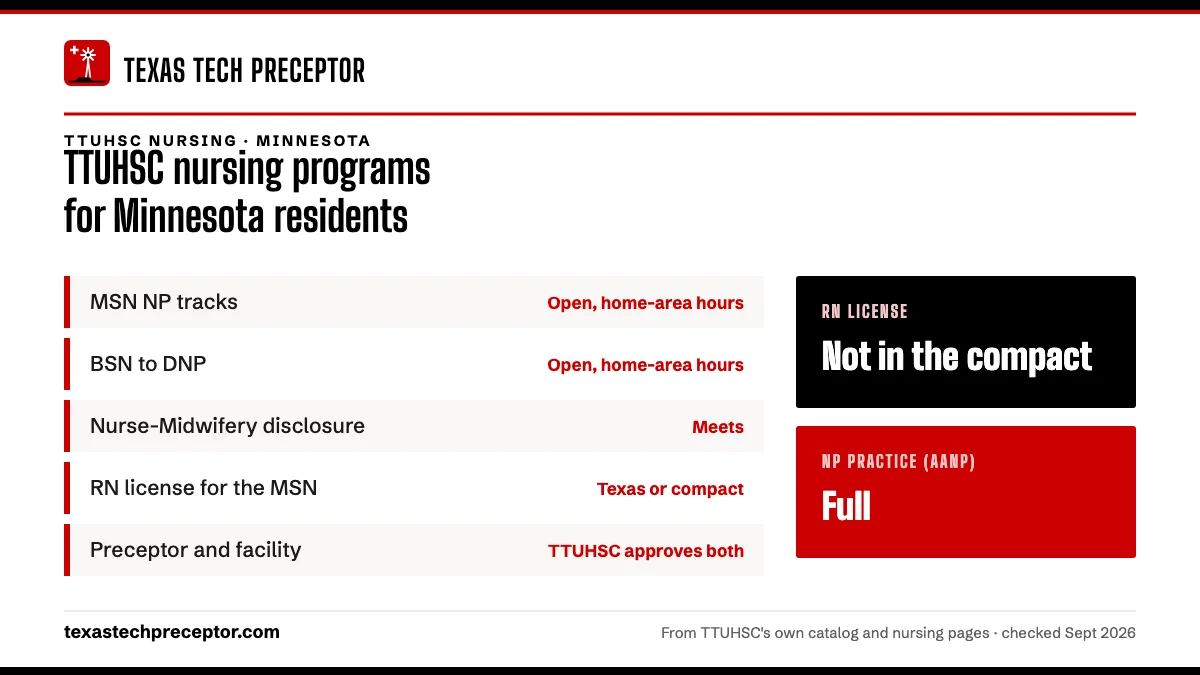
The short answer, track by track
Minnesota carries no unable-to-accept note on any of TTUHSC's graduate licensure tables.
| TTUHSC track | Minnesota status | Clinical setting |
|---|---|---|
| MSN nurse practitioner (family, acute care, pediatric, psychiatric) | Meets | Your Minnesota area, once SON staff and faculty approve preceptor and facility |
| MSN Nurse-Midwifery | Meets | Locations approved by the Program Director, coordinated with TTUHSC |
| BSN to DNP (FNP, PMHNP) | Meets | Local sites, with faculty and the preceptor team helping |
Admission is a separate call. TTUHSC's graduate program pages explain that shifting regulations keep them from confirming every state at application time, and they point anyone applying from beyond Texas toward Admissions first.
Why the compact gap matters for the MSN
Minnesota has neither joined the Nurse Licensure Compact nor, per the compact map, any bill pending to join. TTUHSC's MSN tracks require an unencumbered RN license that is either Texas-issued or multistate under the compact, and Minnesota's licenses are neither. For an MSN applicant the practical path is a Texas RN license held alongside the Minnesota one. The DNP programs phrase their rule another way, explained on the license requirements page.
Minnesota statute, for its part, makes room for students. Under section 148.271(6), a nurse whose RN license comes from another state needs no Minnesota license for practice that is part of a structured program of study, graduate nursing being one example. Minn. R. 6305.0300 treats U.S. programs approved by their own states as approved, while asking that the instructor overseeing the student be an RN licensed and currently registered in Minnesota. How that clause fits a precepted TTUHSC course is for your TTUHSC course faculty to settle.
When a hospital asks for more than the statute
No extra filing with the Minnesota Board for schools based elsewhere came to light; the Board's approval role covers programs conducted inside Minnesota. Individual systems can go further, and Mayo Clinic's NP clinical education program is a clear example. Mayo's list runs to four items: your school holds an affiliation agreement with Mayo; faculty of record are licensed as RNs or APRNs where the experience takes place; you complete a Minnesota DHS background study; and your own Minnesota license is unencumbered with its registration current.
Conditions like these feed directly into TTUHSC's approval of the facility and the affiliation agreement behind it, so they belong in the plan before a preceptor commits.
Full practice, reached through collaboration
Minnesota earns AANP's full practice label, but only once a new NP has logged 2,080 hours or more in a collaborative agreement, with a physician or an APRN as the partner. A preceptor may be past that mark or still working toward it, and either way the preceptor's credentials go to TTUHSC for review.
The Twin Cities metro holds most Minnesotans, far ahead of Duluth, Rochester and St. Cloud. Major systems include Allina Health, Mayo Clinic and M Health Fairview, and HealthPartners and Essentia Health are two more. Read them as places NPs practice, not as TTUHSC partners. The state's MERC fund partly offsets training costs for Minnesota clinical sites, but its eligibility rules require a Minnesota-based teaching program, so a TTUHSC rotation earns a site nothing from it.
Across the St. Croix and a possible move
Both the Twin Cities and Duluth metros reach into Wisconsin, where rule N 1.06 says out-of-state schools, graduate programs included, need the Wisconsin Board's approval. That is a different footing from Minnesota's, so keep the search on the Minnesota side unless TTUHSC approves otherwise. Should you move to another state mid-program, TTUHSC wants two months' warning (60 days), and the new state's clinical approval is individual (moving out of state).
What Minnesota students get from us
TTUHSC students choose us because our work follows TTUHSC's own steps closely. We look for a Minnesota preceptor whose practice fits your course, find out early what the facility will require, from license registration to background studies, and prepare what SON reviewers need for approval and each semester's agreement. Start with the form below, naming your town and course, or read how it works first.
Questions TTUHSC students ask
Does TTUHSC accept graduate nursing students from Minnesota?
Minnesota is marked "Meets" on the MSN nurse practitioner, midwifery and BSN to DNP tables, with no restriction noted. Being eligible to apply is not the same as admission, and TTUHSC prefers that non-Texans settle eligibility with Admissions ahead of an application.
Will a Minnesota RN license alone meet TTUHSC's MSN rule?
Most likely not. The rule names Texas licenses and compact multistate licenses, and Minnesota issues only single-state licenses because it is not a compact member. Keep your Minnesota license active for practice at home and confirm the Texas route with Admissions. DNP wording differs, so check it separately.
Does the Minnesota Board of Nursing have to approve TTUHSC first?
Research found no Board approval process aimed at schools from other states. Minnesota's rule treats programs approved by their home state as approved and exempts out-of-state RNs practicing within a formal course of study. Individual facilities may still set their own conditions, and TTUHSC approves every preceptor and site.
Can I use a Mayo Clinic site for TTUHSC clinical hours?
Only if Mayo's own conditions are met and TTUHSC approves the site. Mayo's NP clinical education page lists a background study through the state's DHS, an affiliation agreement with your school, faculty licensed in Minnesota and your own registered Minnesota license. Raise it with your course faculty early.
Related pages
Last checked 2026-09-26
We check these pages against TTUHSC's catalog, Student Handbook, program pages and licensure disclosures. Your course faculty, your program director and the plan of study for your cohort have the final word.
Your TTUHSC preceptor search, run by specialists.
Tell us your TTUHSC track, your next clinical course and the town you'll train near. We find preceptors who fit the course and pull together what SON staff and faculty need to approve both the clinician and the facility, early enough for the electronic preceptor agreement to go through before the term.
- Preceptors matched to the track: family primary care, adult-gerontology acute care, pediatrics, psychiatric mental health
- License, certification and facility details ready for TTUHSC's preceptor and facility approval
- In Lubbock, Amarillo, Abilene, the Permian Basin, Dallas-Fort Worth and the states TTUHSC accepts
Start your placement plan
Your track, your town and your next clinical term is all we need to begin.