Connecticut nurses in TTUHSC's graduate programs
For TTUHSC's graduate nursing tracks, Connecticut is an open state, and since October 2025 it is a compact state as well, which makes the MSN license rule simpler to meet from there. Connecticut's education rules were written for programs leading to first licensure, so for an NP rotation the approvals that count most are TTUHSC's own.
Get your placement plan
Tell us your TTUHSC program and where you live. A placement advisor replies with the preceptor and site options that fit your TTUHSC course.
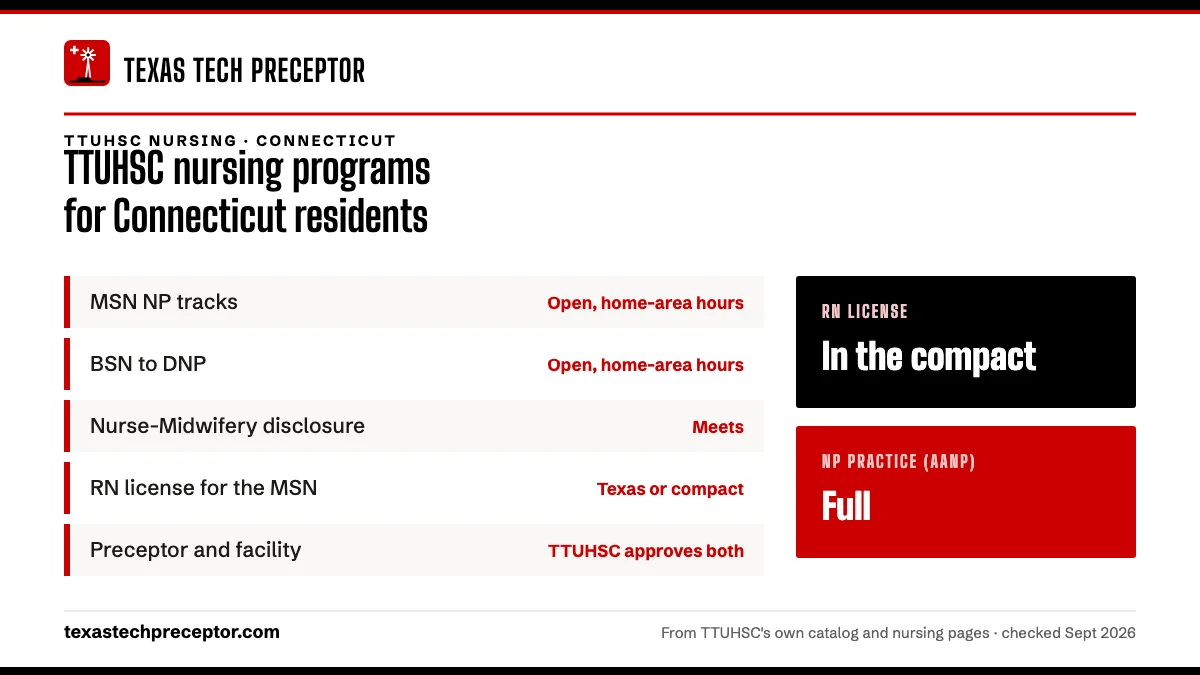
TTUHSC tracks at a glance for Connecticut
On TTUHSC's professional licensure page, none of the graduate tables puts an unable-to-accept note next to Connecticut.
| Track | TTUHSC's mark | Clinical setting |
|---|---|---|
| Family, Adult-Gerontology Acute Care, Pediatric or Psychiatric NP (MSN) | Meets | Your part of Connecticut, with a preceptor and facility the SON approves |
| Nurse-Midwifery (MSN) | Meets | Locations the Program Director approves, coordinated with TTUHSC |
| BSN to DNP, FNP or PMHNP | Meets | Local sites, with faculty and TTUHSC's preceptor team assisting |
Treat that mark as a green light to ask, since admission is a separate decision. Regulations change, so TTUHSC's graduate pages hold back from confirming at application time that residents of every state can join, and they send anyone applying from outside Texas to Admissions to settle eligibility first.
A compact state since October 2025
For Connecticut, the compact took hold on October 1, 2025. From that date, nurses may work in Connecticut either on a license the state issued or on the multistate license of their own compact home state. A Connecticut resident whose license is multistate therefore fits the MSN rule TTUHSC prints, which accepts a compact multistate license as readily as a Texas one, provided it is current and unencumbered. If you were licensed before the switch, look up whether your license now shows multistate status. DNP applicants work to TTUHSC's U.S. RN license rule; the license guide explains the wording.
AANP rates Connecticut as full practice, though new NPs grow into it: 2,000 hours and three years of collaboration with a physician come first. A preceptor could be at either stage, and either way goes through TTUHSC's approval like anyone else.
Connecticut's regulations and a TTUHSC rotation
Connecticut counts a program from another state as deemed approved when the home state's board has signed off and Connecticut's own standards are equaled or exceeded, and it describes no extra filing (Regs. Conn. State Agencies 20-90-59). Those regulations govern programs that prepare graduates for licensure, though, and say nothing specific about APRN or other post-licensure programs.
Two provisions still make useful background. Programs using Connecticut agencies follow its written-contract rules and ratios, one of which caps a preceptor at two students. Another asks preceptors of advanced-level students to hold a BSN, an RN license from Connecticut or wherever the precepting happens, and two years or more in the role or specialty. How far either reaches a TTUHSC NP rotation is for your course faculty to say.
Hartford, New Haven and the New York line
Hartford is the largest metro, with Bridgeport-Stamford-Danbury second; New Haven and Waterbury-Shelton follow. Systems with a big Connecticut footprint include Trinity Health Of New England, Hartford HealthCare, UConn Health and Yale New Haven Health, while New York-based Northwell Health now operates hospitals in the west that belonged to Nuvance, including Danbury Hospital. Use them to picture where NPs practice; they are examples, and each site needs its own TTUHSC approval.
Fairfield County presses against New York, which TTUHSC's disclosure closes to graduate applicants living there, and New York also expects out-of-state NP programs to register before placing students in the state. Keep the search on the Connecticut side unless TTUHSC approves otherwise. Any move out of state calls for notice to TTUHSC 60 days in advance; the relocation page explains.
Why Connecticut students pick our placement desk
We are built around TTUHSC's own process: a preceptor near home, approval of both preceptor and facility, and the electronic preceptor agreement each semester. For Connecticut students we search from Hartford to the shoreline for a preceptor whose practice fits your course, assemble the license and facility details TTUHSC reviews, and stay on call if plans change. See how it works.
Questions TTUHSC students ask
Does TTUHSC take graduate nursing students who live in Connecticut?
Connecticut shows as meeting requirements on TTUHSC's MSN nurse practitioner, midwifery and BSN to DNP tables, with no unable-to-accept note. Acceptance still rests on TTUHSC's review of your application, and people applying from outside Texas are asked to clear eligibility with Admissions before they submit.
Is my Connecticut RN license enough for TTUHSC's MSN?
It works if it carries multistate status, because TTUHSC's MSN rule accepts compact multistate licenses alongside Texas licenses. Connecticut's compact participation began in October 2025, so check how your license is listed. If it is single-state, ask TTUHSC which route it expects.
Must TTUHSC register with Connecticut before my clinical hours?
Connecticut's program rules are aimed at pre-licensure programs and describe no separate filing for an out-of-state program its home board approves. For an NP rotation, the decisions that matter are TTUHSC's: the preceptor, the facility and the agreement completed each semester.
Could I complete clinical hours in New York while living in Connecticut?
Ask TTUHSC before anything else. New York is on its unable-to-accept list for graduate students, and New York expects out-of-state NP programs to register with its education department before placing students in the state. Plan on Connecticut sites unless your program director approves something different.
Related pages
Last checked 2026-09-26
We check these pages against TTUHSC's catalog, Student Handbook, program pages and licensure disclosures. Your course faculty, your program director and the plan of study for your cohort have the final word.
Your TTUHSC preceptor search, run by specialists.
Tell us your TTUHSC track, your next clinical course and the town you'll train near. We find preceptors who fit the course and pull together what SON staff and faculty need to approve both the clinician and the facility, early enough for the electronic preceptor agreement to go through before the term.
- Preceptors matched to the track: family primary care, adult-gerontology acute care, pediatrics, psychiatric mental health
- License, certification and facility details ready for TTUHSC's preceptor and facility approval
- In Lubbock, Amarillo, Abilene, the Permian Basin, Dallas-Fort Worth and the states TTUHSC accepts
Start your placement plan
Your track, your town and your next clinical term is all we need to begin.