From the islands to TTUHSC: graduate nursing in Hawaii
Hawaii is open on TTUHSC's licensure disclosure, so island residents can look at its online NP, midwifery and DNP tracks. Two things take more thought than usual: the license, since Hawaii has no part in the multistate compact, and the flights to Lubbock for campus days.
Get your placement plan
Tell us your TTUHSC program and where you live. A placement advisor replies with the preceptor and site options that fit your TTUHSC course.
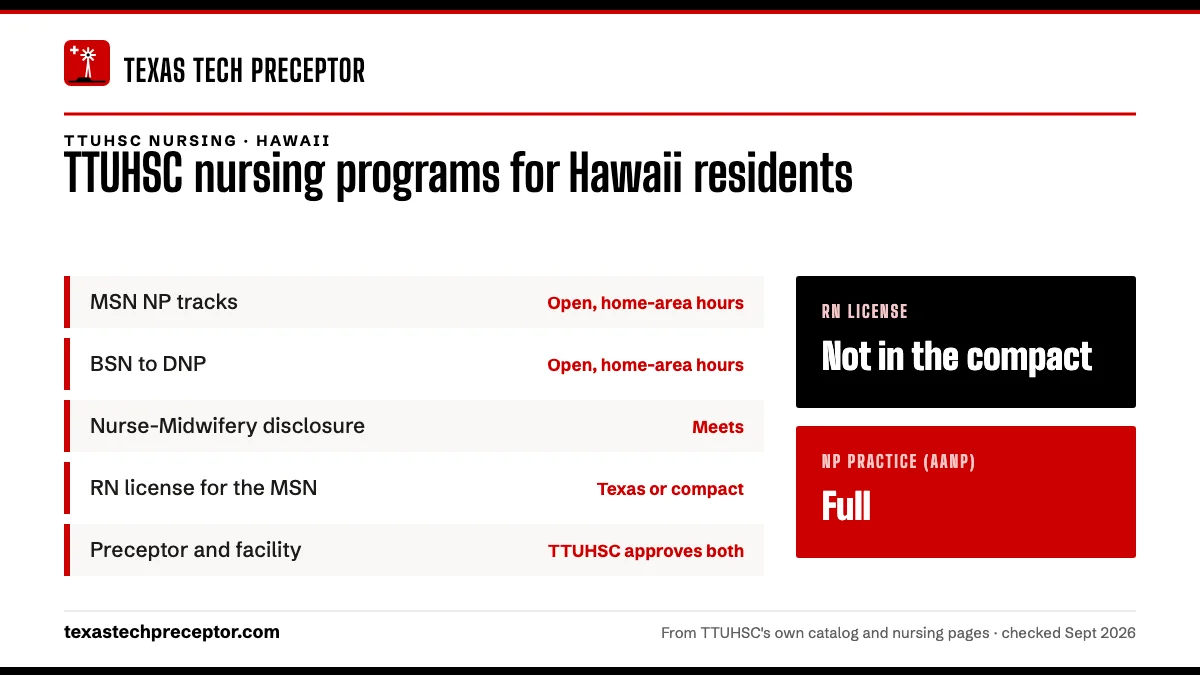
The license puzzle for Hawaii nurses
For MSN students, TTUHSC's handbook names two acceptable licenses: a Texas RN license, or multistate status under the compact, current and unencumbered either way. NCSBN's compact map leaves Hawaii out and shows no joining bill pending, so a Hawaii RN license is single-state. It works in reverse as well: a mainland multistate license carries no privilege on the islands, where clinical work requires a license issued by Hawaii.
Put together, an MSN student living and training in Hawaii would hold a Hawaii license for the clinical hours, while TTUHSC's wording points to a Texas RN license for the program itself. Confirm TTUHSC's exact expectation before you apply. DNP applicants face the handbook's U.S. RN license rule instead; the RN license guide compares TTUHSC's wording across its pages.
What Hawaii's Board says about programs from elsewhere
For pre-licensure students, Hawaii holds firm. State law exempts only students of programs the Hawaii Board has accredited, and back in 2016 the Board's Education Committee agreed that a pre-license BSN student from an out-of-state school could not do clinicals in Hawaii.
Post-licensure is a different story. The Board publishes a FAQ for distance and online programs from other states: a program of that kind without a Hawaii campus gets no approval from the Board, has no application to file and owes no notice. Bridge programs for LPNs and RN-to-BSN completion programs are the kinds it cites. Nothing from Hawaii addresses graduate or APRN programs head-on, so TTUHSC is the one to ask how that gap is read. As for TTUHSC faculty, Hawaii licensure comes into play only when one of them is physically on the islands to teach or precept.
On AANP's map, Hawaii is a full practice state.
TTUHSC's tracks, seen from Hawaii
The School of Nursing sends graduate clinical courses to the student's home area and must approve every preceptor and facility, whether the site is in Lubbock or Hilo.
| Program | Hawaii | Clinical hours |
|---|---|---|
| MSN nurse practitioner tracks | Meets | On your island, with an approved preceptor and facility |
| MSN Nurse-Midwifery | Meets | Program Director-approved locations |
| BSN to DNP (FNP, PMHNP) | Meets | Local sites, with the preceptor team assisting |
Admission is a separate matter. TTUHSC's graduate pages explain that changing regulations stop it from confirming at submission that some states' residents can enroll, so Hawaii applicants should talk to Admissions first. Budget for travel too: MSN NP and midwifery students log 7 to 8 campus days over their studies, OSCEs in Lubbock among them, and BSN to DNP students plan a campus visit every semester. The campus days page has specifics.
Honolulu, Maui, Hilo: where the clinicians are
Urban Honolulu dominates the state's population, well ahead of Maui's Kahului-Wailuku and the Big Island's Hilo-Kailua. The largest providers are The Queen's Health Systems; Kaiser Permanente Hawaii; HHSC, the Hawaii Health Systems Corporation; and Hawaii Pacific Health, its hospitals carrying the Wilcox, Straub, Kapiolani and Pali Momi names. They outline the landscape and imply nothing about hosting TTUHSC students.
Island geography limits how far you can drive for a rotation, so start the search early. Hawaii does give preceptors an income tax credit, but it follows the student, whose program must hold Hawaii accreditation or sit physically in Hawaii, so a TTUHSC rotation earns nothing under it. Leaving the islands mid-program? TTUHSC needs notice 60 days ahead (moving guide).
How we support TTUHSC students in Hawaii
Island placements leave little room for a late start, and early, careful work is where we shine. On your island we look for the preceptor and clinic best matched to your TTUHSC course, confirm their Hawaii licenses, and prepare what TTUHSC's approval and each semester's preceptor agreement need, well ahead of the term. Tell us your island and course.
Questions TTUHSC students ask
Can I take TTUHSC's online PMHNP program while living in Hawaii?
You can look at it: Hawaii meets requirements on TTUHSC's MSN APRN table and has no unable-to-accept note. Admission is TTUHSC's call, and it asks anyone applying from outside Texas to check eligibility with Admissions first. The PMHNP guide covers the Spring start and clinical hours.
Does my Hawaii RN license meet TTUHSC's MSN requirement?
Not by itself, based on TTUHSC's wording. The MSN rule wants a Texas RN license or multistate compact status, and a Hawaii license is neither. You would still need your Hawaii license for clinical work on the islands, so ask TTUHSC which Texas license route it expects.
Will TTUHSC file anything with Hawaii's Board for my rotation?
The Board's FAQ covers online post-licensure schools from other states that have no Hawaii campus: no approval from the Board, no notice owed. Its examples stop at RN-to-BSN and LPN-to-RN, and nothing speaks to graduate programs directly, so confirm the answer with TTUHSC.
How often would I travel to Texas?
Over an MSN NP or midwifery program, plan on 7 to 8 days in Texas, with Lubbock OSCE dates shared a couple of months beforehand. BSN to DNP students visit at least once per semester, usually for 1 to 2 days, in Lubbock, Austin or Dallas.
Related pages
Last checked 2026-09-26
We check these pages against TTUHSC's catalog, Student Handbook, program pages and licensure disclosures. Your course faculty, your program director and the plan of study for your cohort have the final word.
Your TTUHSC preceptor search, run by specialists.
Tell us your TTUHSC track, your next clinical course and the town you'll train near. We find preceptors who fit the course and pull together what SON staff and faculty need to approve both the clinician and the facility, early enough for the electronic preceptor agreement to go through before the term.
- Preceptors matched to the track: family primary care, adult-gerontology acute care, pediatrics, psychiatric mental health
- License, certification and facility details ready for TTUHSC's preceptor and facility approval
- In Lubbock, Amarillo, Abilene, the Permian Basin, Dallas-Fort Worth and the states TTUHSC accepts
Start your placement plan
Your track, your town and your next clinical term is all we need to begin.