What the best TTUHSC placement service does for you
A placement service is only as useful as its grasp of your school's process. For a TTUHSC student, that means matching to your exact clinical course, preparing what SON staff and faculty review for both the preceptor and the facility, and staying on call through the semester. Here is how to judge any service, ours included.
Get your placement plan
Tell us your TTUHSC program and where you live. A placement advisor replies with the preceptor and site options that fit your TTUHSC course.
Fluent in TTUHSC's process
Start with a simple test: does the service describe TTUHSC the way TTUHSC actually works? Graduate clinicals take place in your home area. SON staff and faculty approve the preceptor and, separately, the facility. An electronic preceptor agreement is completed for every preceptor each semester. Facility agreements run through the School of Nursing's Clinical Placement, Affiliation Agreements, and Preceptor Management unit. A service that plans around these steps spares you rework, while one that treats every school alike leaves gaps you find late.
Ask how the service handles the affiliation agreement step for a practice that is new to TTUHSC, and what it prepares for the electronic preceptor agreement. Clear, specific answers are a strong sign.
Matching at the level of your course
Being a nurse practitioner does not make a clinician the right preceptor for your course. TTUHSC's tracks call for particular settings and populations. Adult-gerontology acute care courses belong in acute care settings. The MSN PMHNP rotations move from children and adolescents to adults to complex patients across the lifespan. Pediatric primary care and pediatric acute care are different worlds, and the DNP Advanced Practicum courses carry aims of their own.
The best service reads the course before it searches, and it checks readiness items that could stall you, such as ACLS for FNP and AGACNP students or PALS for pediatric students before the first population-focus clinical course. Our pages on PMHNP rotations and AGACNP clinical courses show how specific those needs get.
Details ready for TTUHSC's review
TTUHSC's staff and faculty make the final decision. What a service controls is how complete the file is when it reaches them. Look for one that verifies the preceptor's license and certification at the source, documents the practice setting and patient mix, confirms the facility's legal details and agreement status, and gives you an answer for every field of the semester agreement.
Completeness keeps a review moving. A missing certification date or an unclear facility name can send a submission back with questions, and within a single term those days matter. A service that catches such gaps before you submit is doing the part of the job that most affects your start date.
Plain talk about who decides
Approval belongs to TTUHSC, and a trustworthy service says so openly. Be wary of any company that promises approval, a start date or a success rate it cannot document. The strongest services describe exactly what they do and leave the outcomes TTUHSC controls with TTUHSC.
Pricing deserves the same clarity. A written quote that names each rotation and what it includes lets you compare services on substance rather than on a headline number. Our pricing page explains what shapes a quote for a TTUHSC placement.
The approval is TTUHSC's. Choose a service for how thoroughly it prepares you for that review, not for promises about the result.
Questions to put to any placement service
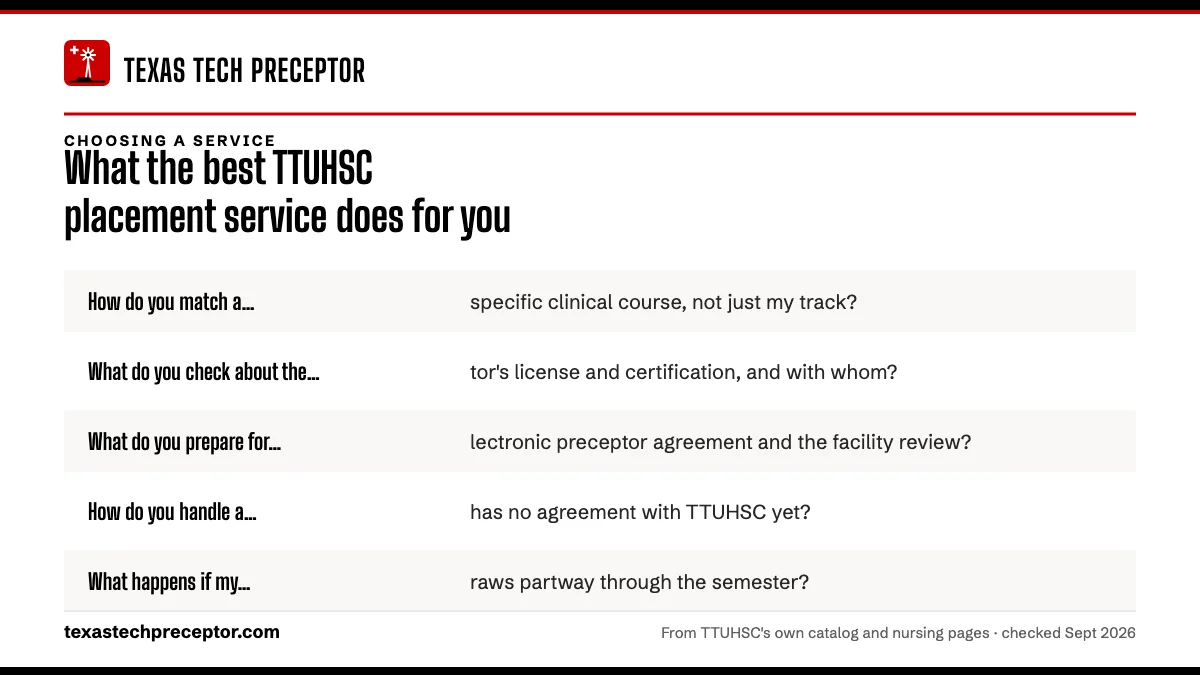
- How do you match a preceptor to my specific clinical course, not just my track?
- What do you check about the preceptor's license and certification, and with whom?
- What do you prepare for TTUHSC's electronic preceptor agreement and the facility review?
- How do you handle a practice that has no agreement with TTUHSC yet?
- What happens if my preceptor withdraws partway through the semester?
- Do you know which states TTUHSC is unable to accept graduate students from? (Compare the answer with TTUHSC's licensure disclosure.)
- Is your quote written and itemized by rotation?
- Who is my contact during the semester, and how do I reach them?
A service built for TTUHSC students should answer each of these readily and in specifics.
Why TTUHSC students choose us
We built our placement desk around TTUHSC's process, from the home-area rule to the semester agreement. Your placement advisor reads your course before searching, reaches practices within your drive radius, and introduces a preceptor only once dates and weekly hours are agreed.
Then comes the careful part: license and certification checked at the source, facility details and TTUHSC agreement status confirmed, and every agreement answer prepared so you finish TTUHSC's steps quickly. If a preceptor steps away, the replacement search starts at once. See how it works for each step, or send your details through the form below.
Questions TTUHSC students ask
What should a placement service ask me at intake?
At minimum: your TTUHSC program and track, the clinical course and term, your town and drive radius, your available clinic days and your certification status. A service that also asks which clinicians you have already contacted, and whether you plan to move before the course, is working from TTUHSC's real process rather than a generic template.
How do I compare quotes from two services?
Set them side by side by what each includes: how many rotations, whether facility details and agreement answers are prepared for you, how a replacement search works, and how long support lasts. A lower number that leaves out paperwork or backup can cost you time later. Ask each service to put its terms in writing.
Should a placement service contact TTUHSC for me?
Approval runs through TTUHSC's own channels: you complete the electronic preceptor agreement, and TTUHSC's affiliation agreements staff handle facility contracts. A good service works alongside that by preparing every detail and coordinating with the practice, so what you submit is ready. Questions about your standing in a course are best raised by you with your course faculty.
Can a service help if I live outside Texas?
Yes, when you live in a state TTUHSC accepts graduate students from. A service that knows TTUHSC checks your state against the licensure disclosure first, then searches near you. If you plan to relocate during the program, TTUHSC's 60-day notice rule and case-by-case approval come before any search in the new state.
Related pages
Last checked 2026-09-26
We check these pages against TTUHSC's catalog, Student Handbook, program pages and licensure disclosures. Your course faculty, your program director and the plan of study for your cohort have the final word.
Your TTUHSC preceptor search, run by specialists.
Tell us your TTUHSC track, your next clinical course and the town you'll train near. We find preceptors who fit the course and pull together what SON staff and faculty need to approve both the clinician and the facility, early enough for the electronic preceptor agreement to go through before the term.
- Preceptors matched to the track: family primary care, adult-gerontology acute care, pediatrics, psychiatric mental health
- License, certification and facility details ready for TTUHSC's preceptor and facility approval
- In Lubbock, Amarillo, Abilene, the Permian Basin, Dallas-Fort Worth and the states TTUHSC accepts
Start your placement plan
Your track, your town and your next clinical term is all we need to begin.